
























































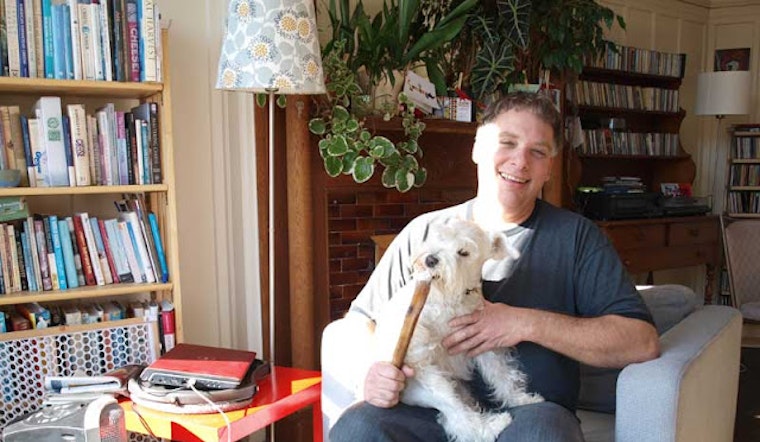
They say that some things get better with age. Like fine wine, and good cheese, and possibly Gordon Edgar.
He's lived on Hermann Street in the Lower Haight for 18 years, and worked as a cheesemonger at Rainbow Grocery for just as long.
We recently sat down with Gordon and his schnauzer Shnitzel to talk Lower Haight and cheese. But mostly just cheese.
Haighteration: You've lived in this apartment since 1994. Is that when you first came to the city? Gordon Edgar: No, I've lived in the city since 1989. And I grew up in the Bay Area. H: So, how did you end up at Rainbow? How did that career path unfold? GE: I'd been working mostly stupid jobs, kind of doing other things and not really worrying about work. My mid-twenties I was trying to think of some place that I could work for a while. And with Rainbow it wasn't cheese that appealed to me, I wanted to work in a large scale democratic workplace and see what that would be like, and the opening just happened to be in the cheese department and I've been there ever since. But mostly I was attracted to the cooperative aspect of it. H: Was there a moment for you when you were like, "Cheese is my thing"? GE: When I first started working at Rainbow it was at the old location on 15th and Mission. We moved to where we are now in 1996, and it was during that time where all of a sudden me and a couple others were in charge of developing our cheese selection to add more special cheeses. I started tasting all these cheeses and being blown away. I liked cheese just fine before, but all of a sudden I realized how much diversity of taste there was, the amount of work that went into all the different cheeses, all the different recipes and countries that make their own cheeses. I started being like, "Whoa, this is something I could do for a while." H: So I have some silly questions for you. GE: Oh that's fine. H: If there were one cheese that would be the last cheese you would ever eat, what would it be? GE: Well. It's such a hard question to answer. This isn't necessarily one I would recommend to other people, but for me, an aged gouda. Something that's aged 2 years or more, because it's hard and it's sweet and it's just like … cheese candy. And I could totally eat that forever. There are other cheeses that are probably more impressive, but that's the one I would choose as a personal preference. H: Huh. I was just thinking that gouda, smoked gouda is the one cheese that I'm not that into. GE: But not all gouda is smoked, you know? The aged ones are like parmesan in hardness, and they get the crystallization you get in aged cheeses with those little crunchy bits in it. And they're sharp and sweet and salty.
 Illustrations by Rose Garrett
H: What are the main differences between a goat cheese, a cow's cheese, and a sheep's milk cheese?
GE: Well, they all have different chemical compositions, so there's different fat levels, different levels of protein and all that stuff. But tastewise, cow is kind of the default because we're all used to eating cow's milk cheese. It's kind of the most buttery and rich. Sheep's milk cheese tends to be more salty and nutty and it's also very rich--it's actually richer than cow's milk cheese. But you don't taste the richness as much depending on what style it is. And goat's milk cheese is a lower fat milk and you won't get the richness that you get in other cheese's but you'll definitely get a tangier flavor. It's not necessarily a more gamey flavor although it can be. So that's what I'd say in general.
H: Okay! Are there any niche cheeses that don't fall into those categories?
GE: Well there's water buffalo cheese, which is real traditional in Italy. The traditional mozzarella is water buffalo cheese. And they're starting to make a few other cheeses with water buffalo now. There's this guy in Marin who's got a water buffalo herd and he's starting to make his own cheese starting next year. And then there's yak cheese. This nonprofit was starting to make yak cheese to help benefit impoverished Tibetan communities, but it didn't really work. We actually carried it for a little while. But … I think they're actually using it to make dog treats now. Animal House now has these yak sticks for dogs that are made out of yak milk.
H: Do you think Schnitzel would like that?
GE: He loves it! But it gives him an upset stomach because it's a little too rich for him.
H: How would you characterize the cheese culture in the Bay Area right now?
GE: It's really changed. Cheese is much more interesting to people now than it was 10 years ago. Me and most of the people from my generation just kind of fell into cheese. But there's a lot of people who want to "get into" cheese right now for whatever reason. Like they're going to make money out of it! But the American-made cheeses are so much better now than they were when I started, and every farmer's market you go to now has local cheesemakers now. It's back to where it was in the 1800s in a way, with every local area having its own cheesemakers. And that's growing.
H: What are the top American-made cheeses that you recommend to people?
GE: Stuff like the Cowgirl Creamery cheeses, that are all organic using Strauss milk. I mean that's just a mainstay, I don't even recommend that, it just flies out the door. All the great local goat cheeses, things like Cyprus Grove (although they're now owned by a Swiss company), and Laura Chenel (which is now owned by a French company).
I love the Point Reyes Toma, which is a relatively new cheese. They've been making a blue cheese for years that's our most popular blue cheese, and now they made this other cheese which is just a real milky, grassy, rich cheese, and that's been super popular.
There's also a new local cheese called Highway One, from Valley Ford which is up near Petaluma. That's another one that's really taken off. It's a fourth generation dairy farm up there but they just started making cheese last year. And it's really great stuff. They're one of those families that's just trying to stay on their land as it gets more expensive. The cheese is another one that's very rich, very creamy, it kinda goes with anything. You can melt it, you can put it on a cheese plate.
H: So how would you categorize it?
GE: You know, you'll notice a lot of people aren't using the typical cheese types anymore. They always used to name American cheeses after the European equivalent. There are certain cheese recipes, so you can say that the Point Reyes Toma is basically a Havarti recipe, or that the Highway One is basically a fontina recipe, but the thing is the milk being different here and the tweaks they make to the recipe, people are starting to name things more on location because it's not a direct equivalent anymore.
Illustrations by Rose Garrett
H: What are the main differences between a goat cheese, a cow's cheese, and a sheep's milk cheese?
GE: Well, they all have different chemical compositions, so there's different fat levels, different levels of protein and all that stuff. But tastewise, cow is kind of the default because we're all used to eating cow's milk cheese. It's kind of the most buttery and rich. Sheep's milk cheese tends to be more salty and nutty and it's also very rich--it's actually richer than cow's milk cheese. But you don't taste the richness as much depending on what style it is. And goat's milk cheese is a lower fat milk and you won't get the richness that you get in other cheese's but you'll definitely get a tangier flavor. It's not necessarily a more gamey flavor although it can be. So that's what I'd say in general.
H: Okay! Are there any niche cheeses that don't fall into those categories?
GE: Well there's water buffalo cheese, which is real traditional in Italy. The traditional mozzarella is water buffalo cheese. And they're starting to make a few other cheeses with water buffalo now. There's this guy in Marin who's got a water buffalo herd and he's starting to make his own cheese starting next year. And then there's yak cheese. This nonprofit was starting to make yak cheese to help benefit impoverished Tibetan communities, but it didn't really work. We actually carried it for a little while. But … I think they're actually using it to make dog treats now. Animal House now has these yak sticks for dogs that are made out of yak milk.
H: Do you think Schnitzel would like that?
GE: He loves it! But it gives him an upset stomach because it's a little too rich for him.
H: How would you characterize the cheese culture in the Bay Area right now?
GE: It's really changed. Cheese is much more interesting to people now than it was 10 years ago. Me and most of the people from my generation just kind of fell into cheese. But there's a lot of people who want to "get into" cheese right now for whatever reason. Like they're going to make money out of it! But the American-made cheeses are so much better now than they were when I started, and every farmer's market you go to now has local cheesemakers now. It's back to where it was in the 1800s in a way, with every local area having its own cheesemakers. And that's growing.
H: What are the top American-made cheeses that you recommend to people?
GE: Stuff like the Cowgirl Creamery cheeses, that are all organic using Strauss milk. I mean that's just a mainstay, I don't even recommend that, it just flies out the door. All the great local goat cheeses, things like Cyprus Grove (although they're now owned by a Swiss company), and Laura Chenel (which is now owned by a French company).
I love the Point Reyes Toma, which is a relatively new cheese. They've been making a blue cheese for years that's our most popular blue cheese, and now they made this other cheese which is just a real milky, grassy, rich cheese, and that's been super popular.
There's also a new local cheese called Highway One, from Valley Ford which is up near Petaluma. That's another one that's really taken off. It's a fourth generation dairy farm up there but they just started making cheese last year. And it's really great stuff. They're one of those families that's just trying to stay on their land as it gets more expensive. The cheese is another one that's very rich, very creamy, it kinda goes with anything. You can melt it, you can put it on a cheese plate.
H: So how would you categorize it?
GE: You know, you'll notice a lot of people aren't using the typical cheese types anymore. They always used to name American cheeses after the European equivalent. There are certain cheese recipes, so you can say that the Point Reyes Toma is basically a Havarti recipe, or that the Highway One is basically a fontina recipe, but the thing is the milk being different here and the tweaks they make to the recipe, people are starting to name things more on location because it's not a direct equivalent anymore.
 H: I'm going to transition to the Lower Haight for a minute. What's your favorite neighborhood hangout around here?
GE: I definitely have a few favorite places. I would maybe consider this technically out of the neighborhood, but Club Waziema, the Ethiopian restaurant on Divis. It's friendly, it's got a nice dark bar, it has great Ethiopian food, and it's walking distance from here. It's so funny because I've been here long enough to see all these places change, from one business to the next to the next. Cafe du Soleil was the Armadillo, which was a punk rock biker bar for years, and then it became this weird techno music place, but I gotta say I love the place now. The food is great. I actually really like the sushi place, whatever it's called, that used to be Hanabi.
H: What are some of the more notable changes you've observed in the neighborhood?
GE: Well. As with the whole city, the disappearance of black people. I don't know if this street was 50/50 African American when I first moved here, but it was pretty close. And now, you know, there's almost no one. This neighborhood has gotten more wealthy. Across the way there used to be an activist house, down the street there were people working on their cars. It was a different neighborhood than it is now. I still love living here, this neighborhood isn't nearly as bad as some neighborhoods for that kind of thing. It's still got its really good funky bits and it's still got regular people here, but the whole city has changed. In terms of positive things, certainly there's a lot better food and better restaurants. But I would hate to have it seem that that's the tradeoff.
H: Do you see yourself staying in the Lower Haight for good?
GE: Well you know, that's the thing. As long as I have this apartment I'll stay. But I could never afford to buy in this neighborhood. When I first moved here, you could say "I want to live in X neighborhood," and you could find a place, and that's just not true anymore. You kind of end up where you find some place you can afford. Would I stay here? I'd love to. Will I? I don't know.
H: So you're a writer as well as being a cheesemonger.
GE: I had a book come out last year, it's called "Cheesemonger: A Life on the Wedge". You have to have a cheese pun in your title. It's the law. The book is kind of three things put together: my memoir of becoming a cheesemonger, a book about cheese and how it's made, and then also a food politics book as it relates to cheese. And I'm working on a proposal for another book.
H: Oh! Can I get an inside scoop?
GE: It's gonna be a book on cheddar, specifically. Cheddar is a really interesting cheese because it encompasses everything from a traditional, bandage-wrapped cheese that's been made in some cases by the same farm for 500 years, all the way the other direction to Kraft singles which are basically cheddar that's emulsified and plasticized and turned into food that doesn't expire. A lot of the issues that dairy farmers and food producers have because cheddar is a commodity. The price for blocks of mild cheddar is actually set at the Chicago Mercantile Exchange, so people if they choose to make that style of cheese are working within certain price parameters. So it's a way to talk about all that stuff and Americans' relationship with cheese, because you don't have to be a cheese snob to eat cheddar. So that's what I'm working on.
H: I'm going to transition to the Lower Haight for a minute. What's your favorite neighborhood hangout around here?
GE: I definitely have a few favorite places. I would maybe consider this technically out of the neighborhood, but Club Waziema, the Ethiopian restaurant on Divis. It's friendly, it's got a nice dark bar, it has great Ethiopian food, and it's walking distance from here. It's so funny because I've been here long enough to see all these places change, from one business to the next to the next. Cafe du Soleil was the Armadillo, which was a punk rock biker bar for years, and then it became this weird techno music place, but I gotta say I love the place now. The food is great. I actually really like the sushi place, whatever it's called, that used to be Hanabi.
H: What are some of the more notable changes you've observed in the neighborhood?
GE: Well. As with the whole city, the disappearance of black people. I don't know if this street was 50/50 African American when I first moved here, but it was pretty close. And now, you know, there's almost no one. This neighborhood has gotten more wealthy. Across the way there used to be an activist house, down the street there were people working on their cars. It was a different neighborhood than it is now. I still love living here, this neighborhood isn't nearly as bad as some neighborhoods for that kind of thing. It's still got its really good funky bits and it's still got regular people here, but the whole city has changed. In terms of positive things, certainly there's a lot better food and better restaurants. But I would hate to have it seem that that's the tradeoff.
H: Do you see yourself staying in the Lower Haight for good?
GE: Well you know, that's the thing. As long as I have this apartment I'll stay. But I could never afford to buy in this neighborhood. When I first moved here, you could say "I want to live in X neighborhood," and you could find a place, and that's just not true anymore. You kind of end up where you find some place you can afford. Would I stay here? I'd love to. Will I? I don't know.
H: So you're a writer as well as being a cheesemonger.
GE: I had a book come out last year, it's called "Cheesemonger: A Life on the Wedge". You have to have a cheese pun in your title. It's the law. The book is kind of three things put together: my memoir of becoming a cheesemonger, a book about cheese and how it's made, and then also a food politics book as it relates to cheese. And I'm working on a proposal for another book.
H: Oh! Can I get an inside scoop?
GE: It's gonna be a book on cheddar, specifically. Cheddar is a really interesting cheese because it encompasses everything from a traditional, bandage-wrapped cheese that's been made in some cases by the same farm for 500 years, all the way the other direction to Kraft singles which are basically cheddar that's emulsified and plasticized and turned into food that doesn't expire. A lot of the issues that dairy farmers and food producers have because cheddar is a commodity. The price for blocks of mild cheddar is actually set at the Chicago Mercantile Exchange, so people if they choose to make that style of cheese are working within certain price parameters. So it's a way to talk about all that stuff and Americans' relationship with cheese, because you don't have to be a cheese snob to eat cheddar. So that's what I'm working on.
 H: If the Lower Haight were a cheese ….
GE: [laughs] The book talks about how I was in the punk rock scene, then became sort of a political activist, then I went to work at Rainbow. And the publisher kept hyping the "ex-punk rocker" thing and I was just like, whatever that means. And this one interviewer asked me, "If Greenday was a cheese, what cheese would it be?"
H: Did you answer?
GE: I did but it wasn't a very good answer, I don't even remember what I said. And you'll get the same kind of answer. Let's see … it's an interesting question. It'd be the cheese on the distributor's list of heavily discounted, slightly messed up, not quite rejected cheeses. It wouldn't be full price. I don't know how people will respond to that. It's difficult to answer those kinds of cheese questions.
H: What are the craziest cheese questions you've gotten? In addition to the Greenday question?
GE: From customers, I don't want to mock anybody, but they don't really understand the difference between sheep and goats sometimes. I've had customers be like, "So the sheep are the males, right?" I think everyone who works with goat or sheep gets that.
H: That's kind of … wow. Okay.
GE: I'm trying to think of things that aren't just petty, like people coming up to me and saying "This cheese says French Brie. Is it really french?" I get that all the time. It's like, yes. That's why it says french. I think people all the time ask about raw versus pasteurized cheese. It's not an insignificant question, but they come at it either, "Is this raw cheese going to kill me," or "anything that's not raw is just crap." People come in with a little bit of knowledge a lot of times, and try to make grand sweeping judgments based on that, or to make decisions based on one thing that they've read. It's actually a reason why I wrote the book.
H: I've been to Rainbow and I love the cheeses. But I'm a little bit shy and intimidated when it comes to talking to the cheese guys. I don't think I've ever asked them any questions, I just try to pretend that I know what I'm doing. So what would you recommend for someone like me?
GE: One of the other reasons I wrote the book is to demystify cheese a little bit. It's one of those things that people feel intimidated about, but you know, it's just peasant food. Sure, there's a lot of expertise that goes into making good cheese but there's nothing to be ashamed of in not understanding what all the different cheeses are, especially these days when there are new ones coming out every month.
I think the thing to do when you go to a cheese place is a) ask if they have anything that they're sampling out or that people are really excited about, because usually most cheese places will have something behind the counter, and b) just knowing what kind of cheese you like, and going in and saying, "I like this, what would you recommend as something different?" If you say you like sharp cheddar, I'd maybe recommend an aged sheep milk cheese or something else that wouldn't be that far away but still different. I think that's the way to get the best results at a cheese shop.
H: If the Lower Haight were a cheese ….
GE: [laughs] The book talks about how I was in the punk rock scene, then became sort of a political activist, then I went to work at Rainbow. And the publisher kept hyping the "ex-punk rocker" thing and I was just like, whatever that means. And this one interviewer asked me, "If Greenday was a cheese, what cheese would it be?"
H: Did you answer?
GE: I did but it wasn't a very good answer, I don't even remember what I said. And you'll get the same kind of answer. Let's see … it's an interesting question. It'd be the cheese on the distributor's list of heavily discounted, slightly messed up, not quite rejected cheeses. It wouldn't be full price. I don't know how people will respond to that. It's difficult to answer those kinds of cheese questions.
H: What are the craziest cheese questions you've gotten? In addition to the Greenday question?
GE: From customers, I don't want to mock anybody, but they don't really understand the difference between sheep and goats sometimes. I've had customers be like, "So the sheep are the males, right?" I think everyone who works with goat or sheep gets that.
H: That's kind of … wow. Okay.
GE: I'm trying to think of things that aren't just petty, like people coming up to me and saying "This cheese says French Brie. Is it really french?" I get that all the time. It's like, yes. That's why it says french. I think people all the time ask about raw versus pasteurized cheese. It's not an insignificant question, but they come at it either, "Is this raw cheese going to kill me," or "anything that's not raw is just crap." People come in with a little bit of knowledge a lot of times, and try to make grand sweeping judgments based on that, or to make decisions based on one thing that they've read. It's actually a reason why I wrote the book.
H: I've been to Rainbow and I love the cheeses. But I'm a little bit shy and intimidated when it comes to talking to the cheese guys. I don't think I've ever asked them any questions, I just try to pretend that I know what I'm doing. So what would you recommend for someone like me?
GE: One of the other reasons I wrote the book is to demystify cheese a little bit. It's one of those things that people feel intimidated about, but you know, it's just peasant food. Sure, there's a lot of expertise that goes into making good cheese but there's nothing to be ashamed of in not understanding what all the different cheeses are, especially these days when there are new ones coming out every month.
I think the thing to do when you go to a cheese place is a) ask if they have anything that they're sampling out or that people are really excited about, because usually most cheese places will have something behind the counter, and b) just knowing what kind of cheese you like, and going in and saying, "I like this, what would you recommend as something different?" If you say you like sharp cheddar, I'd maybe recommend an aged sheep milk cheese or something else that wouldn't be that far away but still different. I think that's the way to get the best results at a cheese shop.
Thanks to Gordon and Schnitzel for spending time with us. You can find his book at Rainbow Grocery, online and in bookstores, and you can find him, along with some stellar cheeses, at the Rainbow cheese counter.
Haighteration: You've lived in this apartment since 1994. Is that when you first came to the city? Gordon Edgar: No, I've lived in the city since 1989. And I grew up in the Bay Area. H: So, how did you end up at Rainbow? How did that career path unfold? GE: I'd been working mostly stupid jobs, kind of doing other things and not really worrying about work. My mid-twenties I was trying to think of some place that I could work for a while. And with Rainbow it wasn't cheese that appealed to me, I wanted to work in a large scale democratic workplace and see what that would be like, and the opening just happened to be in the cheese department and I've been there ever since. But mostly I was attracted to the cooperative aspect of it. H: Was there a moment for you when you were like, "Cheese is my thing"? GE: When I first started working at Rainbow it was at the old location on 15th and Mission. We moved to where we are now in 1996, and it was during that time where all of a sudden me and a couple others were in charge of developing our cheese selection to add more special cheeses. I started tasting all these cheeses and being blown away. I liked cheese just fine before, but all of a sudden I realized how much diversity of taste there was, the amount of work that went into all the different cheeses, all the different recipes and countries that make their own cheeses. I started being like, "Whoa, this is something I could do for a while." H: So I have some silly questions for you. GE: Oh that's fine. H: If there were one cheese that would be the last cheese you would ever eat, what would it be? GE: Well. It's such a hard question to answer. This isn't necessarily one I would recommend to other people, but for me, an aged gouda. Something that's aged 2 years or more, because it's hard and it's sweet and it's just like … cheese candy. And I could totally eat that forever. There are other cheeses that are probably more impressive, but that's the one I would choose as a personal preference. H: Huh. I was just thinking that gouda, smoked gouda is the one cheese that I'm not that into. GE: But not all gouda is smoked, you know? The aged ones are like parmesan in hardness, and they get the crystallization you get in aged cheeses with those little crunchy bits in it. And they're sharp and sweet and salty.
Illustrations by Rose Garrett
Thanks to Gordon and Schnitzel for spending time with us. You can find his book at Rainbow Grocery, online and in bookstores, and you can find him, along with some stellar cheeses, at the Rainbow cheese counter.





