

























































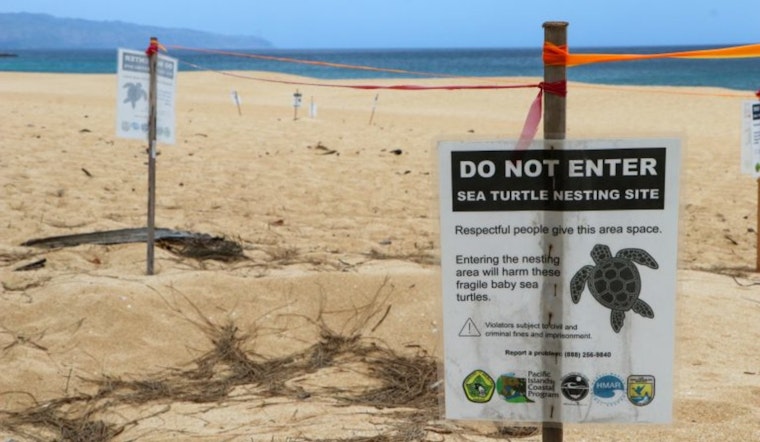
Hawaiian beaches are entering the peak nesting season for the endangered honu, or Hawaiian green sea turtles, which typically spans from August through November. According to a recent statement from the Department of Land and Natural Resources (DLNR), there has been a steady increase in nesting activity since 2020. While this trend is viewed as a positive sign for the species, hatchlings continue to face challenges during their journey to the ocean, including disruptions caused by human activity.
The Department of Land and Natural Resources (DLNR) reports that female Hawaiian green sea turtles return to shore to lay their eggs, followed by an incubation period of approximately 60 days. DLNR notes that both the temperature and duration of incubation play a role in development; temperature influences the sex of the hatchlings, while the overall incubation time varies based on nest conditions. Officials advise the public to maintain a distance of at least 10 feet from nesting turtles and marked nests, as the species is federally protected. Driving on beaches is prohibited under state law, due to the potential risk it poses to nests and hatchlings.
The Department of Land and Natural Resources (DLNR) advises that artificial lighting can disorient sea turtle hatchlings, which rely on natural light sources such as the moon and stars to navigate toward the ocean. Coastal residents and visitors are urged to turn off beach-facing lights during the nesting and hatching season and to use red-filtered flashlights when on the beach at night. DLNR also reminds the public that beach campfires are prohibited, as they can attract hatchlings away from the water and increase mortality risks.
The odds of sea turtle survival are stark, with only about one in a thousand hatchlings making it to adulthood. Organizations like Mālama i nā Honu, a nonprofit group, work alongside the U.S. Fish and Wildlife Service, keeping a keen eye on known nesting sites and educating the public on how to minimize disturbances. Want to get involved and help make those odds a little less daunting? Check out malamanahonu.org for volunteer opportunities. And remember, if you encounter any turtle in distress or witness a potential violation, don't hesitate to reach out to the proper authorities. The NOAA Marine Wildlife Hotline is at your service at 888-256-9840 for injured or hatching turtles, while violations like beach driving can be reported to 911 or 808-643-3567 for DLNR Enforcement.





