

























































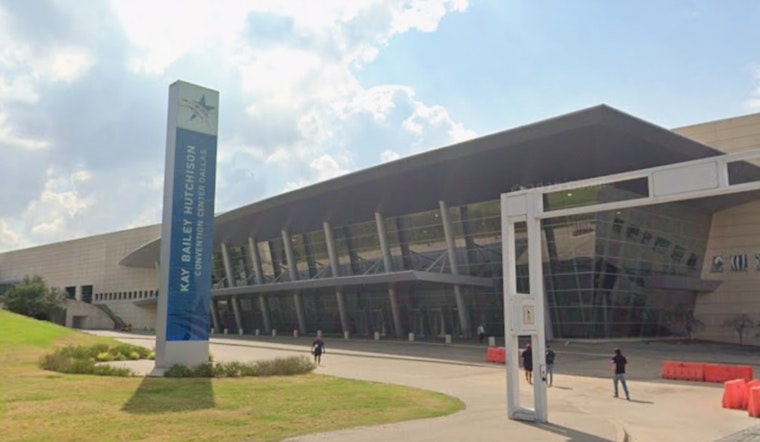
Dallas’ convention center overhaul stopped being just glossy renderings in 2025 and started turning into real money, real land deals and very real construction headaches. City officials are racing to button up property acquisitions, complete design work and line up financing so the Kay Bailey Hutchison Convention Center can pull double duty as both a long-term economic engine and a short-term World Cup media hub.
The payoff they are chasing is big. The cost is big too. And downtown traffic is about to feel every penny of it.
City records show the Kay Bailey Hutchison Convention Center is set to host FIFA’s International Broadcast Center from January through August 2026, with halls A, B and C reserved exclusively for the broadcast operation under the city’s use agreement and related lease items.
The master plan pegs the full convention center revamp at up to $3.7 billion, according to The Dallas Morning News. Meanwhile, design and construction teams hit 100 percent schematic design in the spring and began shifting into detailed design and bidding, according to a briefing video from the City of Dallas.
On the land side, the council signed off on buying large portions of the former Dallas Morning News campus for roughly $51 million to assemble the “West of Lamar” expansion footprint. The purchase and vote were reported by KERA.
Trinity Alliance, a joint venture of national firms, has been tapped as the Component 1 construction manager at risk and has started pre-construction coordination with city staff and designers. The selection, announced in a city press bulletin, is meant to speed up early site and enabling work, according to the City of Dallas.
Transit is taking a direct hit. DART’s station page notes that Convention Center Station will close during reconstruction. Trains will still pass through but passengers will not be able to board, and several bus bays will be out of service. The closure is expected to last about 3.5 years while the expansion moves forward, and riders are being steered to nearby stations and rerouted buses during construction, according to DART.
To keep work from slipping, the council authorized up to $1 billion in bridge financing in June to cover early enabling projects and lock down contracts ahead of long-term bond sales. Repayment plans rely on pledged hotel-occupancy tax revenues and project financing zone collections, according to City of Dallas finance documents.
Convention demand is not exactly blinking at the construction warnings. Visit Dallas has already booked 68 conventions beyond 2029, totaling more than 1.17 million hotel room nights and an estimated $1.75 billion in economic impact. Another 101 events are holding dates while they wait for final plans, according to the city’s year-end review reported by The Dallas Morning News. Those numbers help explain why city leaders are racing ahead, even as they ask meeting planners and local businesses to tolerate several years of noise and detours.
Timeline and what to watch
The master plan lays out a phased construction schedule with substantial completion targeted for 2029. City staff say the project will be staged so that some halls and the arena complex can keep operating while demolition and buildout west of Lamar Street take shape.
The next pressure points are not glamorous: detailed permitting, staging logistics and traffic-control plans. How those shake out will determine whether the schedule holds and how many conventions and events have to be shifted, resized or rebooked during peak construction.
Legal and financing risks
The funding strategy relies on a short-term bridge loan that will later be taken out with hotel-tax-backed revenue bonds. That setup is designed to shield the city’s general fund, but it also leaves the project exposed to hotel revenue trends and interest rate swings. Those trade-offs are already front and center in council and finance briefings, and they are expected to resurface when final bond documents, major contracts and construction bids land back on the council agenda for approval.
In the coming months, watch for new council items tied to bond sales, updated DART service plans and more detailed construction phasing. Those filings will show how aggressively the city is willing to push the timeline and which nearby neighborhoods will feel the brunt of lane closures and rerouted buses.
For downtown hotels, small businesses and anyone who regularly threads the maze of streets around the convention center, the near-term questions are basic: which routes will change, where displaced convention traffic will land and whether the city’s big-bet projections for economic payoff actually materialize once the new complex opens its doors.





