

























































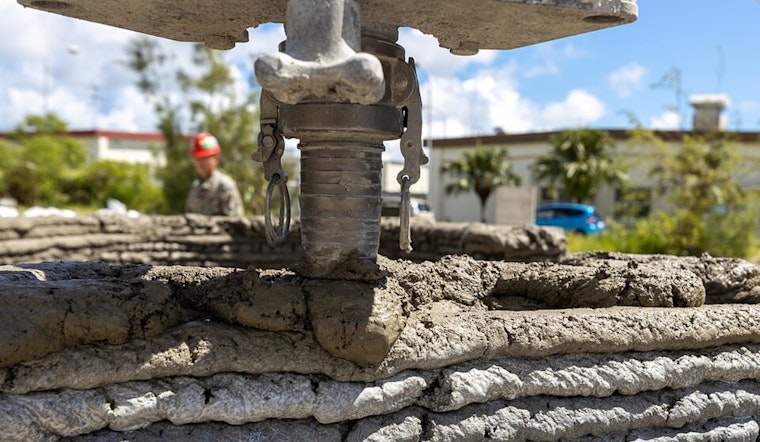
GREELEY — A northern Colorado concrete startup that used to be a curiosity on job sites just landed something closer to the big leagues. Greeley-based Alquist 3D is gearing up to print walls for more than a dozen Walmart buildings around the country, shifting its robotic 3D-concrete operation from one-off pilots into a full retail pipeline.
The work could speed up small-footprint stores and add-ons in markets nationwide, and it quietly puts Greeley in the national conversation about what happens when construction looks a lot more like manufacturing. Local leaders say the deal is already triggering workforce programs and hiring plans in town.
Walmart deal pushes 3D printing into prime time
In a November announcement, Alquist said it will deliver “more than a dozen” 3D-printed commercial projects for Walmart and other retailers, and that it has launched a partnership structure with Hugg & Hall and contractor FMGI to lease and service its A1X printers, according to PR Newswire. The first project under that model is slated to start at a Walmart in Lamar, Missouri, as the company works to standardize how it prints walls at retail sites.
Company officials say the arrangement is designed so crews can print walls directly on site without constantly hauling the heavy printers across the country. In theory, that means less time on the road and more time laying down concrete layers.
Pilots showed promise, and plenty of headaches
Alquist’s expansion project, completed in October 2024 at a Walmart in Athens, Tennessee, created one of the largest 3D-printed commercial structures in the United States. It was also a reality check. The job ran into heat and material snags, including clogged hoses, temperature-sensitive mixes, and permit delays, that stretched the schedule and left total costs roughly on par with traditional construction methods, as reported by The Wall Street Journal.
Alquist leaders say those headaches helped drive changes to both equipment and concrete mixes for later projects. Industry observers still caution that weather, material performance, and code acceptance remain big swing factors in whether 3D-printed construction actually scales.
Greeley leans into training and local jobs
Alquist moved its headquarters to Greeley in 2023 after the city and state put roughly $4 million in incentives on the table to attract the company, according to The Denver Gazette. That relocation is now colliding with the Walmart work, and local institutions are trying to make sure residents are not just watching from the sidelines.
Aims Community College has announced that Alquist will serve as the inaugural industry tenant at its Workforce Innovation Center, and the firm has donated $25,000 for student scholarships, according to Aims Community College. College and city officials say the goal is straightforward: building a homegrown pipeline of technicians who can run the printers, manage the specialized concrete mixes, and handle the logistics that come with this kind of work.
Leasing model targets repeatable printing, not one-offs
To grow quickly, Alquist has set up a structure in which FMGI owns and leases the A1X printers, while Hugg & Hall finances and services the machines. That approach, industry coverage suggests, could cut down on logistical friction and help speed deployments across multiple sites, according to Facilities Dive.
Supporters argue that a mix of leasing, localized training, and bulk purchasing of materials could gradually push per-project costs lower. Experts, however, point out that the real test will come from regulators and engineers, who will determine how codes, approvals,s and material refinements shape the path for 3D concrete printing in mainstream retail and commercial buildings.
If the rollout stays on track, Walmart and other retailers could treat 3D-printed concrete as a standard option for certain additions and smaller stores rather than a flashy experiment. For Greeley, the payoff is already visible: a budding tech cluster, new student training slots, and a rare commercial-scale construction technology hub on the Front Range.





.jpg)