

























































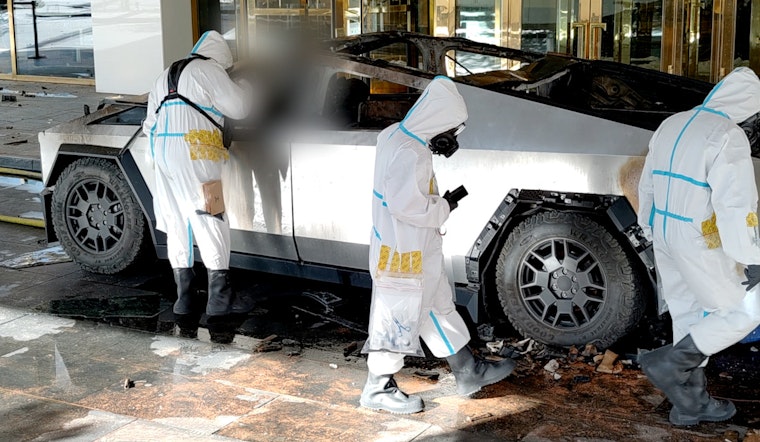
On Jan. 1, 2025, a Tesla Cybertruck exploded outside the Trump International Hotel in Las Vegas, injuring seven people and killing the driver. Investigators later identified the driver as Army Green Beret Matthew Livelsberger and said he had used a generative AI chatbot to research explosives and ignition methods. The disclosure has turned a once-theoretical question into a very real one for cities like Las Vegas and for the companies that build these systems: when a user asks a chatbot how to carry out violence, do firms have a duty to warn law enforcement?
What investigators released
Las Vegas police said they found a possible manifesto and released a set of slides tied to the suspect’s digital activity. According to LVMPD and reporting by The Verge, the slides include ChatGPT queries about tannerite, whether a gunshot could ignite a device, and where to buy fireworks and firearms along a route from Colorado to Nevada.
OpenAI, the logs and the debate
The New York Times published a detailed look at the legal and ethical questions on Feb. 26; its reporting says OpenAI provided chat logs to investigators and that an OpenAI reviewer checked whether the suspect had used ChatGPT. OpenAI has said it is cooperating and that its models are designed to refuse harmful instructions, and outlets including CNBC quoted company spokespeople stressing those safeguards as the reporting unfolded.
How "duty to warn" has worked in law
The idea of a duty to warn is well established in some professions. Courts applying Tarasoff have held that clinicians who learn of a specific, serious threat may be obliged to warn identifiable potential victims, as explained in medical and legal literature. See JAMA for background on Tarasoff and its limits. But legal scholars say applying that obligation to private tech firms would be novel. Adapting product-liability or post-sale failure-to-warn doctrines is one possible route, a line of analysis explored in commentary at Lawfare.
What is likely to change
Regulatory pressure is already mounting. A December 2025 letter from New York Attorney General Letitia James and a bipartisan coalition urged Big Tech to harden safeguards and to consider notifying users exposed to potentially harmful outputs, according to the attorney general’s office. At the same time, law enforcement officials say there is no standardized channel for AI companies to automatically flag troubling queries, a gap highlighted in reporting by CNBC and other outlets.
Local impact
For Las Vegas, the case made an abstract policy problem concrete. Sheriff Kevin McMahill called the use of generative AI in the attack a “game-changer” for policing, according to reporting by AP. Whether that translates into local rules on data retention or into federal reporting mandates is uncertain, but researchers and victims’ advocates say the episode will accelerate oversight, litigation and scrutiny of how chat histories are stored and shared.
Legal implications
Civil suits alleging negligence or defective design, and regulatory enforcement demanding clearer reporting rules, are plausible next steps if courts or lawmakers decide developers can be treated like product makers with post-sale duties. Any push to require companies to alert police will have to balance public safety against privacy, evidentiary and free-speech concerns, and would probably play out in litigation or in the drafting of new statutes.



