

























































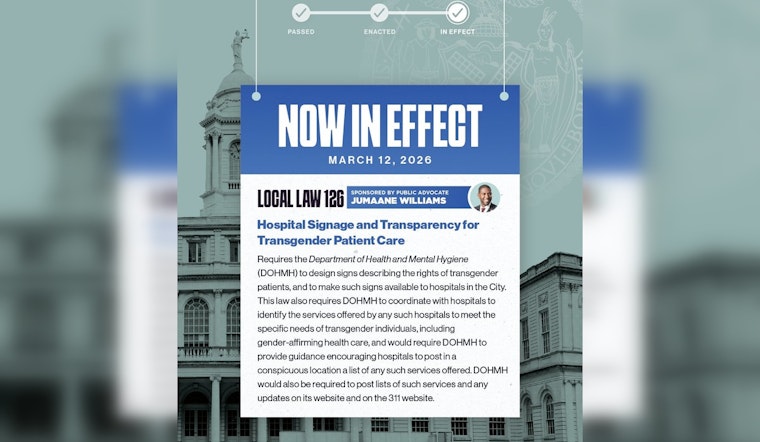
New York City's Local Law 126 is now officially on the books, tasking the Department of Health and Mental Hygiene (DOHMH) with getting clear, visible information about transgender patients' rights into hospitals across all five boroughs. The law requires the city to create and distribute signs spelling out those rights, including the right to be addressed by a patient's preferred name, title, gender and pronoun, and to compile and publish lists of gender-affirming and other transgender-specific services where they are offered.
NOW IN EFFECT
— New York City Council (@NYCCouncil) March 12, 2026
Local Law 126, sponsored by @NYCPA
This law would require @NYCHealthy to design signs describing the rights of transgender patients, and to make such signs available to hospitals in the City. @NYCHealthy would also be required to post lists of such services and any updates on its website and on the 311 website. https://x.com/i/status/2032165595710439765
The City Council flagged the change with a "NOW IN EFFECT" post on its official account as the law took hold. The city's administrative code lists Local Law 126 (L.L. 2025/126) with an effective date of March 12, 2026, according to American Legal Publishing. As announced by the New York City Council, DOHMH has 180 days after enactment to begin rolling out the required signage and service lists.
What the law requires
Local Law 126 adds a new section to the Administrative Code instructing DOHMH to design signs that describe the rights of transgender patients and to make those signs available to hospitals. The materials must make clear that people have the right to be referred to by their preferred name, title, gender and pronoun. The law also directs DOHMH to work with hospitals to identify services that address transgender patients' needs, including gender-affirming health care, and to publish that guidance, plus updates, on the DOHMH website and on the city's 311 portal in the designated citywide languages. These requirements are detailed in the legislation posted by the New York City Council.
DOHMH's role and limits
Health officials told council members they support the bill's goals but pointed out that hospitals fall under the oversight of the New York State Department of Health, which means the city cannot legally force hospitals to post the signs. In testimony, DOHMH also warned that keeping a fully updated, exhaustive list of every hospital service would be a heavy lift, and noted that the city already operates tools such as the NYC Health Map that help residents find affirming providers. Even so, the department said it would work with hospitals to supply guidance and materials that make it easier for patients to navigate care, according to testimony from the New York City Department of Health and Mental Hygiene.
Advocate reaction and context
Public Advocate Jumaane Williams, who sponsored the measure, has argued that simple, visible signage can help cut down on mistreatment and confusion in clinical settings and make it less daunting for transgender New Yorkers to seek care. His office and committee statements point to survey data showing that many transgender patients report negative experiences in health care settings, and some avoid care altogether because they fear how they will be treated. Williams has framed the law as one piece of a broader effort to close health gaps for transgender residents, according to the Office of the Public Advocate.
What to expect next
Under the law, DOHMH must post the new signage and the compiled hospital service lists on its own website and on 311, and make them available in the city's designated languages. In practice, that should mean more information about transgender patients' rights appearing in hospital lobbies, waiting rooms and intake desks, at least where hospitals agree to put the materials up. Facilities will be encouraged to display the lists in prominent locations, and advocates say they plan to watch how widely the signs and service information actually show up. For now, patients and providers can look to the DOHMH site and the 311 portal for downloadable signs and guidance as implementation moves forward, as outlined in the legislation posted by the New York City Council.




