

























































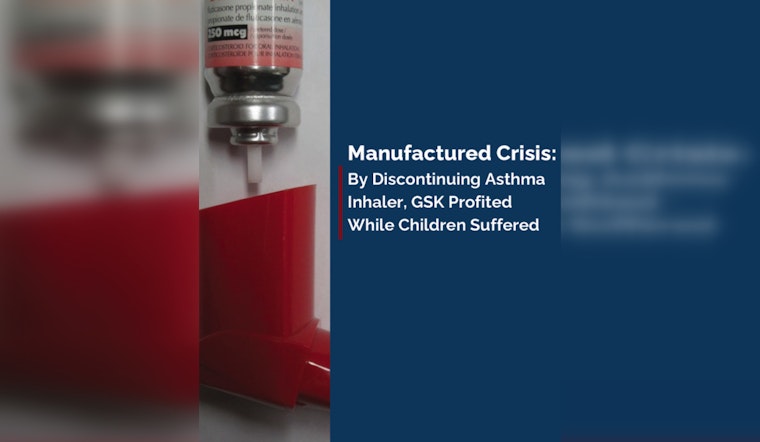
Boston families with kids who rely on inhalers have been caught in the crossfire of a pharmaceutical shake-up, and a new Senate report says the fallout has not been theoretical. When GSK pulled the children’s inhaler Flovent from the market, some kids landed in emergency care and many parents were left scrambling for alternatives and facing higher bills.
Physicians surveying families at Boston Children’s Hospital reported that, for a slice of their young patients, asthma got harder to control after they were switched off the branded Flovent product. At the same time, some families saw their out-of-pocket costs climb, even as federal officials and advocates questioned whether GSK used an “authorized generic” to dodge pricing rules and push more of the tab onto families and insurers.
What the Hassan report found
In a detailed investigation released by Sen. Maggie Hassan, staff for the Senate subcommittee dug into pharmacy benefit manager data alongside surveys of clinicians and parents. The report describes a drop in the use of inhaled corticosteroids and rising plan costs after GSK stopped selling the branded medicine.
According to the surveys summarized in the report, many families had to switch medications. Roughly a quarter of those responding said they were hit with higher out-of-pocket expenses after the change. Clinicians also frequently reported that it was tricky to line up age-appropriate alternatives for younger children, a problem that can turn a paperwork issue into a health scare when a child’s asthma is poorly controlled.
How the switch happened
GSK’s own regulatory filings show that the company discontinued its branded Flovent products as of January 1, 2024, shifting its supply to an authorized generic distributed by Prasco. On paper, GSK said that move was meant to preserve access for patients.
Critics and several state officials saw something else in the timing. They argue the move allowed the company to sidestep steeper Medicaid rebate obligations that kicked in under new federal rules, effectively protecting the bottom line at the potential expense of public programs. That allegation is now in court. In Arizona, the attorney general has sued GSK, accusing the company of putting patients at risk while improperly avoiding Medicaid payments.
FDA approval brings a true generic
Federal regulators are now trying to change the landscape. Earlier this month, the Food and Drug Administration signed off on the first true generic version of Flovent HFA, saying the newly approved product should broaden access and help bring down costs for many patients.
Glenmark Specialty, which received final FDA approval along with a Competitive Generic Therapy designation, has said it plans to begin distribution in the United States in March. Regulators and patient advocates are banking on that launch to relieve at least some of the price and supply pressure that doctors and families have been wrestling with.
Parents say the change had real consequences
For parents who spoke alongside Hassan at her news conference, the story was painfully concrete. They described acute asthma episodes and long stretches of scrambling to adjust medications after their children were moved off Flovent and onto other options.
As reported by The Boston Globe, families recounted kids missing school, new medical bills piling up, and emergency department visits they linked to gaps in coverage and access created by the switch. In a city that prides itself on top-tier medical care, parents said it felt surreal to be fighting this hard just to keep a basic asthma controller inhaler within reach.
Legal and policy fallout
Hassan’s office has made it clear that the report is not the last word. The senator plans to push legislation that would close the loophole that let a branded drug be replaced with an authorized generic in a way that avoided Medicaid price limits, while keeping the pressure on both GSK and Prasco through continued oversight.
At the same time, state attorneys general and consumer advocates have opened their own fronts. Several investigations and legal actions are underway, including Arizona’s lawsuit that alleges GSK prioritized profits over the safety of patients who relied on Flovent.
What families should know
For Boston families still trying to make sense of all this, clinicians have one core piece of advice: do not guess. Parents of children who used Flovent are being urged to talk directly with their child’s provider and pharmacist about which inhalers are currently covered under their plan, whether that is the authorized generic or the newly approved true generic, and whether prior authorization is needed.
The FDA’s approval of a true generic is a significant step toward broader affordability, but it is not an automatic fix at the pharmacy counter. Insurers and pharmacy benefit managers will decide how the new option is covered, which in turn will determine how quickly, or slowly, families in Boston and beyond will feel any real relief in their out-of-pocket costs.





