

























































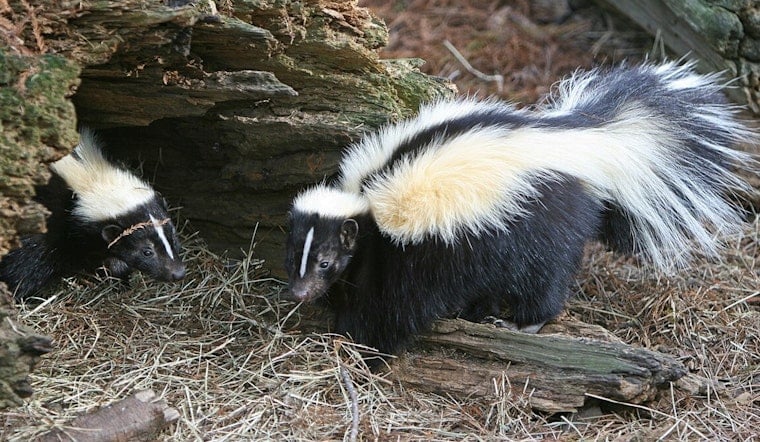
If your block has been smelling like a meatball left in the sun, you can probably thank baby skunks. Mothers are starting to move their kits out of dens for nighttime foraging, and that combo of nervous moms and clueless youngsters means extra musk drifting through yards and alleys. Here is what to watch for, how to keep pets safe and how to handle a spray without turning a bad situation into a full-blown disaster.
Ted Stankowich, a biological sciences professor who directs the Mammal Lab at Cal State Long Beach, says the striped skunks most Californians see are nocturnal omnivores that come out at dusk to hunt insects, raid trash and eat fruit. He notes that lactating mothers can be “a bit more ornery” when protecting kits. That explanation and related advice were reported by LAist, and Stankowich’s faculty profile is available at Cal State Long Beach.
When and why you’re noticing more skunks
In warmer parts of California, mating can start as early as January, and a roughly two-and-a-half-month gestation means kits often arrive in April and May. The San Diego Zoo notes that striped skunks give birth after about 59 to 67 days; kits are born blind, deaf and mostly hairless, open their eyes at around three weeks, and begin accompanying their mother on night forages by about eight weeks. That timeline helps explain why sightings and occasional sprays spike in spring and early summer across Los Angeles.
How to behave if you run into a skunk family
Wildlife experts recommend giving skunks plenty of space: stay still or back away slowly, keep pets on a leash and never try to feed or pick up kits. Those precautions were emphasized in local reporting by LAist. If an animal bites or behaves oddly, the Los Angeles County Department of Public Health recommends reporting the incident and following its rabies guidance for testing and post-exposure care; the county has protocols for bite reporting and rabies testing in its rabies control manual.
Cleaning up a skunk spray
Tomato-juice baths are largely a myth; they mostly just cover up the smell. Instead, experts point to a peroxide-based neutralizer. County guides and wildlife pages recommend mixing 1 quart of 3% hydrogen peroxide, 1/4 cup baking soda and 1 teaspoon dish soap, applying it promptly (avoiding eyes), letting it sit for a few minutes and then rinsing. Repeat only if needed. A single-page de-skunking handout from San Bernardino County lists those exact proportions as an effective household remedy for people and pets.
Public-health note
Skunks are one of several wild species that can carry rabies, so do not touch animals that appear sick or unusually disoriented. The Los Angeles County rabies control manual explains when public-health testing is performed and why pet vaccinations and prompt reporting of bites matter; the manual is available from the county’s veterinary public health program. If you suspect an exposure, contact local animal control or the county veterinary public health program for instructions.





