

























































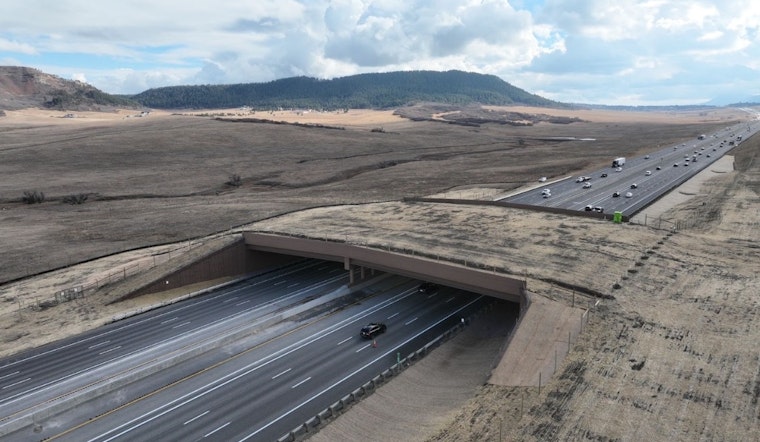
Colorado's Greenland wildlife overpass, now stretching across six lanes of I‑25 just south of Castle Rock, is officially open and already being treated as a win for both drivers and wildlife. The dirt‑topped structure reconnects roughly 39,000 acres of habitat and offers a broad, natural crossing designed for elk and pronghorn. State leaders say it closes a critical gap in a larger mitigation system that already includes underpasses and fencing along the corridor.
Official rollout and what it does
State officials are calling the I‑25 Greenland structure North America's largest wildlife overpass. It measures about 200 by 209 feet and covers roughly 41,800 square feet, and crews finished seeding and landscaping the surface ahead of schedule, according to the Colorado Governor's Office. The bridge sits near the Greenland interchange between Larkspur and Monument and was bundled into the broader I‑25 South Gap corridor improvements. Key construction milestones were tracked in mid‑2025 as the massive structure rose over the highway, as per Hoodline.
A final link in a decades‑long plan
The overpass plugs a 3.7‑mile gap in a chain of crossings and fencing that now runs 18 miles between Castle Rock and Monument, part of CDOT's I‑25 South Gap project, according to the Colorado Department of Transportation and project archives. That larger South Gap effort added four new wildlife crossings and roughly 28 miles of exclusion fencing, measures CDOT says are expected to cut wildlife‑vehicle collisions in the corridor by about 90 percent. Biologists and transportation officials say the mix of underpasses, fencing and this wide overpass gives different species the options they need to cross the interstate safely.
How big, how fast and how much
The bridge itself is nearly an acre of soil and native plants, stretching 200 feet across and 209 feet long, with its superstructure supported by 76 girders, state officials note. CDOT lists the overpass construction cost at about $15 million, while roughly $22 million in federal infrastructure funds and $8 million from the state were allocated to the broader mitigation effort; contractor efficiencies helped deliver the structure for less than the full allocation, according to the Colorado Governor's Office. Officials say crews wrapped up major work in roughly 10 months and moved quickly into planting to make the span usable for migrating animals as soon as possible.
A grieving family makes the case
For some nearby residents, the opening is bittersweet. Mary Rodriguez, whose father Victor was killed when a 700‑pound elk crashed through his windshield on a different Douglas County road last year, says the crossing offers some relief but arrived too late for her family. "We are trying desperately to cope with losing him," Rodriguez told CBS Colorado, and she has been pushing for fencing and crossings on other dangerous stretches of roadway.
Federal money and national momentum
The Greenland overpass was built with help from the Wildlife Crossings Pilot Program, created by the Bipartisan Infrastructure Law to fund projects that reduce wildlife‑vehicle collisions, according to the U.S. Department of Transportation. Early rounds of that federal program awarded money to projects around the country and helped make this bridge possible, and conservation groups say the work here is already shaping similar efforts in other states and regions.
What comes next
Officials plan to track how animals use the span and to monitor crash data so planners can apply lessons across Colorado and beyond. Early monitoring and follow‑up studies will test whether the design and location cut collisions as projected, and transportation and wildlife agencies say they will use those results to prioritize where new fences and crossings are most urgently needed. Over the long term, they aim to rely on performance data to guide future investments and reduce the human and animal toll of roadside collisions.





