

























































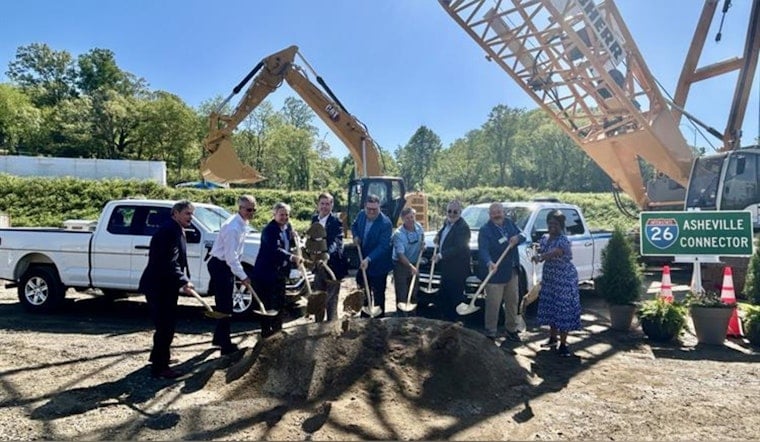
Golden shovels hit the dirt Thursday as state transportation officials finally kicked off construction on Asheville’s long-debated I-26 Connector. The roughly $1.8 billion effort is designed to peel apart local and interstate traffic, ease the chronic logjams around the Bowen Bridges and stitch together a continuous freight route from western North Carolina to the Port of Charleston. Work will unfold in several sections over the next few years.
According to the N.C. Department of Transportation, construction is already underway on both the north and south sections, and the overall program is slated to wrap up by late 2031. Plans call for new interchanges, major bridge work, multi-use paths and stronger pedestrian and bicycle links as part of a broader set of multimodal upgrades.
The department posted video of the groundbreaking on its Facebook page. In the clip, Transportation Secretary Daniel Johnson tells the crowd, “This project has been a long time coming.” The NCDOT Facebook reel shows local leaders lined up at the Archer-Wright staging yard for the ceremonial golden-shovel photo op.
Why the connector matters
Backers say the connector will finally untangle the confusing weave of interstate and local lanes across the Bowen Bridges, a spot that has frustrated drivers for years. At the same time, the plan has stirred fresh opposition in West Asheville. As Blue Ridge Public Radio reported, the project will force out dozens of homes and businesses and brings back a controversial flyover design that neighborhood groups previously fought off.
Contractors and early impacts
Archer-Wright Joint Venture is heading up the North Section under a design-build contract that includes hundreds of drilled shafts and several new bridges over the French Broad River. The Asheville Citizen Times reports that Archer-Wright’s award for that segment came in at more than $1.1 billion and that crews have already shut down a few ramps near the Jeff Bowen Bridge as staging work ramps up.
NCDOT says most early construction this year will happen outside active traffic lanes, but drivers should brace for larger lane closures and detours once the big bridge work kicks in. The agency also notes that the $1.8 billion program is backed by a mix of state and federal funds and that officials will roll out regular schedule updates as the project moves forward.





