

























































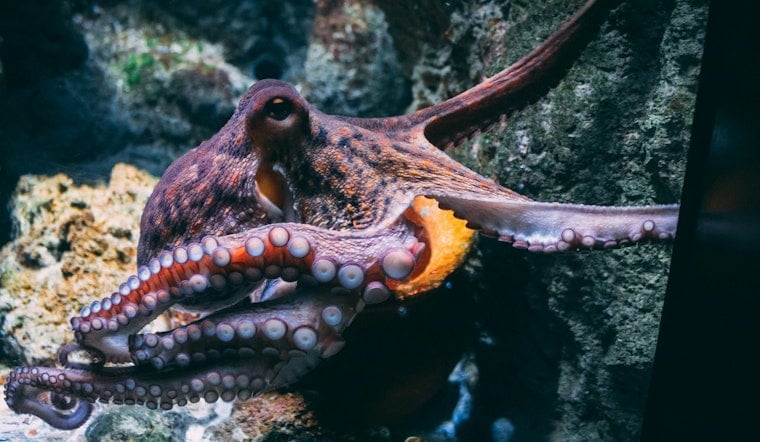
Colossal, finned octopuses may have haunted the Late Cretaceous oceans, and one species might have stretched an astonishing 62 feet from tip to tip. That bold claim rests almost entirely on fossilized beaks, the only part of an octopus tough enough to survive deep time, which show heavy wear that lines up with a life spent crushing hard-shelled prey. By rebuilding jaws that had been hiding inside chunks of rock, researchers say these spineless predators could have cruised the same waters as mosasaurs, plesiosaurs and giant sharks.
The findings appeared April 23 in the journal Science, where the authors revisited 15 previously known jaw fossils and then used a technique they call "digital fossil mining" to pull 12 more beaks out of sedimentary rock. The study combines meticulous measurements with 3D models generated through grinding tomography and AI-assisted reconstruction, letting the team estimate whole-body size from the preserved jaws.
Two Species, Colossal Sizes
The fossils were assigned to two species of finned octopus, Nanaimoteuthis haggarti and N. jeletzkyi. The heavyweight of the pair, N. haggarti, is estimated to have reached up to about 18.6 meters, or roughly 62 feet, while N. jeletzkyi topped out near 25 feet. Those numbers would place them among the largest invertebrates ever known, according to National Geographic.
What The Jaws Reveal
The fossil beaks themselves tell a rough-and-tumble story. They show chipping, scratching and rounded tips that match repeated encounters with hard prey, and in the biggest specimens the researchers report about a 10 percent loss of jaw length from wear alone. On some jaws, one side is more worn than the other, a pattern that hints at lateralized, "handed" hunting behavior and surprisingly sophisticated tactics, as described by The Washington Post.
How Researchers Dug Up Hidden Fossils
Instead of limiting their search to what was visible on rock surfaces, the team turned to grinding tomography and AI to look inside the rock itself, imaging and reconstructing fossils still locked in the surrounding matrix. They call the workflow digital fossil mining. That approach produced a dozen previously unseen jaws from Cretaceous deposits in Japan and on Vancouver Island, a result underscored in the study’s press materials and in local coverage in the Charlotte Observer.
Why Paleontologists Are Pumping The Brakes
Not everyone in the field is ready to crown a 62-foot octopus as king of the ancient seas. Some paleontologists caution that any attempt to size up an animal based only on its beak comes with plenty of uncertainty, and a few have labeled the upper-end estimates "quite extreme." Even so, many researchers say the new techniques and fresh data greatly improve the odds of tracking down other soft-bodied creatures that have long slipped through the fossil record.
What Comes Next
The authors plan to push digital fossil mining further, hunting for more hidden cephalopods and other soft-bodied fossils that could redraw scientists’ maps of ancient marine food webs. For now, whether the so-called Cretaceous kraken turns out to be a one-off giant or the first glimpse of a whole league of super-sized octopuses is a mystery still waiting in the rocks.





