

























































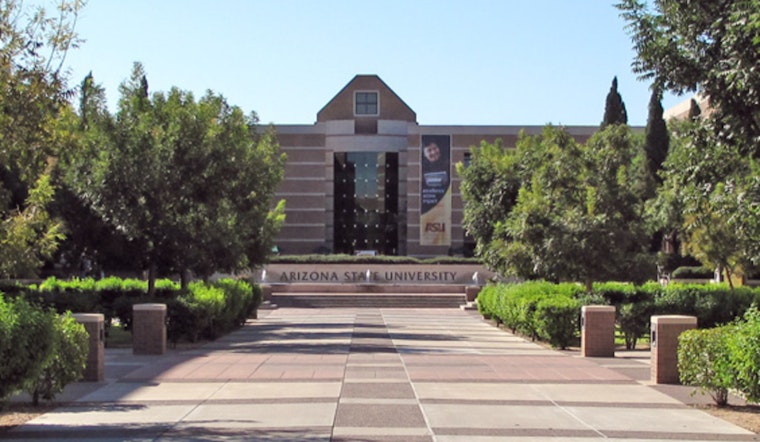
Arizona State University (ASU) is taking a futuristic approach to education by incorporating virtual reality into its science curriculum, a move that is showing promising results in student engagement and success. "Dreamscape Learn," the virtual reality program introduced last year, has expanded from its initial application in biology to chemistry courses, allowing more than 40,000 students to experience an interactive learning environment where they solve real-time challenges.
The use of virtual reality at ASU offers a novel way to visualize complex scientific concepts, particularly in chemistry, where the understanding of molecules is paramount. "We bring in some sophisticated chemistry which they can not see any other way," Ian Gould, associate dean of instructional innovation at ASU, told FOX 10 Phoenix.
At the Polytechnic campus, this technology is being applied across majors – from preveterinary medicine and biological sciences to engineering and the arts. A study comparing student grades before and after the program's implementation revealed not only an increase in grades but also a higher likelihood of students staying in science majors, with the virtual experiences receiving high praise from participants. Maria Bautista, a biology instructor at the School of Applied Sciences and Arts, attributes this success to the hybrid learning models, saying to ASU News, "Using a combination of learning methods: visual, auditory, kinesthetic, solitary, social, verbal, logical ... allows us to reach all the different types of learners and learning styles so students can be more successful."
Moreover, the program proves to be an all-ages affair, as Dreamscape Learn VR technology engages not only ASU students but also local middle and high schoolers, who can experience the same technology on their campuses and in community events. To learn more about the program or to schedule a visit to the Dreamscape Learn pod, interested parties can reach out to Izaac Mansfield at [email protected], ASU News stated.





