

























































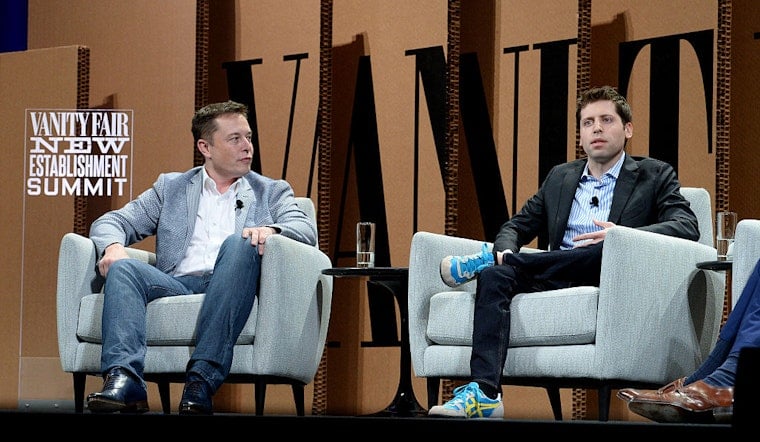
The most consequential courtroom drama in Silicon Valley history kicked off Tuesday at the Ronald V. Dellums Federal Building in downtown Oakland — and if you thought the AI wars were fierce online, wait until you hear what happens when you put Elon Musk and Sam Altman in the same room with lawyers. The two tech titans, who once shared a mission to make artificial intelligence safe for humanity, are now locked in a federal lawsuit that could reshape the future of AI, blow up a trillion-dollar IPO, and — depending on whom you ask — either vindicate a whistleblower or expose a billionaire's sour grapes.
As reported by CNN, Musk was the very first witness called when the trial opened April 28, taking the stand in a compact Oakland courtroom flanked by wooden benches packed with media. Dressed in a dark suit and tie, he framed the case in nothing less than existential terms. "I have extreme concerns over AI," he told the nine-person jury. "It could make everyone prosperous — but it could also kill us all." There's nothing quite like a Terminator reference to kick off a Tuesday morning in Alameda County.
The Charity That Wasn't (Or Was It?)
The core of Musk's lawsuit is this: he says he co-founded OpenAI in 2015 as a strictly nonprofit, open-source entity to benefit all of humanity — a moral counterweight to Google's closed AI development. According to NPR, Musk's attorney Steven Molo told jurors bluntly: "Ladies and gentlemen, we are here today because the defendants in this case stole a charity." Musk's lawyers introduced OpenAI's 2015 founding charter into evidence — a document declaring the company would pursue "open source technology for the public benefit" and was "not organized for the private gain of any person."
Musk testified that he contributed at least $44 million in early funding and played a central role in building the company. "I came up with the idea, the name, recruited the key people, taught them everything I know, provided all the initial funding," he said on the stand, as reported by NBC News. He added, pointedly: "I could have started it as a for-profit, and I chose not to." As for the name "OpenAI" — Musk said "open" specifically stood for open source, not just open-minded aspiration.
He also offered some juicy backstory about why OpenAI came to be at all. According to Fortune, Musk told jurors that the whole venture crystallized after a 2015 meeting with Google co-founder Larry Page, during which Musk found Page "not sufficiently caring about AI safety." When Musk expressed concern about humans' future, Page apparently called him a "speciesist" — presumably meaning Musk was biased in favor of his own species. An insult that, unintentionally or not, apparently helped birth one of the most valuable AI companies on the planet.
OpenAI Fires Back: 'He Didn't Get His Way'
OpenAI's lead attorney, William Savitt, presented a sharply different version of events. As covered by CNBC, Savitt told jurors: "We are here because Mr. Musk didn't get his way at OpenAI. That's what happened. He quit, saying they would fail for sure. But my clients had the nerve to go on and succeed without him." Savitt argued that Musk had promised to help raise $1 billion for OpenAI, then pulled the plug when he couldn't seize total control — and that Musk stayed silent as OpenAI evolved, only suing once the company became spectacularly successful and a rival to his own xAI venture.
The "occasional yelling" detail didn't help Musk's narrative, either. Savitt suggested that while co-founders like Brockman put in daily "sweat equity," Musk swung by every few weeks to give advice and "occasionally yelled at people for not moving fast enough." Microsoft's attorney Russell Cohen added another wrinkle: he pointed to a 2020 post on Musk's own platform X in which Musk wrote that "OpenAI is essentially captured by Microsoft" — arguing that Musk was well aware of the company's direction years before filing suit, per CNN.
The Judge, the Gag Order Threat, and the Jury That Kind of Hates Everyone
Even before Musk set foot in the courtroom, things were messy. The night before opening statements, he was posting on X — calling his target "Scam Altman" and declaring that "Greg Stockman stole a charity. Full stop." Judge Yvonne Gonzalez Rogers was not amused. She scolded Musk Tuesday morning and threatened a gag order, warning that his posts would "only make things worse," according to CNN. Both sides agreed to cool it on social media during proceedings.
Jury selection itself was a minor spectacle, with the judge reportedly noting that "the reality is that people don't like him. Many people don't like him" — a candid acknowledgment of Musk's polarizing public image. The jury ultimately seated was composed largely of individuals who said they held neutral views of both Musk and AI. One rejected juror had described Musk as "greedy" and a "piece of garbage" in their questionnaire; another said their partner's job had been harmed by the Department of Government Efficiency, Musk's federal cost-cutting initiative. The judge, notably, is U.S. District Judge Gonzalez Rogers — the same jurist who ruled against Epic Games in its antitrust case against Apple. She's no stranger to tech giants in her courtroom.
We Asked ChatGPT and Grok: Who Wins?
In what may be the trial's most meta subplot, we did what any self-respecting tech publication would do: we asked two AI chatbots to predict the outcome of a lawsuit about an AI company. Their answers were... surprisingly nuanced.
Grok — the AI built by Musk's own xAI — called Musk the underdog, saying OpenAI is favored to "largely prevail" with roughly 60–70% implied odds. Grok cited Musk's lack of a clear enforceable written contract, the statute of limitations problem (Musk knew about OpenAI's evolution for years before suing), and courts' general reluctance to micromanage successful companies' structures. Even prediction markets on Kalshi, it noted, put Musk's win probability around 45%. It hedged that a narrow Musk "win" — say, modest nonprofit restitution rather than full structural reversal or billions in damages — is more plausible than a transformative ruling. A bit awkward for the plaintiff's own chatbot to be betting against him.
ChatGPT — made by the defendant — was equally measured, and gave OpenAI a "slight edge" based on typical case law: courts defer to corporate structure legality over founder intent, "mission drift" alone rarely rises to a legal violation, and Musk's delayed objection is a genuine liability. But ChatGPT flagged the wildcard: if internal communications contain something like an explicit promise that OpenAI would "never become a for-profit entity," the case could swing hard in Musk's favor. Given the document dumps both sides are presenting, that's no small caveat.
Both AIs, in other words, think their respective creators are probably going to lose. Make of that what you will.
The IPO Elephant in the Room
While this case is a fascinating grudge match on its own terms, the stakes extend well beyond two billionaires and their egos. OpenAI is targeting a Q4 2026 IPO at an eye-popping valuation, with some projections approaching $1 trillion. According to Tech Market Briefs, OpenAI surpassed $20 billion in annualized revenue by the end of 2025, up from $6 billion the year before — but it is still deeply unprofitable, projecting $14 billion in losses in 2026 alone and not expecting to break even until around 2030.
The lawsuit hangs over that IPO like a storm cloud. ResultSense noted that a judgment unwinding OpenAI's for-profit conversion "would touch every commercial commitment OpenAI has made since 2023" — including its $250 billion Azure relationship with Microsoft, its Amazon and Google Cloud partnerships, and a vast web of enterprise contracts. Musk is seeking over $130 billion in damages to be directed back to OpenAI's nonprofit foundation, along with the ouster of both Altman and Brockman. Even a partial adverse ruling could delay the IPO or crater investor confidence at the worst possible moment.
And OpenAI's IPO picture wasn't exactly pristine before this trial started. As Futurism reported, the company missed its own targets of reaching one billion weekly ChatGPT users by the end of 2025, and CFO Sarah Friar has reportedly warned internally that OpenAI may not be able to afford future compute contracts if revenue growth doesn't accelerate. The company has committed to over $1.4 trillion in infrastructure spending through 2033 — a staggering bet that requires the AI revolution to keep accelerating on schedule. Meanwhile, competitor Anthropic recently surged to a trillion-dollar valuation on secondary markets, intensifying pressure on OpenAI to get its own listing done before the AI investment wave peaks.
And Then There's Musk's Other Problem: Tesla
It's worth stepping back and asking: is Elon Musk really in the best position to be playing the principled-nonprofit-guardian role right now? This is, after all, a man whose own flagship company has been struggling badly. According to Axios, Tesla vehicle sales declined for a second consecutive year in 2025, falling 8.6% to 1.64 million deliveries — the lowest since 2022. That same year, Chinese automaker BYD outsold Tesla globally for the first time ever, moving 2.26 million EVs.
Musk himself acknowledged "some blowback" from his political involvement was hurting Tesla's brand, and Today in Detroit reported that U.S. Tesla sales dropped over 8% again in Q1 2026, marking the third consecutive year of decline. Critics point out that Musk's pivot toward AI, robotics, and political theater has left Tesla without a new consumer model since the Cybertruck in late 2023 — and that the company's over-reliance on a single vehicle, the Model Y, is a compounding vulnerability. In short: the man suing OpenAI for "mission drift" has his own drift problem at home.
What Happens Next
Musk's testimony was set to continue Wednesday morning, where he will face cross-examination from OpenAI's attorneys — the moment Sam Altman reportedly called "Christmas in April" back in February. Altman himself is expected to testify, along with Brockman and Microsoft CEO Satya Nadella. The jury's verdict, when it comes, will be advisory — meaning Judge Gonzalez Rogers makes the final call on any remedies. Jurors are expected to begin deliberating on liability by mid-May, according to Fox Business. A full verdict — or more likely, a settlement — could come weeks or months after that.
Whatever happens, the trial has already accomplished something remarkable: it's dragged the inner workings of the most powerful AI company in the world into a small Oakland courtroom with wooden benches and a judge threatening gag orders. Both Musk and Altman took oaths to put their online personas aside. Given their track records, that might be the trial's most optimistic request of all.




