

























































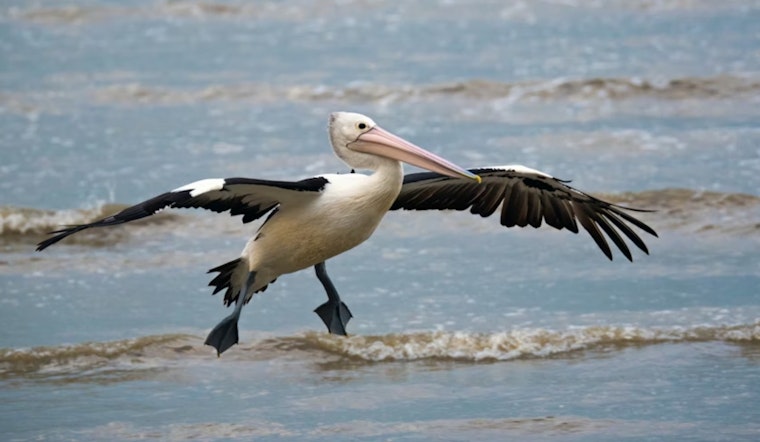
On Sunday, Ocean Beach got briefly hijacked by birds, as thousands of brown pelicans descended on the shoreline, dive bombing a school of fish and then packing themselves onto the closed Ocean Beach Pier. The sky filled with wheeling birds and splashes as they plunged into the water for hours, drawing big crowds and a whole lot of camera lenses. By Monday, the flock had mostly dispersed, leaving behind a pier streaked in white droppings and memories of a rare close-up look at a massive gathering of adults in bright breeding colors and hundreds of darker juvenile birds.
Beachgoers documented the whole thing in photos and videos, and photographer Jim Grant told NBC 7 San Diego he rushed over after a friend sent him footage. According to NBC 7 San Diego, a paraglider spotted the action from above and helped a Scripps Institution of Oceanography researcher identify what appeared to be a school of anchovies hugging the pier, likely explaining why so many pelicans zeroed in on that exact spot.
Why the flock gathered
Tammy Russell, a UC San Diego post-doc who studies seabirds at Scripps, told NBC 7 San Diego that the whole spectacle probably came down to two things: a dense pocket of prey and a quiet place to rest. She said “it was probably anchovies” fueling the frenzy and noted that many of the birds were adults in breeding plumage, with heads streaked in yellow, red and white and pale blue eyes, while the darker birds were likely first-year juveniles. Russell added that she works with a nonprofit called Pelican Science that fits pelicans with electronic leg bands to track where they go between feeding and roosting, in hopes of better understanding patterns behind gatherings like the Ocean Beach event.
What scientists say
Large, tightly focused feeding events like this are often seen as a good sign for the food chain when prey is abundant, according to AP News. The U.S. Fish & Wildlife Service notes that brown pelicans were removed from the federal endangered species list in 2009, after recovery efforts that followed the nationwide ban on the pesticide DDT. For a broader view of how these birds move around, the Cornell Lab of Ornithology describes brown pelicans as coastal birds that shift along the Pacific coast and sometimes form large roosting groups during the nonbreeding season.
Local reaction and next steps
For locals who hustled down to the sand, the moment landed somewhere between nature documentary and neighborhood block party, a reminder of how quickly wildlife can take over a quiet human space once people clear out. Photographers who scrambled to the beach called it a once-in-a-lifetime spectacle, and researchers say that ongoing tracking through leg bands and field observations should help reveal how often big roosts like this occur and what food conditions set them off. By Monday, the pelicans had moved on, leaving behind only a coated pier and the lingering memory of a sudden, short-lived wildlife takeover on the San Diego coast.





