

























































A team of Stanford University materials scientists has pulled off what could be a game-changing achievement in quantum technology—building a device that works at room temperature instead of requiring the extreme deep-freeze conditions that have long made quantum computing impractical for everyday use.
The breakthrough, published this week in Nature Communications, represents years of work by Professor Jennifer Dionne's lab in the university's Materials Science and Engineering department. The device uses "twisted light" to entangle photons and electrons at normal temperatures—a feat that could eventually reshape everything from cybersecurity to artificial intelligence, according to Stanford Report.
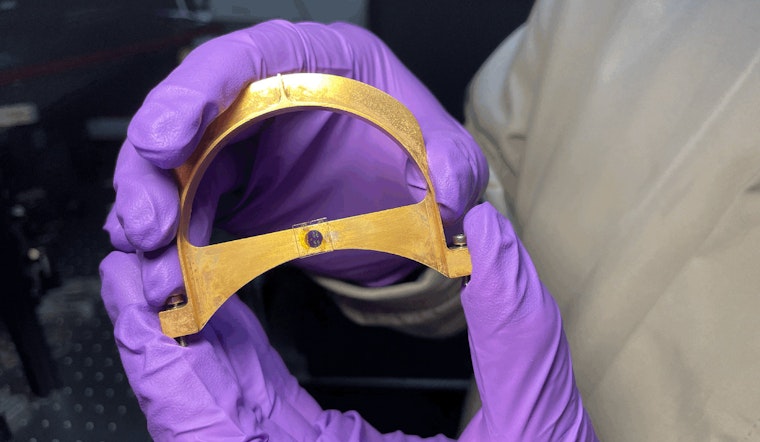
"The material in question is not really new, but the way we use it is," Dionne told Stanford Report. The device combines a thin layer of molybdenum diselenide atop patterned silicon nanostructures to create spinning photons that transfer their quantum properties to electrons—the building blocks of quantum computing.
Here's why that matters: Today's quantum computers are massive, expensive machines that need to be cooled to nearly -459 degrees Fahrenheit (close to absolute zero) just to function. This requirement has kept quantum technology confined to specialized laboratories with elaborate cooling systems. The Stanford device sidesteps this entirely.
Bay Area's Quantum Ecosystem Heats Up
The timing couldn't be more significant for the Bay Area's burgeoning quantum technology sector. The region is already home to major quantum computing companies including Rigetti Computing in Berkeley, PsiQuantum in Palo Alto, and Atom Computing, along with dozens of smaller startups. Stanford's breakthrough could accelerate development across this ecosystem.
Dionne, who also serves as deputy director of Q-NEXT (a Department of Energy National Quantum Initiative) and co-founded quantum sensor company Pumpkinseed, brings serious credentials to the work. She's previously won the NSF Alan T. Waterman Award and appeared on Oprah's "50 Things that will make you say 'Wow'!" list, according to her Stanford faculty profile.
Lead author Feng Pan, a postdoctoral scholar in Dionne's lab, explains the device creates what they call "twisted light"—photons spinning in a corkscrew pattern. These spinning photons then impart their quantum spin to electrons, creating stable qubits (quantum bits) without the need for cryogenic cooling. "The photons spin in a corkscrew fashion, but more importantly, we can use these spinning photons to impart spin on electrons that are the heart of quantum computing," Pan said in the Stanford announcement.
From Lab Bench to Cell Phone? Not Quite Yet
Before anyone gets too excited about quantum computing in their iPhone, Pan offered a reality check: "If we can do that, maybe someday we could do quantum computing in a cell phone," he said with a smile. "But that's a 10-plus-year plan."
The research team collaborated with Stanford chemistry professor Fang Liu and applied physics professor Tony Heinz, both experts in transition metal dichalcogenides—the class of materials used in the device. The work was funded by multiple federal agencies including the Department of Energy, Office of Naval Research, and DARPA, as noted in Phys.org's coverage.
The team is now exploring other material combinations and working to integrate their device into larger quantum networks. That will require developing new light sources, modulators, detectors, and interconnects—essentially building an entire ecosystem around the core technology.
What It Means for Practical Applications
Room-temperature quantum devices could transform several fields, according to the Stanford team's findings. Quantum cryptography could become practical for securing communications, as any attempt to intercept entangled quantum states would immediately alert users. Quantum sensors operating at room temperature could achieve unprecedented precision in medical imaging, materials science, and environmental monitoring, as reported by Quantum Zeitgeist.
The breakthrough arrives as a Stanford report from earlier this year cautioned that quantum computing remains a long-term bet, with most systems still in the experimental "Noisy Intermediate-Scale Quantum" (NISQ) era. Dionne's device doesn't solve all quantum computing challenges—error correction and scaling remain major hurdles—but it removes one of the field's most fundamental barriers.
The work was conducted at Stanford's Nanofabrication Facility and Nano Shared Facilities, both located on the university's campus at 496 Lomita Mall. Graduate students Amalya C. Johnson, Chih-Yi Chen, Sahil Dagli, and Ashley Saunders contributed to the research, along with collaborators from Marvell Technology and Lawrence Berkeley National Laboratory, as detailed in The Quantum Insider's reporting.
For Stanford and the wider Bay Area tech community, this represents another milestone in the region's push to lead quantum technology development. Whether it ultimately delivers on the promise of quantum computing in consumer devices remains to be seen—but at least scientists won't need to pack a freezer anymore.





