

























































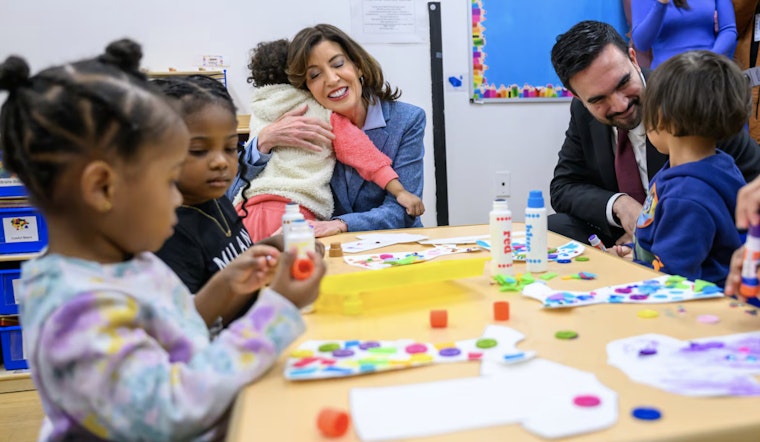
Gov. Kathy Hochul took to X late Tuesday with a bold promise: “We’re delivering universal child care across New York.” With that post, she doubled down on a multi‑billion dollar effort to expand publicly funded early childhood programs, anchored by a new city‑state “2‑Care” program for two‑year‑olds and a statewide push to make Pre‑K universal. Hochul is pitching the plan as a centerpiece of her affordability agenda to keep families from bolting for cheaper pastures and to make New York, in her words, “the best place in the country to raise a family.”
What the Plan Would Do
Hochul’s budget proposal asks lawmakers for a $1.7 billion bump in early‑childhood spending, which would bring next year’s total to about $4.5 billion, and would create a new Office of Child Care and Early Education to steer the rollout, according to Governor.ny.gov. In a X post that echoed the budget pitch, the governor said the plan would expand subsidies, stabilize 3‑K and work toward making Pre‑K available to every four‑year‑old statewide by the 2028–29 school year.
How 2‑Care Will Roll Out in New York City
Under the city‑state agreement, the new 2‑Care program is set to launch this fall with roughly 2,000 seats in high‑need neighborhoods. The state would put in about $73 million in the first year and roughly $425 million in the second year as capacity ramps up, according to The New York Times. Officials say the program is supposed to scale up each year so that within four years every family that wants a seat can get one, while the state also commits money to shore up the city’s existing 3‑K system.
Pilots Beyond the City
Outside New York City, the governor’s office is planning pilot partnerships with counties including Dutchess, Monroe and Broome to test community‑based models and add full‑day, year‑round seats for infants and toddlers. A separate state announcement puts initial funding for those pilots at about $60 million, with the aim of helping smaller communities “catch up” to New York City’s early‑childhood infrastructure as the state moves toward universal Pre‑K.
Funding, Capacity and the Politics
Hochul says the state will pick up the program’s early tab and fold most of the spending into the FY27 budget, but analysts warn that the real challenge will be locking in long‑term funding and hiring enough qualified early‑childhood educators, as reported by Bloomberg. Policy observers have also flagged a host of logistical hurdles, from finding classroom space to setting sustainable staff wages, that advocates argue must be sorted out if “universal” care is going to be more than a slogan, as detailed by Vox.
The proposals now head into Albany’s budget grinder and City Hall’s implementation maze before families see any new seats, a timeline that could easily stretch into the next legislative session. Lawmakers and advocates are preparing to scrutinize the fine print on funding and deadlines as the state and city move from announcement to actual rollout, with the governor’s X blast serving as her latest effort to keep universal child care front and center.





