

























































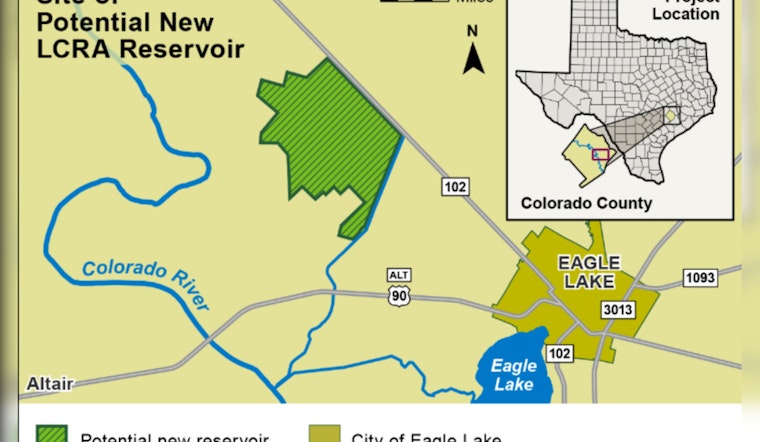
The Lower Colorado River Authority has kicked off a major “what if” on nearly 2,000 acres it owns northwest of Eagle Lake, launching a feasibility study to see whether the land can host a new off-channel reservoir to shore up water supplies for communities and businesses in the lower Colorado River basin. LCRA officials stress that this is still early-stage work, focused on technical and environmental review that would come well before any design, permitting, or construction if the site ultimately checks out. Local leaders are cautiously optimistic, while farmers and downstream users are already eyeing how a new pool of water might shift long-standing irrigation rules.
LCRA Begins Feasibility Work And Floats A Capacity Range
At a Feb. 18 board meeting, the authority said it is “quickly moving forward” with a study of the Colorado County property, according to LCRA. The roughly 2,000-acre tract northwest of Eagle Lake could hold an estimated 48,000 to 80,000 acre-feet if developed as a reservoir, a size that would top the recently completed Arbuckle Reservoir, which came online in October 2025 and stores about 40,000 acre-feet. “It’s too early to know specifics, because we first need to do our due diligence,” LCRA General Manager Phil Wilson told the board, saying the study will examine technical, environmental, and permitting constraints before the authority even starts talking about cost or timeline.
Local Leaders Weigh In As Water Rules Shift
County officials in the lower basin are generally welcoming the idea, with a few caveats. Wharton County Judge Phillip Spenrath told the Austin American-Statesman that a new reservoir “would increase water storage downstream for the growing needs of businesses and communities downstream of Austin,” while Colorado County Judge Ty Prause said “more storage to ultimately make more water available for the various needs we all have is a good thing.” The Statesman also noted that the LCRA board approved an update to the authority’s water management plan, over two dissenting votes, that raises the lake-level thresholds that trigger cuts to interruptible irrigation supplies and trims the amount of water that can be released for some farmers.
How The Project Fits LCRA’s Long-Term Strategy
LCRA says the possible reservoir would support its goal of adding about 60,000 acre-feet of new supplies by 2040 and give the agency more day-to-day flexibility in managing water below the Highland Lakes, according to LCRA. The agency points out that an off-channel reservoir near an existing intake and pump station would let operators move water in and out of storage as conditions change and contracts come due. LCRA also reminds readers that a single acre-foot equals roughly 325,851 gallons, a handy way of underlining just how much water is at stake when planners start talking about tens of thousands of acre-feet at a time.
Next Steps: Studies, Permits And A Long Road To Construction
For now, LCRA says it is focused on technical, environmental, and permitting studies before putting any price tag or schedule on the table. Independent coverage of the announcement notes that even if the site proves workable, any project would still be years away, with design, permitting, and financing all queued up ahead of shovels in the ground. Reporting by Community Impact highlights that, if it advances, the Eagle Lake-area project would be the second off-channel reservoir in the lower basin after Arbuckle and would add another late-stage tool for meeting municipal, industrial, and environmental water needs.
Why It Matters For Central Texas
Any new reservoir in the lower Colorado basin will reshape the balancing act LCRA performs among city customers, industrial users, and agricultural irrigators. This move is less a dramatic water grab and more an early signal that the authority sees rising demand and the recent Arbuckle build-out as reasons to explore added storage now instead of waiting for shortage-driven crises later. Residents, farmers, and local officials say they plan to track the feasibility work closely, then scrutinize the regulatory filings that follow, to see exactly how a new Eagle Lake reservoir might affect who gets water, and when.





