

























































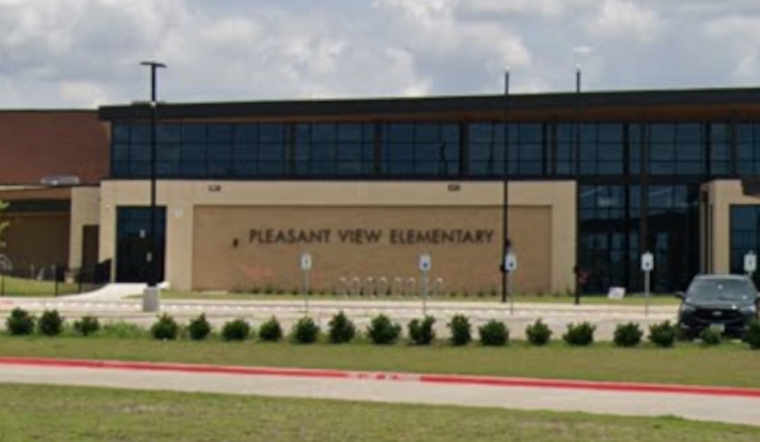
Parents in Godley are grappling with an unnerving question: Was oilfield drilling waste, laced with naturally occurring radioactive material, spread on the very ground where their kids now go to school?
Residents and a former oil-field worker say land-spreading of drilling waste took place on what is now the campus of Pleasant View Elementary, prompting worries that radium and other radioactive substances could sit beneath the school. The Godley ISD campus, which opened in January 2023, serves roughly 500 elementary students. Limited soil testing taken near the subdivision has shown elevated radium in some samples, although at least one analyst has said those readings were still below federal cleanup triggers.
School, Development and the Neighborhood
Pleasant View Elementary lists its address as 7800 Silo Mills Parkway, and the district notes the campus opened for students in January 2023, according to Godley ISD. The school sits inside Silo Mills, an 840-acre master-planned development marketed by its builder as a family-focused neighborhood. The subdivision is in Johnson County, on the southwestern edge of the Dallas–Fort Worth metro area.
Worker's Claims and Recent Testing
Former dozer operator Lee Oldham says he helped spread drilling waste on the land that is now home to Pleasant View Elementary. "They weren't telling anyone this was a radioactive material. They told us it was safe," Oldham told reporters, as reported by The Texas Observer. That reporting says former Department of Energy scientist Yuri Gorby collected soil samples along Silo Mills Parkway and that University of Texas nuclear engineer Sheldon Landsberger analyzed them. Landsberger told the outlet, "From the samples we have tested, the levels we are seeing are elevated, but below the 5 picocuries per gram regulatory limit."
What Research and Federal Guidance Show
The U.S. Environmental Protection Agency notes that oil-and-gas wastes can concentrate uranium, thorium and radium, and warns that workers who handle uncovered waste sites may inhale radioactive dust. A DOE-sponsored modeling assessment, followed by field work, has flagged land-spreading as a disposal pathway that, under worst-case assumptions, could produce radiation doses far above typical public limits. Field sampling in the Barnett Shale has also turned up spot readings hundreds of percent above guideline values.
Federal cleanup guidance used in Superfund work treats roughly 5 picocuries per gram in surface soils, and 15 picocuries per gram below the surface, as levels that trigger remediation action. That threshold is why even relatively modest upticks in radium are not brushed off as a minor technicality.
Regulatory Gaps and Oversight
The Railroad Commission of Texas permits landfarming and other land-application methods for certain oilfield wastes and spells out permitting and monitoring rules for those facilities. At the federal level, drilling fluids and many exploration and production wastes are classified as "special wastes" that are exempt from RCRA's Subtitle C hazardous-waste rules. Critics note that this statutory carve-out can make disclosure, cleanup and long-term oversight more complicated for communities that end up built on top of former disposal areas.
Local Officials and Next Steps
Johnson County law enforcement and an environmental crimes detective have been notified of Oldham's complaint, and the constable's office says it is investigating, according to reporting. School leaders told reporters the district required a Phase I environmental site assessment before construction and that the review "indicated that no evidence of recognized environmental conditions was identified." The developer has not produced the assessment on request, according to The Texas Observer.
What to Watch
Public-health and radiological experts say any serious follow-up will need more than a couple of surface samples. A thorough check would likely include systematic, deeper auger sampling, comparisons to background radiation levels and radon monitoring inside nearby homes and school buildings.
If further testing turns up hotspots, state permitting records and any documentation from the developer will be central to deciding what comes next, whether that means remediation, formal disclosure to homeowners or other actions.





