

























































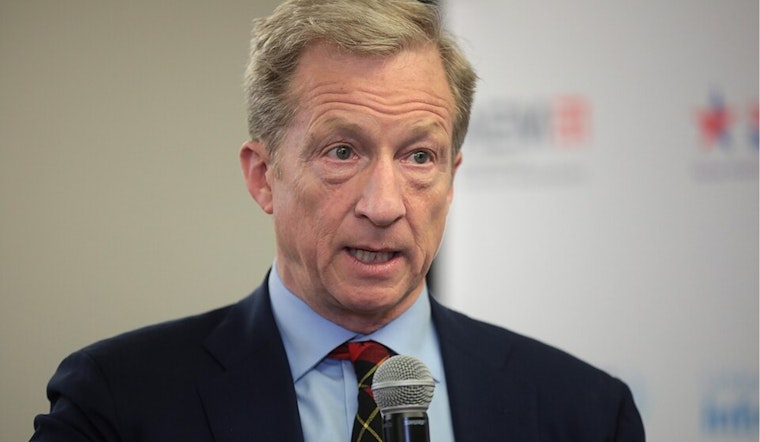
Tom Steyer is quietly pitching one of the biggest gambles in recent California politics: a special off-year election, once he is governor, to hike corporate taxes and rewrite a core piece of the state's tax code. He has told labor leaders he wants a 2027 ballot measure that would raise taxes on corporations and create a "split roll" under Proposition 13 so commercial properties are regularly reassessed at market value. Steyer argues that pairing that with moves to close corporate tax loopholes could plug what he calls a looming hole in the state budget. He scheduled a San Francisco press conference for today to roll out the plan.
Steyer floats a special election
Union officials and Steyer himself say he has been quietly workshopping a 2027 strategy that marries a special legislative session with an off-year statewide vote to seek approval for new tax rules, including fresh assessments on commercial real estate, as reported by POLITICO. He told POLITICO that "the big Republican bill is really going to hit the California budget, and that is going to blow a hole in it," insisting the state "can't wait." It is the clearest sign yet that Steyer wants revenue measures to sit at the center of his affordability message.
Where the revenue would come from
On the campaign trail, Steyer has rolled out a grab bag of tax proposals that he says would help pay for housing and public services, including closing the so-called water's edge corporate loophole, imposing a new billionaires' tax and layering on other levies, according to CalMatters. His broader affordability pitch has dominated recent candidate forums, where he contrasts his willingness to confront corporate interests with rivals' more cautious approaches. Labor organizations, for their part, have long argued that fresh revenue is needed to stabilize local budgets and head off cuts.
Union politics and past ballot fights
Union leaders say Steyer has indicated he will "do what it takes" to get a split-roll system across the finish line, while organized labor pursues its own options to raise money for public coffers. Some unions are backing legislation to close offshore tax breaks and ballot measures aimed at billionaire wealth, as reported by POLITICO. Steyer has been in this fight before: he helped fund the high-profile 2020 split-roll measure that ultimately went down to defeat at the ballot box.
Steyer's money and the political calculus
Steyer is well known for opening his own wallet in politics. He spent hundreds of millions of dollars on his 2020 presidential campaign and has bankrolled multiple ballot initiatives in California, a track record that simultaneously shows he can finance big-ticket efforts and feeds criticism that he is a wealthy outsider trying to purchase policy outcomes, according to The Washington Post. That financial muscle gives him influence with labor and progressive groups, but it also guarantees attacks from opponents who bristle at his checkbook politics.
Costs and risks of a special ballot
Statewide special elections are not cheap, and they are not simple. Recent off-year votes have required hefty spending by the state and counties and sparked recurring arguments over who should pay the bill, according to tracking by the California State Association of Counties. Supporters say a standalone election can resolve thorny budget questions faster than waiting for a regular cycle. Critics counter that off-year timing can warp turnout, skew outcomes and saddle counties with major administrative and financial burdens.
For now, Steyer's trial balloon signals just how central tax and revenue fights will be in the 2026 governor's race, and it sets up a real-world test of whether voters are ready to revisit Proposition 13's protections for commercial landlords. His campaign has not publicly detailed how a 2027 ballot drive would be funded or who would shoulder the costs of the push, and those questions are still hanging out there, as reported by Yahoo.




.jpg)