

























































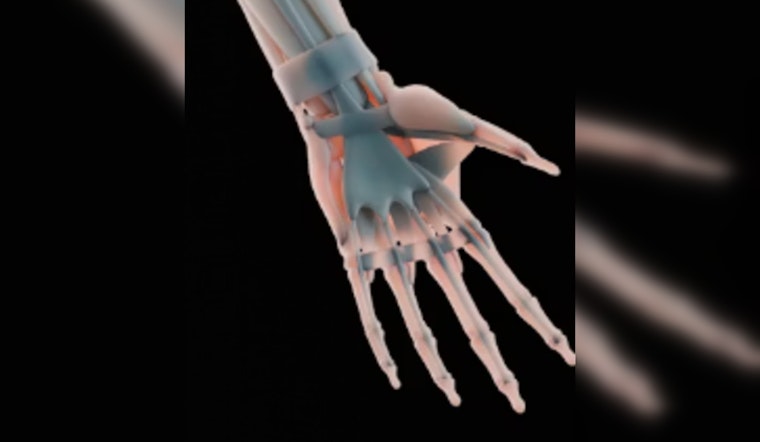
UT Austin researchers and national-lab partners have rolled out a 3D-printing method that turns low-cost equipment and a single common resin into lifelike body parts, including a realistic human hand. The trick is programming hard and soft regions inside one continuous object so a single print can act like bone, ligament, and skin without weak seams or glued joints. If the approach scales up, Austin-area medical programs and simulation centers could see far cheaper training models than the current cadaver supply allows.
What researchers built
Using a process the team calls Crystallinity Regulation in Additive Fabrication of Thermoplastics (CRAFT), researchers produced a printed hand with built-in stiff and flexible zones that echo the connected anatomy of a real limb. According to UT Austin, the prints come from a single cyclooctene-based feedstock and avoid the failure points that often show up when different materials are bonded together. The university notes that the method could ease the cost and logistical headaches of securing human donors for medical training programs.
How CRAFT controls material properties
CRAFT works by varying light intensity during lithographic 3D printing, which lets the team control polymer stereochemistry and crystallinity at the voxel level. As described in Science, control means one base material can behave like a hard plastic in one region and a softer, more stretchable plastic in another. The voxel-by-voxel tuning creates shifts in hardness, opacity, and extensibility across a single printed object without swapping out feedstocks. The paper presents the advance as a way to program mechanical and optical properties directly into parts instead of assembling them after printing.
Why it matters for training and gear
Potential uses go well beyond anatomy labs. Researchers say the same method could produce energy-damping components, next-generation helmets, and soft-robotic parts alongside surgical models that more closely mirror human tissue. As detailed by Lawrence Livermore National Laboratory, national-lab partners helped turn the materials discovery into practical manufacturing instructions that run on real printers. Project leaders also flag that repeatability, thermal management, and standards work will be needed before CRAFT-printed models can seriously challenge current surgical simulators.
Cheap printers and recycling
One of the project’s big selling points is how accessible it could be. The technique runs on common DLP and LCD projection printers using a widely available resin, and the researchers say it can work on machines that cost under $1,000, according to UT Austin. The authors also report that parts printed this way can be melted or dissolved and then re-cast, which could cut waste compared with multimaterial composites. “Since we can control the mechanical properties, this could be something where doctors-in-training could actually go and practice surgeries on these materials,” Zak Page told the university.
Next steps and limits
The authors of the Science paper say the method can scale to larger printers and could, in principle, be used to print full bodies for medical training. Getting there will not be instant, though, since scaling introduces thermal, processing, and material-compatibility challenges that still need to be solved. The project was led by Alex Commisso and Samuel Leguizamon with collaborators from UT Austin, Sandia, Lawrence Livermore, and other labs, according to the journal. Moving from eye-catching lab demos to hospital-grade models will also require tests for sterilization, repeatability, and regulatory acceptance before CRAFT becomes a standard tool in surgical education.



