

























































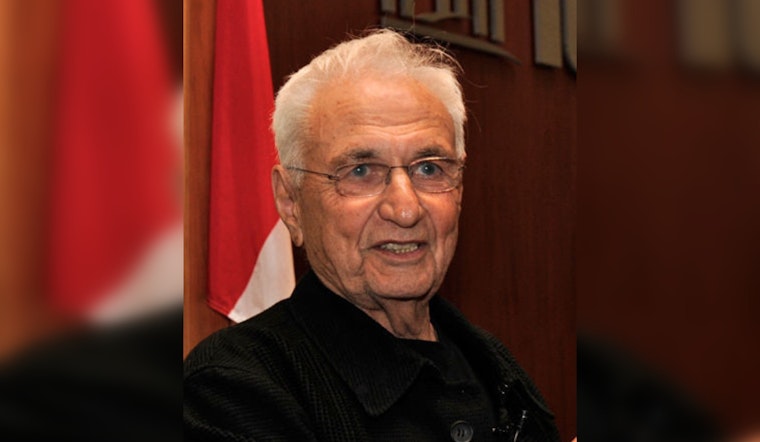
Frank Gehry’s long-unbuilt plan for Grand Avenue, a mash-up of new performance spaces, public plazas, and street-level fixes, is finally starting to look less like a dream and more like a construction schedule. With the Colburn Center rising and Related’s Grand project rolling out fresh dining spots and public space, pieces of the architect’s vision are quietly locking into place. The big question now is whether city leaders will move fast enough on the smaller, highly visible tweaks that would stitch the whole district together before the 2028 Olympics arrive.
Gehry’s unrealized upgrades
Many of the details come from Mark Swed’s reporting, which walks through the sketches Gehry drew up for the Grand Avenue corridor. The ideas include projected imagery on the stainless-steel skin of Walt Disney Concert Hall, converting BP Hall into a dedicated chamber-music room, reshaping the Keck amphitheater into a jazz club, and adding a glass-enclosed bar called the Ernest.
The plans also reach into the street grid. Gehry proposed lowering the 2nd Street hill and routing more surface traffic into the 2nd Street tunnel, opening up two pedestrian-focused blocks to link the Broad and Grand Central Market with Bunker Hill’s cultural core. According to the Los Angeles Times, Swed argues that, with political will and quick coordination, those moves could land ahead of the Olympic deadline.
Colburn Center gives the plan momentum
One piece of Gehry’s downtown vision is already under construction. The Colburn School has broken ground on a Gehry-designed expansion at 2nd and Olive that will feature the 1,000-seat in-the-round Terri and Jerry Kohl Hall, several professional dance studios, and a flexible 100-seat studio theater. Engineering News-Record reported on the April 5, 2024, groundbreaking and noted that the hall is designed to host orchestra, opera, and dance, making it the only mid-size concert venue currently planned for downtown.
With cranes and concrete already visible on the site, the Colburn project turns what had been mostly models and renderings into something you can actually walk past. It also helps prove that at least some of Gehry’s longtime sketches are now on a firm path to opening night.
The Grand is already reshaping Grand Avenue
Just across from Disney Hall, Related’s Gehry-designed Grand complex is quietly rewriting how Grand Avenue feels at street level. Restaurants and public spaces face the concert hall instead of turning their backs to it, offering a real-world example of architecture that tries to animate the sidewalk rather than act as a standalone object.
The project’s own site highlights an “urban room” plaza and a lineup of retailers and restaurants intended to pull people through the corridor instead of pushing them around it, according to The Grand LA. For developers and civic leaders, that kind of active frontage makes Gehry’s smaller cultural flourishes, like video projections, outdoor sound, and programmed plaza nights, feel less like fanciful extras and more like logical next steps.
What it would take and the price tag
Not every idea in Gehry’s notebook is monumental, but even the “simple” ones cost real money. The Los Angeles Times reported that his suggestion to project imagery on Disney Hall stalled when leaders did not commit the “$2 or $3 million” needed for the system.
The larger interventions, like lowering a street, diverting traffic into the 2nd Street tunnel, and reconfiguring amphitheaters, would demand engineering studies, approvals from multiple agencies, and a mix of public and private funding. Turning rough sketches into finished venues and walkable blocks will require formal planning by the Grand Avenue Authority, the city, and developers, all working in sequence if they want shovels in the ground well before 2028.
Why 2028 is the deadline and the upside for DTLA
Supporters frame the 2028 Olympics as a once-in-a-generation excuse to speed up the most visible parts of Gehry’s plan and finally convert long-discussed concepts into concrete placemaking. The Grand’s press materials estimate the development will generate roughly 10,000 jobs and hundreds of millions of dollars in revenues to the city and county over the next 25 years, figures that backers cite when they argue that cultural upgrades double as an economic strategy.
Expanding the mid-size venue options and activating plazas would also give local performing-arts groups more affordable stages within walking distance of transit, potentially reshaping how downtown Los Angeles programs music and dance. The pitch is not just about shiny architecture; it is about filling those spaces with life, audiences, and regular performances.
What to watch next
In the coming months, the real tells will be bureaucratic, not architectural. Watch the Colburn construction timeline, agendas for the Grand Avenue Authority, and any city budget moves that reserve money for public programming or plaza hardware. If officials lean into the visible, lower-cost elements of Gehry’s plan, like projection systems, sound equipment, curated plaza nights, and pedestrian-friendly tweaks, downtown could feel very different by the time the Olympic torch passes through.
For now, the designs have stepped off the presentation boards and onto the street. What happens next depends less on blue-sky creativity and more on policy choices and purse strings.





_(cropped).jpg)