

























































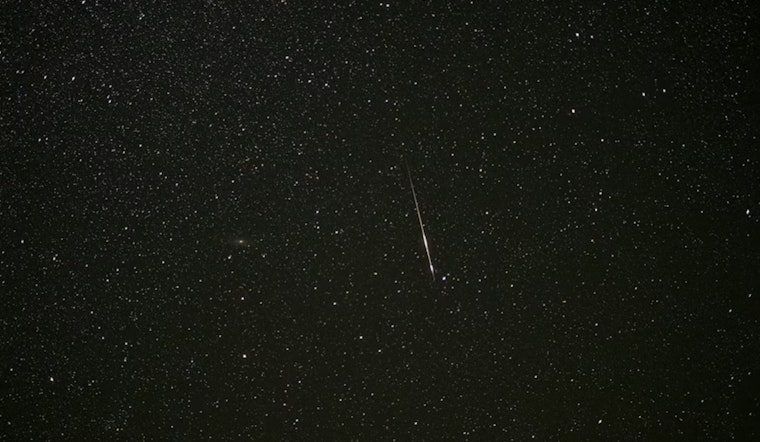
A turnpike service plaza in northwest Ohio turned into an impromptu sky-watching spot late Tuesday when a second meteor in as many weeks lit up the night. Security video from the Indian Meadows service plaza on the Ohio Turnpike captured a bright streak cutting across the sky, part of what has become a surprisingly busy run of fireballs over the state. The flash was quick but intense enough that motorists and travelers noticed, pulled over, and started recording. The clip surfaced just days after a much larger daytime fireball shook homes with a loud boom across the Mahoning Valley.
According to WKBN, Bill Cooke, who leads NASA's Meteoroid Environment Office, said the object was first spotted about 42 miles above Hope, Michigan, before breaking apart around 23 miles over Saginaw Bay. He estimated the visible fragment at just a few inches across and roughly a pound in mass, yet bright enough to shine about 40 times brighter than Venus while zipping northeast at about 29,000 miles per hour. The video WKBN shared was recorded at the Indian Meadows Service Plaza near West Unity, and the station notes that another smaller flash was caught about six minutes earlier that same night.
How This Compares To Last Week's Blast
By comparison, last week's daytime fireball was in a different weight class. Scientists say a refrigerator-size object, weighing roughly seven tons, plunged into the atmosphere over northern Ohio and exploded, setting off a sonic boom that rippled across Cleveland and the Mahoning Valley. AP News reported that meteorite hunters quickly fanned out over parts of the state looking for pieces, while Space.com outlined NASA's early read on the height and energy of that blast. Taken together, the two events are a tidy reminder that incoming space rocks can be anything from brief, harmless streaks to multi-ton bolides that pack an audible punch.
What Scientists And Camera Networks Are Watching
NASA's All-Sky Fireball Network and the American Meteor Society rely on camera footage and eyewitness reports to track these incidents. Their data let researchers triangulate paths, estimate speeds, and gauge whether any fragments might survive the plunge to the ground. NASA's overlapping cameras are designed to nail down altitude, velocity, and even an object's pre-impact orbit, while the AMS public logs and uploaded videos help narrow potential search zones for meteorites. Time-stamped original video files are especially valuable for reconstructing a meteor's trajectory from scattered reports.
For now, WKBN reports no damage or injuries linked to Tuesday night's smaller flash, and experts point out that most objects just a few inches across burn up high above the surface. At this point, the story is in the video clips and a growing stack of eyewitness accounts, while scientists and hobbyists comb through footage and American Meteor Society submissions in case any recoverable pieces can be pinned down.





