

























































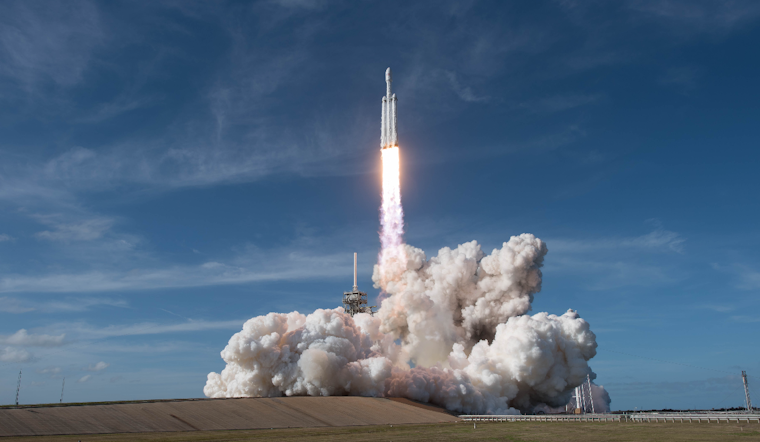
Central Florida could get a wake-up call from the sky Monday morning as SpaceX lines up a Falcon Heavy launch that is likely to echo across the region with one or more sonic booms.
The company plans to send a Falcon Heavy off Kennedy Space Center on Monday morning, the rocket's first heavy-lift outing since October 2024. The mission will haul Viasat's ViaSat-3 F3 communications satellite into a transfer orbit on its way to geostationary orbit, a move that could make itself heard from the Space Coast to well inland neighborhoods.
Viasat confirmed the mission in a press release, noting that ViaSat-3 F3 is scheduled to lift off during an 85-minute window that opens at 10:21 a.m. EDT from Launch Complex 39A and that the satellite is expected to enter service by late summer 2026, according to Viasat. "ViaSat-3 F3 will substantially increase capacity that is secure, reliable and highly flexible for customers operating in APAC," said Mark Dankberg. The company says the spacecraft will spend several months in orbit undergoing tests before it begins commercial service.
Where you might hear the booms
SpaceX has issued an advisory warning that residents in several Central Florida counties may hear one or more sonic booms tied to the launch and booster landings. The notice calls out Brevard, Volusia, Orange, Seminole, Polk, Osceola, Indian River, St. Lucie, and Okeechobee counties as areas that could be affected, according to the Orlando Sentinel.
The advisory adds that the two returning side boosters can create separated or "double" sonic booms roughly eight minutes after liftoff, although whether people actually hear them will depend on weather conditions and the precise flight path. Officials stress that these sharp cracks are a normal part of heavy-lift launch and landing operations, and say local updates will follow if anything in the plan changes.
Boosters and timing
Local coverage reports that the mission's two side boosters are aiming for landings at Cape Canaveral's Landing Zone 40 and Landing Zone 2, while the center core is not expected to be recovered for this flight, according to MyNews13. The outlet also notes that if teams scrub Monday's attempt, the next launch opportunity opens Tuesday with an 85-minute window starting at 10:17 a.m. EDT.
As the boosters head back through the atmosphere, they pass through transonic speeds on the return leg, which is what produces the familiar sharp, staggered booms that can travel miles inland. In other words, if your windows rattle a bit, it is likely just Falcon Heavy coming home.
Falcon Heavy's rarity and power
Falcon Heavy does not fly often, but when it does, it shows up in a big way. It's three-core first stage clusters 27 Merlin engines that together generate more than 5 million pounds of thrust at liftoff, according to Space.com. The rocket last flew in October 2024, when it launched NASA's Europa Clipper mission, per the Los Angeles Times.
Because Falcon Heavy can push hefty payloads to high-energy orbits, customers like Viasat turn to it when they need to reach orbit quickly or simplify satellite operations with more direct injection.
How to watch and what officials say
Kennedy Space Center and SpaceX typically host a live webcast for major launches, and the Kennedy Space Center Visitor Complex has an event page with viewing information and updates for the Falcon Heavy attempt, according to the Kennedy Space Center Visitor Complex. Both Viasat and SpaceX caution that the timing is subject to change, so the launch schedule and any sonic boom advisories could shift if teams hold for weather or technical checks.
Whether you are a regular launch-watcher or about to hear your first sonic boom, officials say the sounds that may ripple across Central Florida are a routine part of heavy-lift flights. Expect a bright plume climbing over the Space Coast and, in some neighborhoods, the signature rattle of returning boosters as the region once again plays host to a heavyweight ride to orbit.





