

























































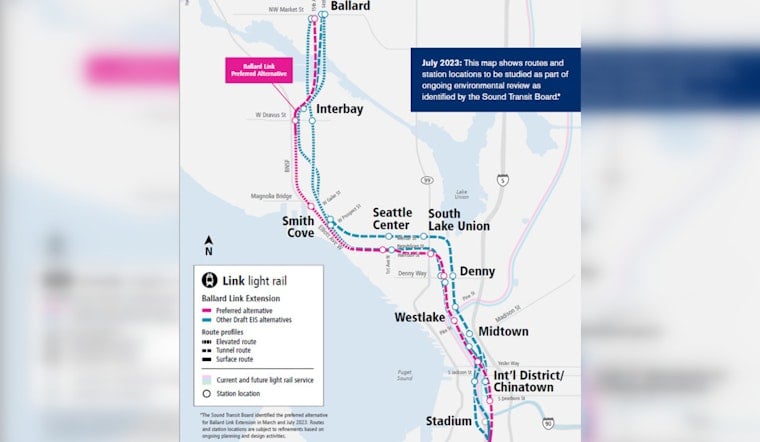
Sound Transit's long-promised Ballard Link Extension has run into yet another delay after federal reviewers slowed down a key environmental document. The Draft Environmental Impact Statement, the report that is supposed to narrow station options and let the agency choose a preferred alignment, will not arrive on the end-of-May schedule and is now expected later this summer, according to the agency. That slip keeps big design calls and possible scope cuts in a holding pattern, with costs continuing to climb for taxpayers and riders.
“Publication of the Ballard Link Extension Draft EIS has been held up by delays at the Federal Transit Administration (FTA),” Sound Transit told The Urbanist. The outlet reported that the agency will miss its end-of-May deadline and now hopes to publish the DEIS in summer 2026. Until that study is out, the Sound Transit board cannot lock in a preferred alternative or move the project into final design, leaving neighborhoods from downtown to Ballard waiting to find out what kind of light-rail line they are actually getting.
Last week, the Sound Transit board approved a contract change that tacks roughly $19.5 million onto its agreement with HNTB to complete the Final EIS and preliminary engineering. The agency says the added money is needed to cover new alternatives and extra work to hunt for cost savings. According to the board motion and staff report, the Ballard Link project sits at about 10 percent completion and carries a preliminary price tag between $20.1 billion and $22.6 billion (in 2025 dollars), a range that explains why managers are scrambling to control scope and schedule. Sound Transit signed off on the amendment at its April meeting.
Federal scrutiny and legal headwinds
The schedule problems tie partly to new federal grant conditions and contracting rules that arrived in 2025, including a Department of Transportation "Follow the Law" letter and an interim rule that revised Disadvantaged Business Enterprise guidance and how agencies must certify compliance with recent executive orders. According to the U.S. Department of Transportation, those steps require grant recipients to affirm that they are following applicable executive orders. In several lawsuits, plaintiffs have won preliminary relief that has complicated FTA review, according to court records. Filings posted on Justia show judges have at times limited enforcement of some grant conditions while the litigation plays out.
Why this matters for Seattle and Ballard
The Ballard Link Extension is a roughly 7.7-mile corridor from downtown to Market Street that voters approved in 2016 as part of the ST3 package. It would add nine stations and a new downtown tunnel and is projected to carry tens of thousands of riders. As reported by The Urbanist, the board’s 2023 move to add five more station alternatives stretched out the environmental review and is a key reason the DEIS schedule has slipped, a delay that now increases cost and timing pressure across the entire ST3 program.
What's next
In its own monthly reporting, Sound Transit had circled May 29, 2026, for the draft DEIS release and flagged the schedule as “pending final FTA guidance regarding executive orders,” a hint that federal review could still shift the timing. According to the agency’s status report, the board will not confirm or adjust its preferred alternative until after the DEIS is published, which means the next round of board votes and public comment will be crucial in shaping the ultimate footprint of the line. Sound Transit lays out that sequence in its system expansion monthly status report.
Community groups and preservation advocates are pressing the board not to drop stations or shorten the line before the public can see the environmental analysis, warning that early scope cuts could permanently reshape several neighborhoods. Local coverage has followed those worries and documented appeals from neighborhood preservation groups and advocates from the Chinatown-International District who argue they need the DEIS to understand impacts and possible mitigation. The International Examiner has captured some of that testimony.
With HNTB’s contract extended and federal review still unresolved, Seattle’s timeline for a train to Ballard continues to slip, and the agency’s list of potential cost-saving strategies, including station consolidations, phased construction, or delayed segments, looks more and more likely to come into play. Expect packed public meetings and a summer of high-stakes choices that will decide whether Ballard gets the full build voters signed up for or a slimmer, compromise version for the foreseeable future.





