

























































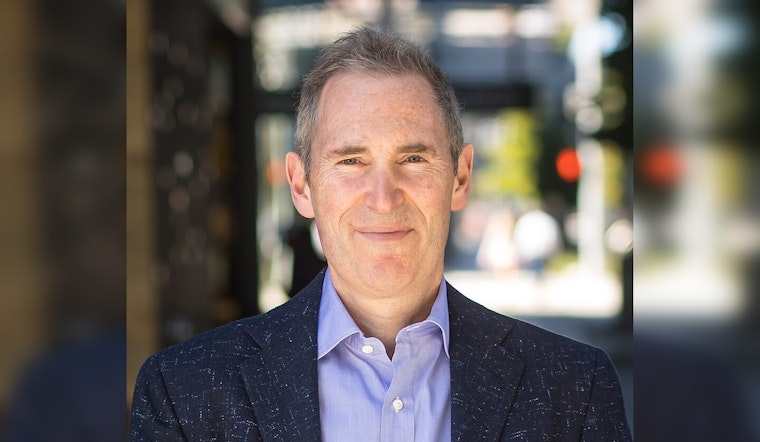
On Thursday, Amazon CEO Andy Jassy mounted a full-throated defense of the company’s plan to sink roughly $200 billion into AI, cloud and related infrastructure, arguing that a tech giant cannot sit out the next big platform shift, even if it rattles existing products and teams. He said the spending is backed by customer demand and long-term returns rather than a wild gamble, as Amazon races to scale data centers, custom chips and its low-Earth-orbit satellite project.
In his annual shareholder letter, Jassy wrote that “when transformative technology like generative AI arrives… you have to pursue it,” and insisted Amazon was “not investing approximately $200 billion in capex in 2026 on a hunch,” according to Amazon. The letter, which the Puget Sound Business Journal reported was aimed at calming shareholder nerves about the scale and timing of the outlays, also highlights Amazon’s nascent satellite service and its custom silicon as central pillars of the spending plan.
Jassy’s case: demand, chips and Alexa
Jassy said AWS’s AI services are already running at an annualized run rate of more than $15 billion, and that Amazon’s chips business is above a $20 billion run rate, figures he pointed to as justification for the massive buildout. He noted that AWS added 3.9 gigawatts of new power capacity in 2025 and expects to double total power capacity by the end of 2027, and cited a recent large OpenAI commitment as an example of relatively predictable customer demand. “AI is a once-in-a-lifetime opportunity,” Jassy wrote, and Amazon said it will invest aggressively to be the meaningful leader in the space, per Amazon.
Investor reaction and the market
The sheer size of the commitment has some investors feeling queasy. The market punished the move after Amazon’s capex guidance first surfaced in February, sending the stock sharply lower, as Investing.com reported. Analysts told reporters that while hyperscalers need to bulk up for AI, the magnitude of Amazon’s plan leaves little margin for error and squeezes near-term free cash flow. Jassy acknowledged the short-term cash-flow pressure but argued that the economics will improve once the new capacity is fully monetized.
What it means for Seattle
Closer to home, the letter spotlights the choices facing the Seattle region: more data-center construction, more grid planning and even greater demand for technical talent in AWS and chip engineering. Hoodline previously reported that Amazon slashed 14,000 corporate roles in October as it reorganized around AI, a reminder that automation and hiring can move in opposite directions. City planners and utilities will be watching how quickly AWS’s buildout flows through to permitting, land use and power demand.
The long game
Jassy pitched the spending as a multiyear play: build capacity now, monetize it later and protect Amazon’s position in AI workloads. Industry watchers note that this is the classic hyperscaler playbook, but one that depends heavily on execution and timing. If Amazon can quickly fill new racks and drive demand for its Trainium silicon, the long-term payoff could be substantial even if near-term free cash flow stays under pressure. As the Puget Sound Business Journal notes, the coming months will reveal whether the demand Jassy cites turns into sustained profit growth.
For now, Jassy is asking shareholders, and the Seattle region, to accept a sizable near-term tradeoff for a shot at shaping the next generation of computing. Whether that calculation proves prescient will be judged in new capacity coming online, major customer billings and how quickly those investments show up as higher free cash flow.



