

























































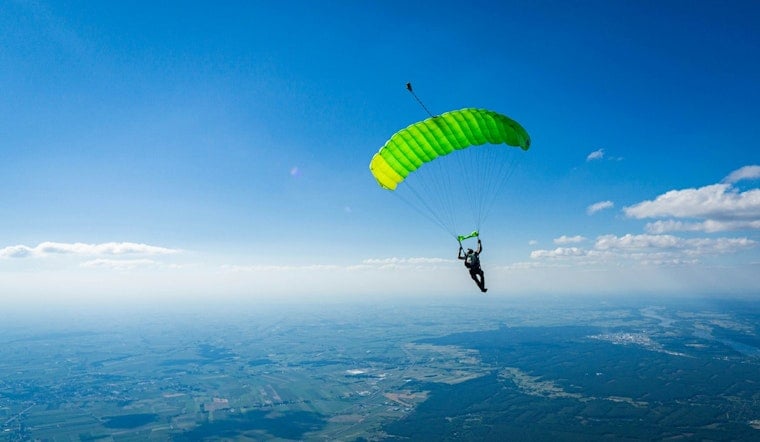
On a brisk Western Washington weekend, Kirkland quadriplegic skydiver Tania Finlayson suited up for what might be her boldest leap yet, a family tandem jump that her team says hit roughly 125 miles per hour after exiting the plane at nearly 18,000 feet. She shared the dive with her husband, Ken, and their 20-year-old son, Michael, and the trio’s descent is being talked up as a possible Washington droguefall speed and altitude record. For Finlayson, who has already logged dozens of jumps, the explanation for why she keeps going back to the sky is short and to the point: “Skydiving feels like freedom.”
As reported by KIRO 7, Ken described the family outing as “the highest and fastest droguefall yet,” and reporter Brandon Thompson noted that Finlayson’s jump tally now stands at 53. ABC News reported the drogue-assisted fall was clocked at about 125 miles per hour, a number that, according to KIRO 7, the family intends to submit for consideration as a state record.
ABC News also reported that Finlayson, who was born with cerebral palsy and is nonverbal, relies on a customized communication system when she gives interviews. The outlet noted that the tandem jump began from nearly 18,000 feet, and that drogue systems are used in tandem skydives to help regulate fall rate, with the jumpers’ top speed again estimated at roughly 125 miles per hour.
How the claim will be verified
Turning a headline-making jump into an official skydiving record is not as simple as uploading a viral video. The United States Parachute Association describes a drogue as a “trailing drag device” that helps control a tandem skydive, and notes that formal record submissions usually require solid data such as altimeter or flight information, along with a review by certified officials, before any performance gets the official stamp.
Finlayson's record track and local impact
Finlayson is no stranger to record books. She already appears in Guinness World Records for a 2023 challenge in Redmond, where Tatiana Finlayson drove a chin-controlled motorized wheelchair 312 kilometers in 24 hours to raise money for the ALS Association. That kind of high-profile, accessibility-focused effort helped rally local organizers behind this latest skydiving attempt, and they say they will gather and submit the necessary documentation for formal verification.
Record or not, Finlayson and her family say the bigger mission is about who gets to feel welcome in extreme sports. “It’s not really about chasing records for the sake of the record,” she told reporters, adding that she wants moments like this to “support others in moving forward,” as reported by KIRO 7.





