

























































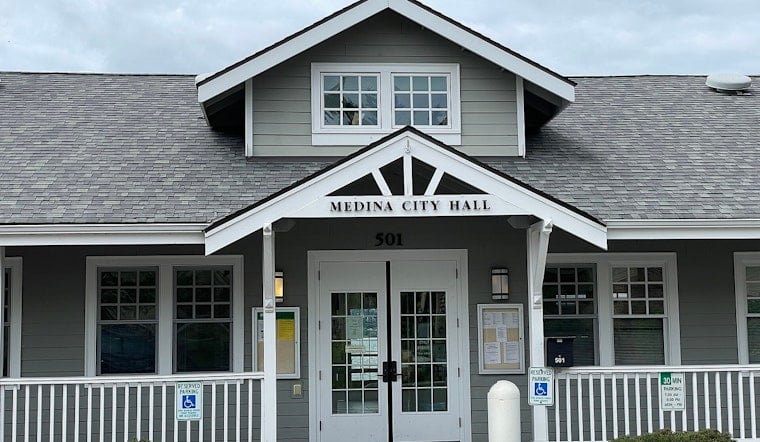
Medina’s fight over what counts as “too big” on its ultra-pricey shoreline has gone official. On February 23, the City Council rushed through emergency building rules after a wave of complaints about an oversized waterfront house that neighbors say looms over their backyards.
The interim ordinance tightens side-yard setbacks, forces landscaping where homes intrude into those setbacks, removes a long-standing height bonus and slaps new limits on exterior lighting and noisy water features. The rules took effect immediately and are set to last six months while staff and the planning commission work on permanent code changes.
What the rules do
The emergency measure rewrites several sections of the Medina Municipal Code to make bulky “maxed-out” homes harder to build.
Key changes include:
- Increasing side-yard setbacks, so houses sit farther from property lines.
- Requiring new planting when any portion of a building extends into a setback area.
- Banning permanently installed water features located in setbacks if they can be heard from neighboring properties.
- Eliminating the bonus-height option that previously allowed extra building height.
The ordinance also tells owners of vacant homes to keep interior lights off when a structure is unoccupied, and it restricts exterior lighting that creates “light trespass” onto neighboring properties. As detailed in Ordinance No. 1052 from the City of Medina, the council declared an emergency so the new rules would kick in immediately rather than waiting through the usual legislative timeline.
Why the council acted now
The flash point is a new residence at 3217 Evergreen Point Road, a waterfront project that has turned into a neighborhood villain of sorts. Residents complained that the house is massively out of scale and boxes in nearby yards. That angst tapped into a broader unease about “maxed-out” lots across the city, where big, boxy homes are crowding right up to their allowed limits.
Deputy Mayor Randy Reeves told colleagues that the Evergreen Point build “cannot be allowed to happen again on our watch,” and Development Services Manager Steve Wilcox labeled the trend the “Medina megabox,” according to reporting from The Urbanist. The council adopted the interim controls on a 5–1 vote, with Councilmember Heija Nunn casting the lone “no,” according to the same reporting.
State law and the city’s growth target
Medina’s crackdown comes while it still has to show room for more housing under county and state rules, even if that number is small by regional standards.
A 2024 land capacity analysis found the city is short 19 housing units compared with the growth target King County assigned it to plan for. The analysis also concluded that Medina lacks zoning that would realistically support housing affordable to households at or below 80 percent of area median income, and it recommended the city explore zoning options that demonstrate capacity for those units.
Washington’s HB 1220, adopted in 2021, added income-targeting requirements and other obligations to local comprehensive plans, outlining how cities must plan for housing across income ranges. Medina’s 2024 land-capacity analysis and the enacted bill HB 1220 say those requirements are now part of the planning framework the city has to follow, according to the Washington State Legislature and city documents.
Local scale and politics
In a place where the average home value hovers around $4.4 million and minimum lot sizes run roughly 16,000 to 30,000 square feet, the stakes of every design tweak are high. Those market figures and lot-size details were reported by The Urbanist.
City leaders argue that tightening bulk standards will push redevelopment toward less bulky, duplex-style layouts instead of single-family “max-outs” that build right up to every limit on the books. Critics counter that without strong affordability tools, stricter rules on house size risk locking in existing exclusionary patterns, simply reshaping the luxury market rather than opening the door to more attainable homes.
Next steps
The ordinance requires a public hearing within 60 days, and the council has scheduled that hearing for April 14, 2026. The planning commission has also been tasked with drafting permanent bulk standards for council review.
Under Ordinance No. 1052 from the City of Medina, the interim controls expire after six months unless renewed and apply only to permit applications filed after the ordinance’s effective date. Residents who want to weigh in can testify at the April hearing or submit written comments through the city’s usual public records and meeting channels.
Legal risk and precedent
There is also a legal line Medina needs to watch. Cities that tighten local regulations while still having to show enough capacity for affordable housing can invite scrutiny under Washington’s Growth Management Act. Recent decisions and appeals have put several Eastside jurisdictions under closer review.
Municipal advisors say Medina will need to document clearly how any permanent code changes still allow the city to meet its county and state planning obligations. For context on how recent hearings and guidance are shifting review of local housing plans, city officials have pointed to the Municipal Research and Services Center’s overview of recent decisions and compliance questions.
For now, Medina’s emergency rules are the new referee for what gets built on some of the region’s priciest large lots, as the city tries to juggle neighbor complaints, land-use law and a small but binding growth mandate. The April hearing will be the next big stage for residents and advocates to argue over where “too big” really begins.



