

























































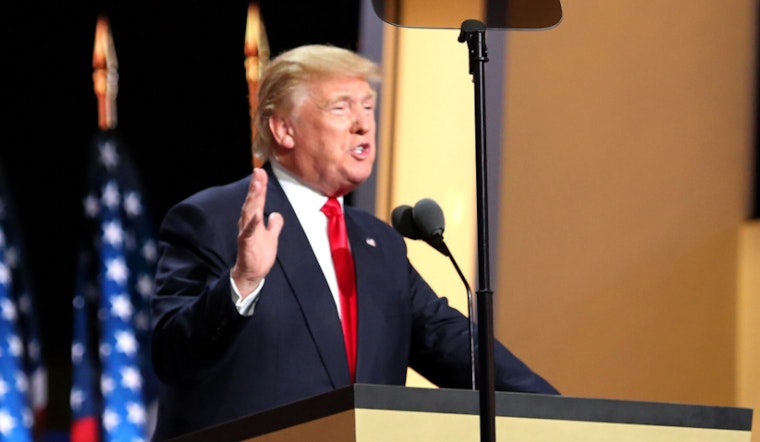
President Donald Trump warned on Thursday that he may slap a “big tariff” on the United Kingdom if London does not roll back its digital services tax, sharply escalating a trade spat that has hovered over U.S.-UK relations for years. Speaking from the White House, Trump put fresh pressure on British officials and on American exporters who could be caught in the crossfire through retaliation. The threat revives a long-running fight over how countries tax global tech platforms, a dispute that has already shaken markets and complicated trade talks.
The remarks were captured in an Oval Office appearance recorded and released by local TV outlet FOX 13 Seattle and then picked up widely, including by Sky News. Trump told reporters that “we’ve been looking at it and we can meet that very easily by just putting a big tariff on the UK,” and warned Britain to “be careful.” The comments echo earlier administration threats and land as U.S. officials reassess how hard to lean on allies over taxes targeting American tech giants.
What the digital services tax targets
The UK’s digital services tax is a 2% levy on revenues that large internet platforms earn from UK users, designed as a temporary stopgap introduced in April 2020 while global tax rules were being negotiated. As explained by Euronews, London and several other governments argue that the tax ensures big tech firms pay up in countries where they actually make money, while U.S. authorities contend it unfairly singles out American companies.
London pushes back
UK officials have defended the levy as a reasonable way to tax digital activity and have kept it on the table even as talks with Washington continue. Bloomberg reports that a Treasury spokesperson has described the Digital Services Tax as “fair and proportionate.”
Legal backdrop: what the president can (and can’t) do
The latest tariff talk arrives against a messy legal backdrop. In February, the Supreme Court ruled that the administration overstepped when it relied on the International Emergency Economic Powers Act to impose sweeping tariffs, a decision that effectively gutted earlier “Liberation Day” levies. Since that ruling, the White House has shifted to more limited, temporary authorities under Section 122 of the Trade Act. As Supreme Court torches Trump tariffs and PBS explain, the decision narrowed the administration’s options and means any new duties would be constrained both legally and politically.
Why U.S. businesses and markets should watch
Even if a new U.S. tariff on the UK were pitched as a way to claw back money tied to tech firms, economists point out that higher duties tend to ripple through supply chains and show up in consumer prices. Financial markets have reacted sharply to broad tariff threats in the past, and trade groups and importers in cities such as New York and Washington say the uncertainty alone is already complicating their planning. Bloomberg has tracked how earlier rounds of tariffs pushed up firms’ costs and affected hiring decisions.
After Thursday’s remarks, White House officials did not spell out any timetable or specific tariff rate, leaving the threat sitting more as leverage than as an imminent policy shift. The video released by FOX 13 Seattle shows Trump casting the move as a straightforward defense of U.S. interests. British and American negotiators now face a short window to decide whether this fight gets settled at the bargaining table or at the border.




