

























































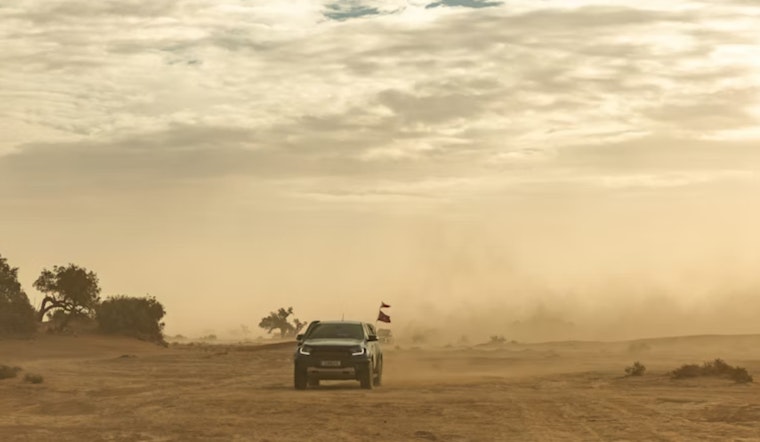
Airborne desert dust is doing more than just dirtying windshields, according to new work from UCLA researchers. Their study finds that dust floating high in the atmosphere traps nearly twice as much longwave heat as most climate models currently estimate, a correction that could sharpen both short-term weather forecasts and long-range climate projections.
The team reports a clear heating effect from dust that does not cancel out the particle's cooling impact from reflecting sunlight, but does shift where models place surface warming and evaporation. That shift matters for regions downwind of major deserts and for parts of California that generate their own dust.
What the study found
Published April 28 in the peer-reviewed journal Nature Communications, the paper blends satellite observations, aircraft measurements, climate simulations, and meteorological records to pin down dust's longwave direct radiative effect.
The authors estimate a global mean longwave heating of +0.25 B1 0.06 W/mB2, nearly double what many climate models currently simulate. They argue that leaving out longwave scattering and very large dust particles leads to biased surface energy fluxes and knock-on errors in clouds and precipitation.
The size problem: coarse particles pack the punch
Lead author Jasper Kok and colleagues report that very coarse dust, particles so large that many models barely count them, is doing an outsized share of the heating. The team estimates about 20 million metric tons of very coarse dust suspended in the atmosphere, "the mass of roughly 4 million African elephants," and says current models capture only about a quarter of that load.
"Improving how models represent warming caused by dust could therefore help improve both weather forecasts and climate projections," Kok said, as reported by Phys.org. In other words, get the big chunks right, and the forecasts should get sharper.
Dust sources and historical trends
The researchers highlight the planet's major desert belts, including the Sahara and the Gobi, as major sources of airborne dust. They also point to human-altered landscapes, such as drying lakebeds and disturbed soils around the Salton Sea, Owens Valley, and the Great Salt Lake, as important contributors to the dust loads of today.
According to EurekAlert, the team finds that atmospheric dust increased through much of the 20th century, peaked in the 1980s, and still sits above pre-industrial levels.
Why forecasters should care
Because dust scatters Earth's thermal radiation back downward, models that skip that physics tend to underplay localized surface warming and can misplace where evaporation and precipitation show up, the authors warn. That kind of error can ripple into everything from storm tracks to snowpack estimates.
To help fix that, the team has made its data and analysis public. They deposited observationally constrained data in Zenodo and posted code that lets others test updated dust parameterizations, giving operational forecast centers a ready starting point, as outlined in Nature Communications.
What it means for Los Angeles
For Southern California, the study is not just an abstract global story. Local dust sources and seasonal winds can loft coarse particles into the Los Angeles basin, which means better dust physics in models could matter for day-to-day forecasts and for long-term water-resource planning.
We first flagged this work after seeing coverage on MyNewsLA, which noted UCLA's accompanying materials listing funding support from the National Science Foundation, NASA, and the Department of Energy.





