

























































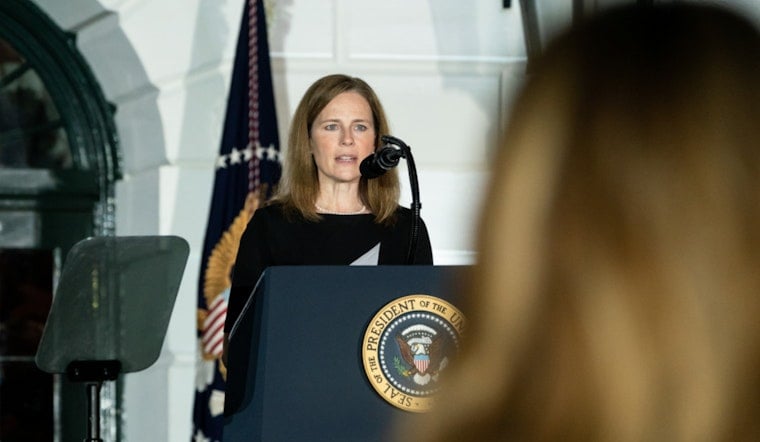
Fairfax County police rushed to Supreme Court Justice Amy Coney Barrett’s Northern Virginia home on Wednesday night after a caller claimed there had been gunfire and an argument at the address. Officers quickly linked up with the Supreme Court Police assigned to the residence, checked the property and determined the report was a hoax. Authorities said Barrett and her family were safe, and they did not immediately say whether they had identified a suspect.
Dispatch Audio Captures Tense Moments
The call hit Fairfax County dispatch just after 9 p.m., reporting “two or three gunshots” and people arguing at Barrett’s address, according to dispatch audio obtained by Bloomberg Law. In the recording, a dispatcher tells responding officers they have been unable to reach the original caller and flags the possibility that “it’s going to be a swatting situation.”
Officers arrived, coordinated with the on-site Supreme Court Police security detail and searched for any sign of a shooting or disturbance. They found none.
Fairfax Officers Move In, Then Stand Down
Fairfax County Police told FOX 5 DC the report came through the department’s non-emergency line, not 911. Even so, officers “immediately coordinated with Supreme Court Police personnel” already posted at the home.
After speaking with the security team and checking the area, the department said officers cleared the call without summoning SWAT or other tactical units. Officials have not announced any arrests or named any suspect tied to the hoax.
Why Swatting Is Not Just a Prank
The Department of Homeland Security defines “swatting” as a malicious hoax in which someone reports a fake violent emergency to trigger an armed law enforcement response, according to DHS. It is the kind of stunt that, in a worst-case scenario, can end with officers storming an unsuspecting home, putting both residents and police in danger.
The FBI has estimated that hundreds of swatting incidents occur across the United States each year, a volume that has drawn increasing federal attention and resources. Beyond the immediate risk, officials warn that swatting ties up phone lines, dispatchers and patrol units who might otherwise be dealing with real emergencies.
Mounting Threats Around the High Court
The Supreme Court justices have had round-the-clock security since 2022 after a high-profile leak and a spike in targeted harassment, Bloomberg Law has reported. Officials say threats against judges have climbed in recent years, part of a broader wave of hostility toward public officials.
Last year’s anonymous pizza deliveries to judges’ homes, also noted by Bloomberg Law, highlighted how easily personal details can be misused to harass or intimidate. And the 2022 attempted attack on Justice Brett Kavanaugh, for which the defendant later pleaded guilty, remains a stark reminder of how quickly threats can move from online bluster to real-world violence, according to The Associated Press.
Criminal Penalties and a Federal Lens
When a swatting incident crosses state lines or targets federal officers or facilities, it can bring federal charges on top of any local cases. Prosecutors have in recent years gone after members of online groups accused of placing hoax calls, the Justice Department notes.
The U.S. Attorney’s Office recently filed charges linked to an online collective accused of making swatting calls at universities, illustrating how these cases can land in federal court, according to the Justice Department.
Fairfax County authorities, working with federal partners, are investigating the hoax call involving Barrett’s home. The county has not said whether they have identified anyone behind the incident. This story will be updated as law enforcement releases additional details.





.jpg)