
























































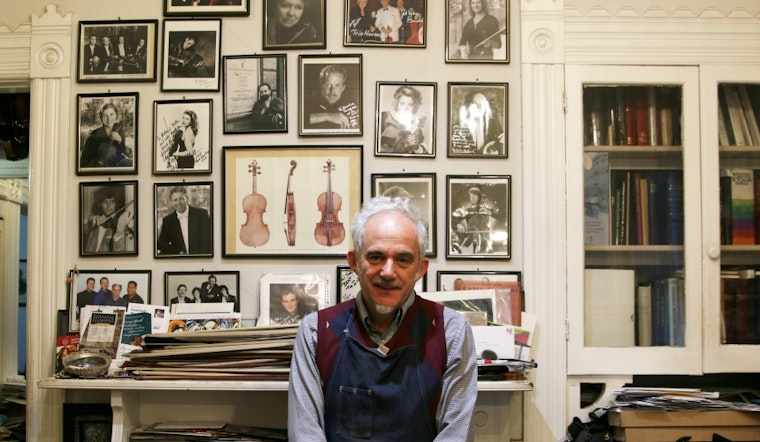
Some of the Bay Area's best musicians (and some of its newest) have walked up the unassuming staircase and through the second-floor door at 551 Divisadero St. to the eponymous shop owned by Roland Feller and his wife, Lois. Specializing in the sale and repair of violins, cellos, and violas, the shop has been on Divisadero since 1989, serving everyone from youngsters purchasing their first violin to world-renowned musicians. We recently sat down with Roland to learn about his craft and his time along Divisadero.
Where are you from? How long have you been in San Francisco, and how long in the neighborhood?
I’ve been in the neighborhood since 1989. Before this location on Divisadero, I had a shop at Masonic and Geary for a dozen years. Prior to that, I was working for someone downtown for three years, and before that, I was working in New York. I went to violin-making school in Germany, and I’m originally from Switzerland.
Can you tell us a bit about your time on Divisadero?
Back in the '80s, when I was looking for a larger space for my shop, this was still a pretty rough neighborhood, and I had mixed feelings about it. But it felt like something was going to happen for the better.
I figured it was probably my only chance to have my own place, or at least to have some control over future rents. Buying this shop was probably one of the best things I ever did, because I couldn’t afford it now, for sure.
There are lot of people unhappy about the gentrification that has taken place in the neighborhood. How do you feel about it?
It’s a mixed bag, no question about it. It’s nice to see families pushing kids in strollers; when I moved here, you couldn’t see anybody on the sidewalk after dark. People were scared to be out, and even for me, it was a little scary at times. Whereas now, you sometimes can’t get through the crowds on the sidewalk—it’s just unbelievable. So there are good things, but on the other hand, a lot of people who were renting had to move out. That’s the negative part.
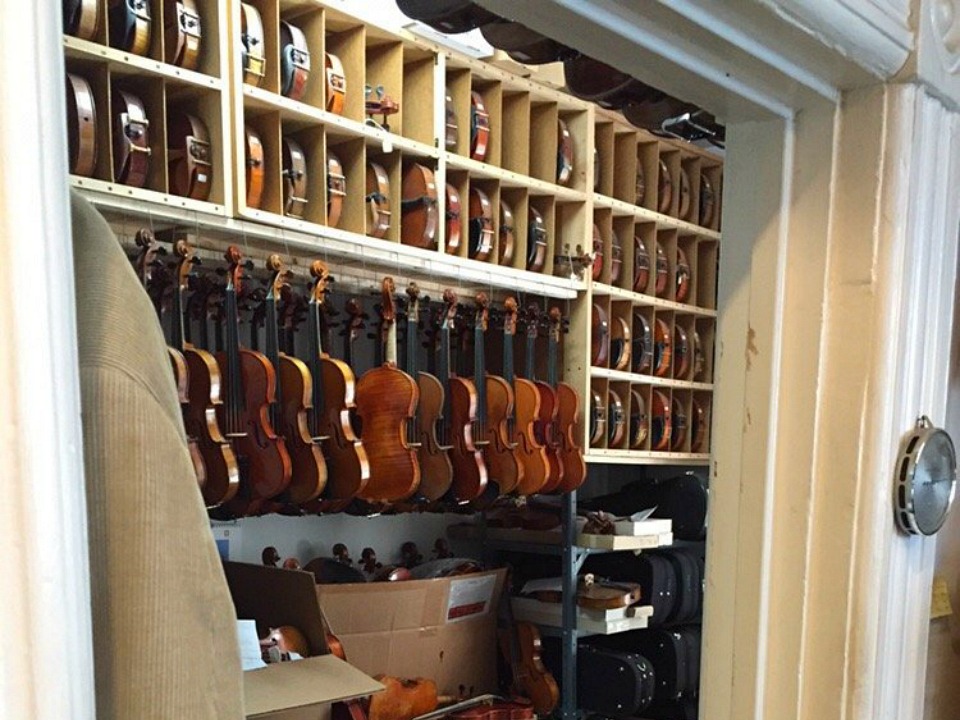 Photo: Michael S./Yelp
Tell us a little bit about your craft. What is it about violins? What drew you to them?
I grew up playing the cello as a hobby. When I was 11 or 12, my dad took me to a violin shop to buy my first full-size instrument. I looked into the shop and saw a guy carving a cello bridge, and I just thought that was the neatest thing, that they could cut wood with a knife. I always enjoyed working with my hands, so I felt like this craft would combine two things I loved: music and woodworking.
So my parents sent me to a violin-making school in Bavaria, where they’d been making violins for 250 years or so. Later on, I got a job offer in New York. I was 19 years old, and had a chance to work in what was one of the top shops in the world, Rembert Wurlitzer.
There, I worked with an Italian violin restorer, Simone Fernando Sacconi. He is looked at by many people as maybe the most important violin restorer of the 20th century. He had the knowledge of instruments, making, and restoration; Rembert Wurlitzer himself was a trained violin maker, but he was more of an expert businessman. They made a fantastic team, and all the great musicians in the world would go there. I was so amazed.
Sacconi asked me if I was interested in coming in on Saturday, when the shop was closed, to learn the Cremonese way of violin-making. He knew I was trained in the German tradition, but he came from Italy and was trained in the Cremonese way. Cremona, near Milan, is where all the great makers lived: Stradivari, Amati, Guarneri. Of course, I was thrilled. I was this nobody, and this great teacher was offering to teach me his way.
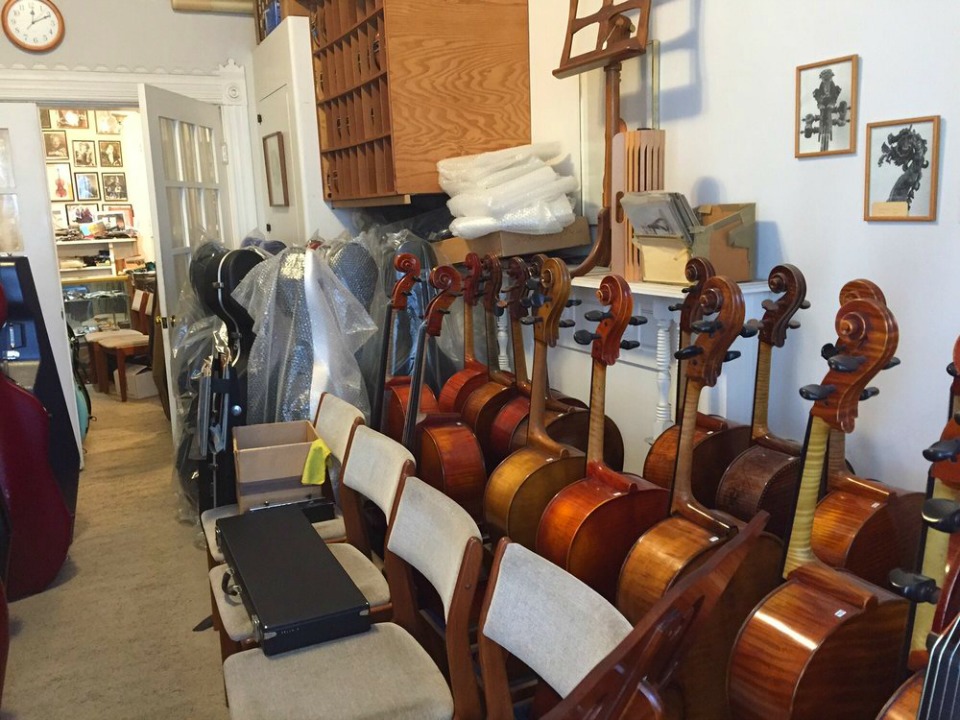 Photo: Clarice O./Yelp
In your decades of experience, you’ve probably come across some amazing instruments. Can you tell us about them?
When I was in New York, the shop I was at had a lot of famous instruments, including the Duport Strad. A lot of the instruments were given the names of their owners at the time, and there was a famous cellist in the 1800s, by the name of Duport. He had owned that cello, and it was sitting in the shop, because it was for sale at the time. I asked if it’d be okay if I played a few notes during my lunch hour. I played it, and I had a lot of fun playing on it, and then that turned out to be the cello that would be Rostropovich’s cello. He was like the Yo-Yo Ma of a previous generation.
I tell people that story when they say, “If only I had the instrument that he or she has, I could sound like that.” I played the cello that became Mr. Rostropovich’s, but I can tell you now that when I played it, it didn’t sound that great, because I’m just an amateur player. Now Yo-Yo Ma or Rostropovich could make any instrument sound great, and a great instrument sound even better. But too many people think it’s the instrument that makes somebody great. No, it’s the talent and hard work that makes them great.
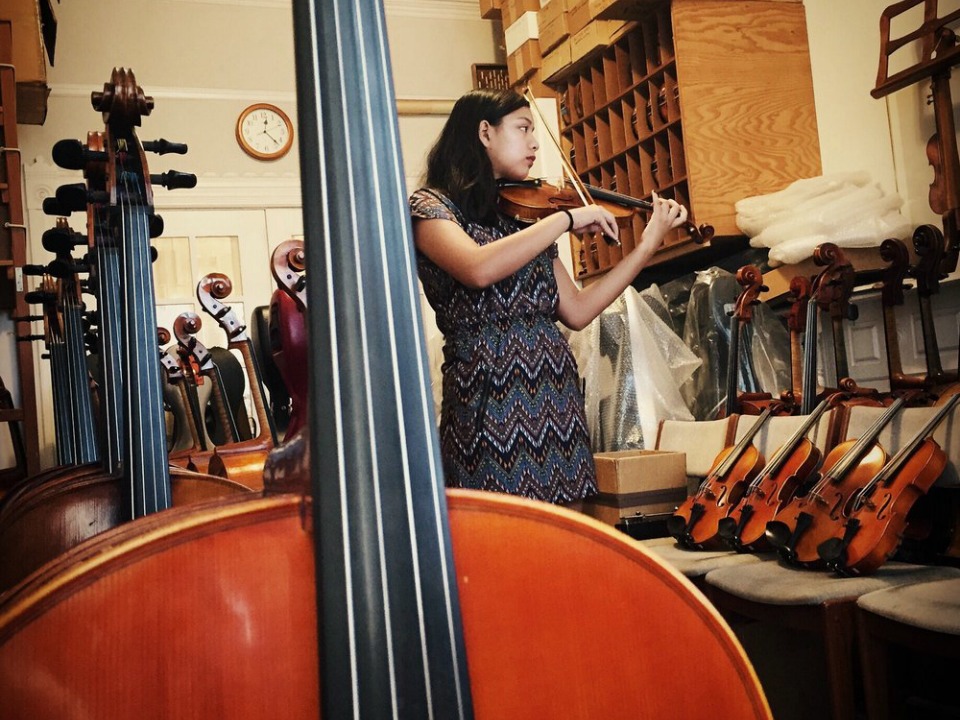 Photo: Clarice O./Yelp
What’s your sense of how many people play cello and violin now? Do you think kids play as much now as in the past?
In the Bay Area, a lot of kids are still playing, particularly in the Peninsula and among Asian families. It’s quite remarkable, actually, when you think of all the youth orchestras around here: the San Francisco Youth Orchestra, several youth orchestras down the Peninsula.
There were youth orchestras when I came here 40 years ago, but the level of playing has gone up. You hear some of the youth orchestras, and you’d think it’s a professional orchestra—it’s quite impressive. The sad thing is that so many people who have the talent are unlikely to make a living playing, because there are so few jobs.
With that said, how do you feel about the future of your instrument?
I’m an optimist by nature, although I do worry at times. As a whole, in this country at least, I don’t think there’s as much emphasis on music compared to Switzerland, where I grew up. Switzerland has roughly the same population as the Bay Area, but there, you have a professional orchestra in Geneva, one in Basil, one in Zurich, one in Bern, not to mention an opera and all that, for about eight million people.
Here, you have the San Francisco Symphony, which you could make a good living at if you’re at the top level. But the San Jose Symphony went under, and Oakland folded its tent. To me, that seems sad, particularly for San Jose, which is such a wealthy area. That they can’t support an orchestra is very hard for me to understand.
Part of the problem, of course, is that so much music got cut out of the schools. The schools have instruments that were good decades ago, but they’ve been so neglected, because there hasn’t been any money. Music is always the first to get cut. This is sad, because to me, music is an important as learning a language. I can’t imagine life without music. It doesn’t have to be classical, it could be any music. Music is part of culture, part of life.



