

























































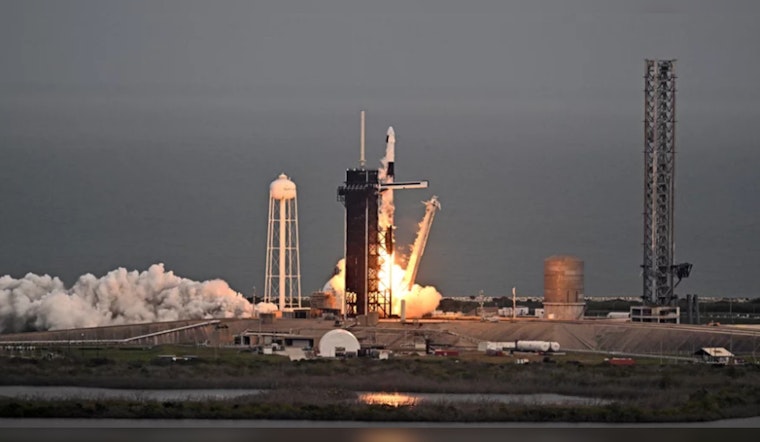
The frontier of private space travel has expanded once again as Axiom Space, the Houston-based company, launched its third paid mission to the International Space Station (ISS) on Thursday. Lift-off occurred at NASA's Kennedy Space Center with a SpaceX Falcon 9 rocket delivering an all-European crew to the space station's orbiting laboratory. The "Ax-3" mission, as it is known, was executed after an initial delay which required additional time for pre-launch checks, including assessments of the parachute system, NPR reported.
Aboard the flight, there’s history being made, with Alper Gezeravcı of Turkey asserting his role as the first Turkish astronaut to venture into space claiming "This spaceflight is not a destination but a journey, this is just the beginning of our journey - for a long growing space journey in our future," according to his poignant words in an NPR interview. The Crew Dragon spacecraft, Freedom, carrying the Ax-3 mission, has a history of its own as this marks its third trip to the ISS.
The crew, which includes former NASA astronaut and now Axiom chief astronaut Michael López-Alegría, who holds American and Spanish citizenships, is accompanied by Walter Villadei of the Italian Air Force and Marcus Wandt of Sweden, in addition to Gezeravcı. López-Alegría, commanding the mission, is embarking on his sixth spaceflight and was quoted in a Houston Chronicle interview expressing the rarity and privilege of the opportunity, whereas Swedish astronaut Wandt noted the surprising amount of training for everyday space living, from space dining to securing items in a zero-gravity environment.
During their two-week stay on the ISS, the multicountry crew will be busy conducting various experiments designed to further the understanding of spaceflight's effects on humans and plants, and experimenting with an AI-powered, free-flying robot aimed at assisting crew members; over the past 25 years, the ISS has welcomed visitors from 21 different nations—a legacy of international cooperation in space exploration, as noted by Dana Weigel, deputy manager for NASA's International Space Station Program and quoted in the Houston Chronicle.
Axiom Space's mission continues to bridge the gap between state-sponsored and private space ventures allowing more nations to have a spot at the table of space exploration, they anticipate their new commercial space station's initial module to be in orbit by late 2026 and this particular mission serves as a stepping stone, a proving ground for operating such monumental off-earth missions.




