

























































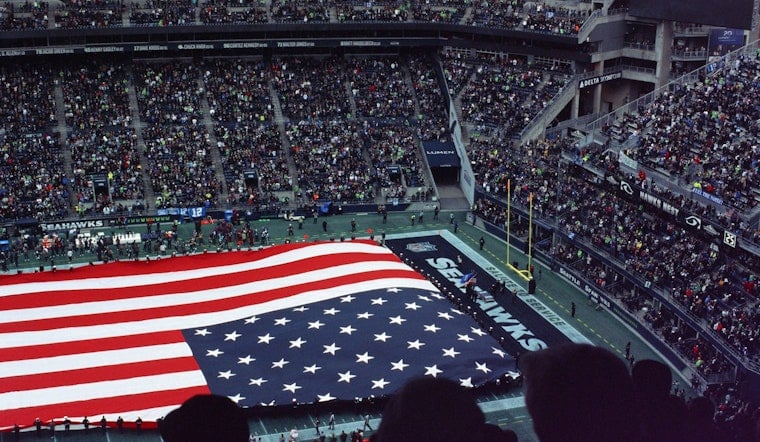
The man who owned a slice of the San Francisco 49ers is about to own the team that humiliated them. Vinod Khosla — Menlo Park venture capitalist, Sun Microsystems co-founder, and, for the last year, a limited partner in the Niners — has agreed to buy the Seattle Seahawks, the defending Super Bowl champions who wrecked San Francisco's season twice and then hoisted the Lombardi Trophy in Santa Clara. If the league signs off, the Bay Area's most litigious billionaire will spend his Sundays rooting for the enemy, and NFL rules will force him to dump his 49ers stake to do it.
A record price, and a Khosla family affair
The Khosla family entered into a formal agreement to purchase the Seahawks for $9.612 billion, a source told the Associated Press, which would make it the richest sale in NFL history — comfortably past the $6.05 billion the Josh Harris group paid for the Washington Commanders in 2023. Owners have reportedly been asked to hold a date in late August for a special meeting to vote, per ESPN.
It's not just Vinod. According to an NFL memo described by Sportico, his wife Neeru Khosla — co-founder of the CK-12 education nonprofit — would serve as control owner, with son Neal Khosla, CEO of AI health startup Curai, taking a significant leadership role. The group reportedly beat out rival bidders including one led by Aditya Mittal, and the proceeds from Paul Allen's estate are bound for philanthropy, a point Khosla flagged himself on social media, Seattle Sports reported, before adding he'd say nothing more until the deal closes.
The Niners stake he now has to sell
Rewind to May 2025, when the York family sold roughly 6.2% of the 49ers to three Bay Area venture families — the Khoslas, Griffiths and Deeters — at a valuation north of $8.5 billion, as NBC Sports reported at the time. Khosla's piece was 3.1%, worth something in the neighborhood of $265 million at that price. Fortress executive Pete Briger later joined the same ownership tier at a similar valuation, 49ers Webzone noted.
Now the NFL memo says the quiet part loudly: the Khosla family would be required to divest that limited-partner interest, a stipulation flagged by Niners Nation. Cross-ownership inside a division is a nonstarter, and the NFC West is the last place the league wants a man holding paper in two clubhouses. The awkward footnote for Jed York: a stake sold at an $8.5 billion mark a year ago is being traded for control of a division rival at $9.6 billion — which suggests the Yorks may have priced their own franchise conservatively right before the market went vertical.
Why this stings in Santa Clara
Seattle didn't just beat the 49ers last season; it took everything from them. A 13-3 Week 18 loss at Levi's Stadium cost San Francisco the NFC West and the No. 1 seed — and with it, the shot at playing a Super Bowl at home — dropping them to the sixth seed, as Yahoo Sports laid out. The Niners upset Philadelphia on wild-card weekend, then got dismantled 41-6 in Seattle in the divisional round, a night that began with a 95-yard kickoff return touchdown, according to 49ers.com.
Then came February 8: the Seahawks beat the Patriots 29-13 at Levi's, on the 49ers' own field, in a stadium the club had poured a fortune into upgrading — Hoodline noted back in 2023 that the venue was gearing up for its Super Bowl 60 and World Cup double-header with a $120 million league loan. The 12s took over San Pedro Square, downtown San Jose threw a sold-out Kehlani block party outside City Hall, and the confetti fell green and blue. HBO is now embedding with the champs; Hoodline reported in March that Hard Knocks is filming Seattle's title defense starting August 11. Rub, meet salt.
The steward problem
In his statement, Khosla called the family the next "stewards" of the franchise — a word that lands strangely for anyone who's driven Highway 1 past a locked gate seven miles south of Half Moon Bay. Khosla paid $32.5 million in 2008 for 89 acres that include Martins Beach Road, the only overland route to a cove families had used for generations, then locked it, posted guards and put up no-trespassing signs, per the San Francisco Examiner.
He lost at trial, lost on appeal, and in 2018 the U.S. Supreme Court declined to hear his case, leaving intact a ruling that closing the gate required a Coastal Act permit — a result the Surfrider Foundation still counts as a landmark. Since then, access has been intermittent, with a parking fee at the gate, as KQED has explained. He has also floated selling permanent public access for $30 million — nearly what he paid for the whole property, and roughly 0.3% of what he's now spending on a football team.
Legal implications
Two clocks are running. The first is league process: the sale requires ratification by NFL membership, with owners reviewing transaction documents and due diligence before an expected August vote, and the Khoslas' 49ers divestiture is a condition of approval, per the league memo cited by Yahoo Sports. Whoever buys that 3.1% slice will do so in a market where a division rival just traded at $9.6 billion.
The second is in San Mateo County Superior Court, where the California Coastal Commission and State Lands Commission's 2020 suit against Khosla's LLCs — arguing a century of public use created a permanent right to the road — has been repeatedly stayed for settlement talks rather than tried, according to the San Francisco Examiner. Owning an NFL franchise is a public-facing job in a way venture capital never is; a decade-plus fight with the state over beach access is precisely the kind of baggage that follows a name onto a jumbotron. Seattle's fanbase is famously proprietary about its 12th man, and it will be watching how a Silicon Valley billionaire defines "public."
For Bay Area fans, the arithmetic is simpler and crueler. The team that took the division, the No. 1 seed, the home Super Bowl, and the trophy from the Niners will now be owned by a guy who, until this weekend, was technically on their side.





