

























































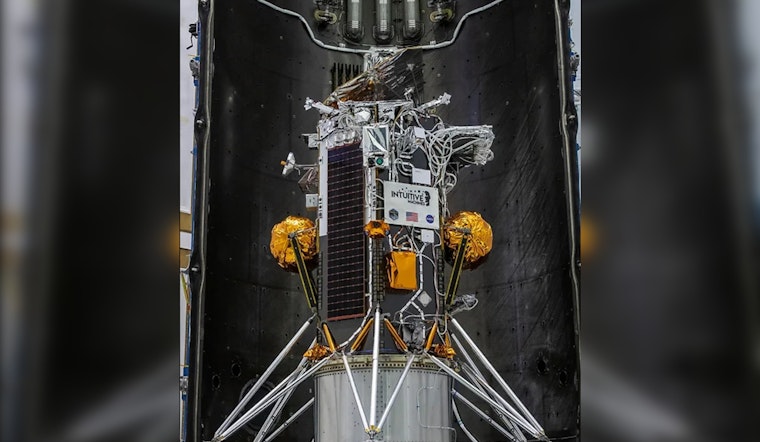
The space race has taken a new turn with the U.S. and China competing to set a presence on the Moon, and the stakes are as high as ever. According to a recent Houston Chronicle report, Houston's Intuitive Machines is scheduled to make a landmark soft landing on the Moon near the South Pole on February 22, a feat not achieved by the U.S. since December 1972. This mission is emblematic of the broader scramble to establish norms and rules for lunar activity among nations and corporations eyeing everything from science to resource extraction on the celestial body.
NASA Administrator Bill Nelson told the Houston Chronicle, "We are in a space race with China," drawing parallels to China's assertive territorial claims in the South China Sea and expressing concerns about similar scenarios unfolding on the lunar surface. Critics fear China could leverage their lunar forays in the same vein, creating de facto territorial claims through infrastructure – similar, to its strategy in maritime disputes.
Concerning international law, the Outer Space Treaty, which prohibits national appropriation of the Moon, lacks clarity and enforcement according to experts. The U.S. has sought to define engagement on the Moon with the Artemis Accords, gaining the buy-in from 34 other countries. However, China and Russia have remained aloof, choosing to forge their path. As Michelle Hanlon, from the University of Mississippi's Center for Air and Space Law, noted in the Houston Chronicle, "There are going to be conflicts."
American space ambitions face challenges, with NASA's Artemis missions, including a crewed lunar landing, pushed back to 2026. According to The National, planetary geologist Gordon Osinski said that despite this,"With this schedule and assuming no more delays, America and it’s international partners should still be there first." ahead of China's aim for 2030. Meanwhile, Congress expresses concern over the country's capacity to remain ahead in the race. Frank Lucas, a committee chairman, emphasized the geopolitical implications of lunar presence, noting that "The country that lands first will have the ability to set a precedent for whether future lunar activities are conducted with openness and transparency, or in a more restricted manner." which he conveyed during a hearing on the Artemis plan.
Both Intuitive Machines and heavy hitters in the aerospace industry like SpaceX and Blue Origin are being leveraged to accelerate the U.S. timeline back to the moon. But as Mojtaba Akhavan-Tafti, an expert from the University of Michigan, indicated in The National, NASA learned from the past and is now prioritizing "sustainable space operations," through commercialization of the process, rather than Apollo-era publicity stunts. China is also ramping up its space program with the Long March 9 rocket and the Tiangong space station already in orbit. As nations jockey for position in this new celestial contest, NASA and others push the boundaries of technology to ensure a safe, and if possible, first, return to the Moon.




