

























































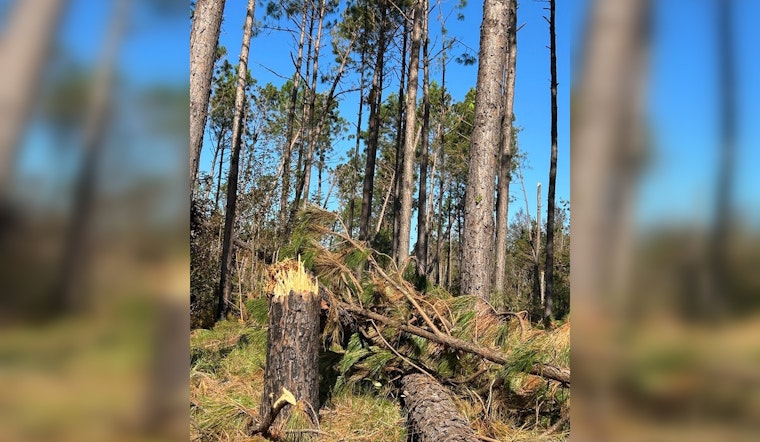
Georgia's stature as the leading timber-producing state in the U.S. faced a staggering blow in the wake of Hurricane Helene, as reported by Atlanta News First and echoed by WRDW. September's hurricane inflicted a $1.2 billion hit on the $4 billion industry, compromising the livelihood of numerous timber farmers, for whom these trees are akin to a retirement account.
With roots extending deeply into the earth, the trees that once stood as testimony to the natural wealth of the region—stretching from Valdosta to Augusta—were uprooted by winds reaching 110 miles per hour, in a devastation that spanned one of Georgia's most expansively forested areas, causing not just an ecological but an economic peril to the very heart of these communities that could not easily recover, not in the least because timber requires decades to mature.
According to Tim Lowrimore, President of the Georgia Forestry Association, speaking to Atlanta News First, an estimated "90% of the timber impacted will be lost," with the remaining 10% potentially salvageable, a grim prospect for an industry vital to the state's rural, forest-based economies. Beyond timber production, healthy forests contribute to cleaner air, cleaner water, and carbon sequestration, supporting environmental wellness alongside the production of material goods.
The situation is further complicated by a market contraction in recent years. Data from Forisk Consulting shows a decline in wood prices following a pandemic-era peak, adding to the industry's recovery challenges. The uncertainty for timber producers is significant, and whether they will replant remains uncertain given current economic conditions. This hesitation could have long-term effects on Georgia's construction costs. Tom Smith of Emory University's Goizueta Business School noted in an interview with WRDW that these challenges could further drive up already-high housing costs, creating a ripple effect throughout the local economy.
Tommy Battle, a fifth-generation owner of Battle Lumber in Wadley, expressed to WRDW the depth of the devastation, revealing his uncertainty about the state's potential to fully recover from such a disaster. Amidst the agricultural ruins and questions of resilience, the governmental response materializes as proposed relief packages, with House Speaker Jon Burns signaling a similarity to the post-Hurricane Michael initiatives that encompassed significant tax credits and aid. As these rural communities grapple with the loss, Georgia turns its eyes to the Capitol, where lawmakers will contend with the relief measures in their biennial January session.





