

























































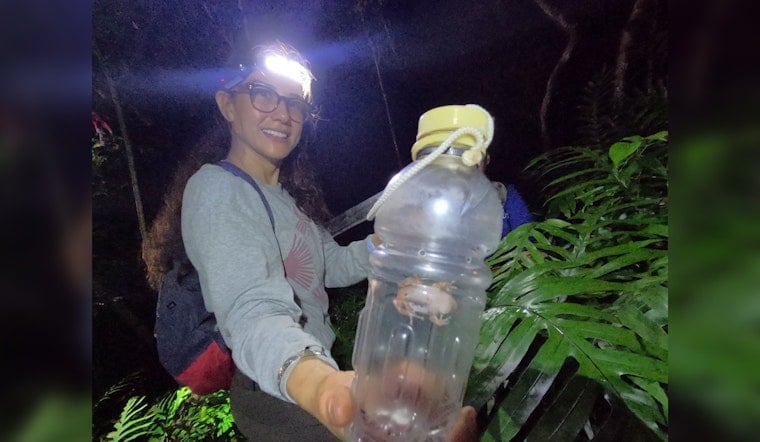
Every Thursday at twilight, volunteers and officials gather in Waimānalo. The invasive coqui frogs, known for their loud calls, threaten the island’s peace and ecosystem. To control their spread, teams search and remove them, protecting O‘ahu’s natural balance. According to a recent report by DLNR, the chorus of these amphibians reaches a noise level comparable to a motorcycle engine, and they're wreaking havoc on native species.
With robust precision, the group, which includes locals and staff from the DLNR Division of Forestry and Wildlife (DOFAW), the Hawaiʻi Department of Agriculture (HDOA), and the O‘ahu Invasive Species Committee (OISC), navigates through the rugged terrain of state lands. “The citric goes through their skin, and it irritates them, basically, and they either move away, or they actually die from contact with the citric,” Ryan Chang, a DOFAW Field Technician, told DLNR. A spray of citric acid becomes a defense when the tiny invaders elude capture, which not only distresses the frogs but doesn't linger long in the environment, lessening any additional ecological impact.
Originating from Puerto Rico, these unwelcome guests were unintentionally introduced to Hawaiʻi in the late 1980s. Surveyors have now noticed a decline in the population of native insects in areas like Hilo, where these coqui frogs have established a sizable breeding ground. The absence of insects is troubling for the indigenous ʻōpeʻapeʻa (hoary bat) and pueo (Hawaiian short-eared owl), which rely on them for food.
The implications of an unchecked coqui population extend beyond the natural. The frogs' incessant croaks disrupt not just the aural environment but the cultural soundscapes that have defined Hawaiʻi for generations. "I think one of the more devastating things is the soundscape of Hawaiʻi is changing. There's rain names, there's wind names, and those things, you know, they're changing with invasive species, especially coqui frog," Chang said in an interview with DLNR. Kimeona Kane, a Waimānalo local and lineal descendent, stresses to volunteers the importance of not acquiescing to this cacophony that was once foreign to their forests. “There’s some comments that people have shared that we’ll get used to it. We shouldn’t have to get used to something that wasn’t here,” he remarked during one of the frog hunts.
"For keiki, they come out and build pilina, or relationship with the place. Kūpuna, they want to see that we’re being present in these spaces and trying to eradicate this invasive species," Chang explained, as noted by DLNR.





