

























































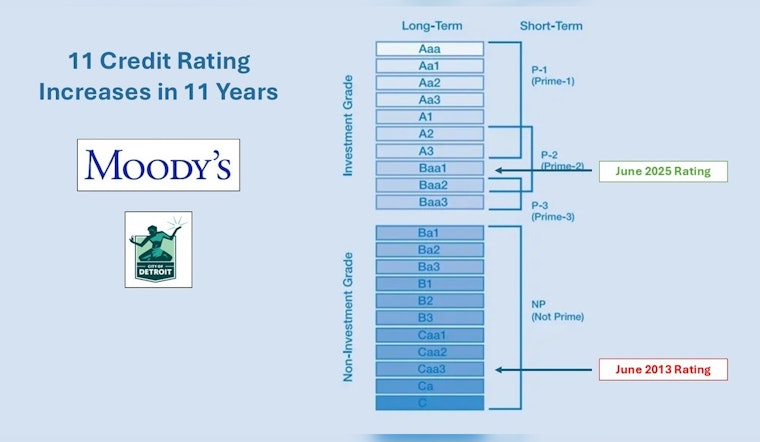
Detroit's economic trajectory continues to be on an upward swing, as evidenced by the latest credit rating upgrade by Moody's Investment Services. The city has received its 11th consecutive upgrade, moving up to Baa1 status with a positive outlook from Baa2. In a statement published on Detroit's official website, Moody's attributed the upgrade to Detroit's solid track record of operating performance and robust reserves, among other factors.
Despite national economic challenges, Detroit's financial stability seemingly remains unshaken. "The city has a track record of solid operating performance, in large part because of its strong governance practices and it maintains robust reserves and low leverage, all of which will help it to weather the adverse effects of an economic slowdown, should one occur," Moody's report indicated, as mentioned on Detroit's official website. This resilience has been fostered over several years, and Moody's believes the city is likely to continue to bolster its financial health. The auto sector does face uncertainties due to trade issues, but Detroit's economic resurgence appears resilient enough to not be significantly hindered, thanks to a pipeline of major projects underway.
Mayor Duggan expressed gratitude to Moody's for the upgrade and highlighted the combined efforts of multiple City officials, including Chief Financial Officers John Hill, Dave Massaron, Jay Rising, and Tanya Stoudamire. He also emphasized the contributions of Detroit City Council in making sound budget decisions over the past 11 years. "This is what happens when elected leaders set aside us-versus-them politics and work together," Mayor Duggan said, as reported by the City of Detroit's news page.
With a positive outlook, Moody's anticipates that Detroit will build and maintain financial resilience on par with higher rated peers. The agency noted that Detroit's tax base has more than doubled over the past five years due to developments and residential value appreciation. "Also, the city adheres to strong governance practices that have enabled it to maintain consistently robust reserves over the past decade," the Moody's report highlighted, as noted by the city's official website. The city's effective governance has seemingly played a crucial role in sustaining a financial environment that can come out on top of uncertainties, such as those brought by the pandemic.
Significant developments continue to reshape the city's landscape, including the $1.4 billion Hudson's Detroit complex, a 600-room riverfront convention center hotel, and a $3 billion Destination Grand development. These projects are expected to generate new jobs and broaden the tax base. In contrast to earlier predictions of population decline, Census data reveals that Detroit has gained 7,000 residents each year during the last two estimates, marking a reversal of a six-decade trend and placing the city among America's fastest-growing. Furthermore, initiatives such as the restoration of iconic buildings into affordable housing contribute to the city's growth and desirability.
Just prior to the Moody’s announcement, the State Financial Review Commission, monitoring Detroit's financial recovery post-bankruptcy, decided to continue waiving active oversight, as long as the city maintains deficit-free budgets and meets financial obligations. Detroit's CFO Tanya Stoudemire, involved in the meeting with the FRC, viewed the decision as a validation of the city's robust financial management, as per details from Detroit's news release.


