

























































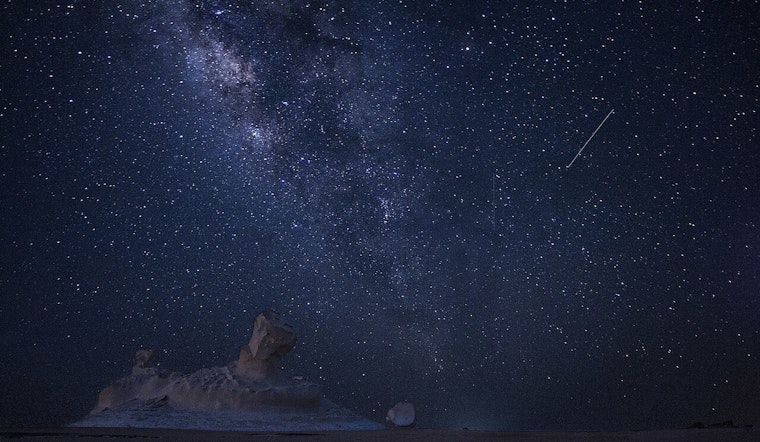
The desert sky above Las Vegas is set to come alive with celestial fireworks this week as the Perseid meteor shower reaches its peak tomorrow and on Wednesday, August 12-13. The annual cosmic spectacle promises to deliver the biggest meteor show of the year, though local stargazers will need to contend with both urban light pollution and an unusually bright moon.
According to 8 News Now, this year's display comes with significant viewing challenges. Live Science reports that "a waning gibbous moon will rise a couple of hours before midnight and be 84% lit, shining brightly all night."
Local Expert Weighs In on Viewing Prospects
College of Southern Nevada astrophysicist Dr. Andrew Kerr remains optimistic about viewing conditions despite the lunar interference. As detailed by 8 News Now, Kerr explained the Perseids in an online video and noted that "even with the full moon, he expects the viewing to be good." The expert suggests that "the best meteors will be noticeable with the additional light from the moon," as mentioned on 8 News Now.
Kerr recommends alternative timing for optimal viewing, suggesting stargazers might get better results "around midnight of Monday, Aug. 11, into the early morning hours of Aug. 12, and again around midnight on Aug. 13 and into the predawn hours," as per 8 News Now. According to American Meteor Society data, skywatchers might expect between 10 to 20 meteors per hour during the peak—a significant reduction from typical rates of 50-100 meteors per hour.
The Science Behind the Spectacular Show
The American Meteor Society explains that the Perseids are particles released from comet 109P/Swift-Tuttle during its numerous returns to the inner solar system. As reported by Space, "they will appear to emanate from a point of origin — known as a radiant — located near the star Eta Persei in the constellation Perseus, which climbs high in the summer sky in the hours leading up to dawn around this time of year."
The shower consists of small particles of ice and rocks from comets and asteroids that create bright, colorful lights when they slam into Earth's atmosphere and burn up. The American Meteor Society notes that the shower's parent object, comet 109P/Swift-Tuttle, has a velocity of 37 miles per second, contributing to the meteors' swift appearance across the sky.
A Challenging Year for Meteor Enthusiasts
The 2025 Perseid show represents part of a particularly difficult year for meteor shower enthusiasts. The American Meteor Society warns that "in 2025, the waning gibbous moon will severely compromise this shower at the time of maximum activity. Such conditions will reduce activity by at least 75 percent as only the brighter meteors will be visible."
However, relief is coming later in the year. According to High Point Scientific, "this year's top three showers all occur later in the year, with the Geminids once again taking the top spot" in December, when viewing conditions will be more favorable with "a waning crescent Moon" and "a zenith hourly rate of over 100."
Viewing Tips for Las Vegas Area
For those determined to catch the peak activity, the American Meteor Society confirms that "all these showers are best seen after midnight." Las Vegas viewers should head to the darkest available locations away from city lights, particularly in the surrounding desert areas that offer clearer skies and reduced light pollution.
Space reports that "despite the moonlight, the Perseids could still put on a nice show" for dedicated observers. The key is patience and proper preparation: allow 20-30 minutes for eyes to adjust to darkness, bring comfortable seating, and avoid looking at phones or other bright light sources during viewing.
Some astronomers are suggesting an alternative approach entirely, recommending waiting a week or so to glimpse shooting stars against a darker sky when the moon will not be as bright. The Perseid viewing season extends through August 23, providing multiple opportunities for Las Vegas stargazers to catch this annual celestial spectacle.





