

























































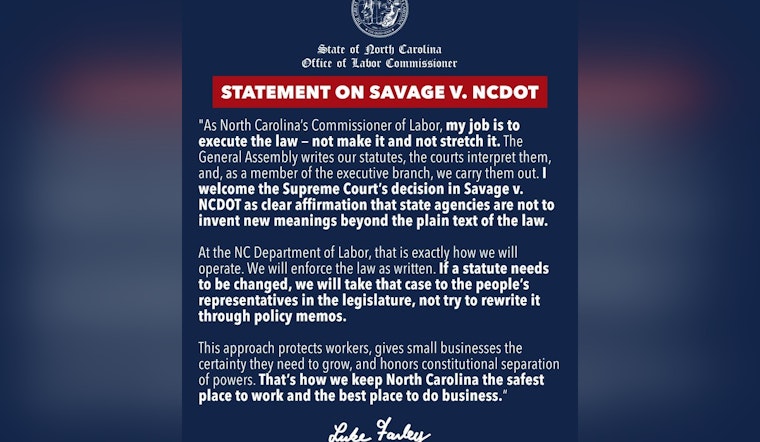
Following the recent Supreme Court verdict in Savage v. NCDOT, North Carolina’s Labor Commissioner Luke Farley issued a statement underscoring the department's adherence to legal interpretation and execution. He emphasized that his role, along with the state agency he leads, is to enforce the law, not to redefine it outside of its intended scope. "As North Carolina’s Commissioner of Labor, my job is to execute the law — not make it and not stretch it," said Farley, according to an announcement on the North Carolina Department of Labor's website.
The Supreme Court's decision has underscored a clear framework within which state departments are to function. According to the North Carolina Department of Labor's website, Commissioner Farley’s comments reflect an intent to operate within these strictures: "We will enforce the law as written. If a statute needs to be changed, we will take that case to the people’s representatives in the legislature, not try to rewrite it through policy memos."
In the broader context of state governance, the stance taken by the North Carolina Department of Labor signals a move towards more literal interpretations of statutes. Commissioner Farley’s comments align with a philosophy that could influence how businesses and workers navigate state regulations. "This approach protects workers, gives small businesses the certainty they need to grow, and honors constitutional separation of powers," Farley elaborated.
Following the Supreme Court’s decision in Savage v. NCDOT, North Carolina Labor Commissioner Luke Farley emphasized the state’s commitment to enforcing laws as written. In a statement of the North Carolina Department of Labor, Farley said the goal is to make North Carolina “the safest place to work and the best place to do business.” The ruling is expected to provide clarity and predictability for businesses and state agencies regarding the enforcement of labor and employment regulations.





