

























































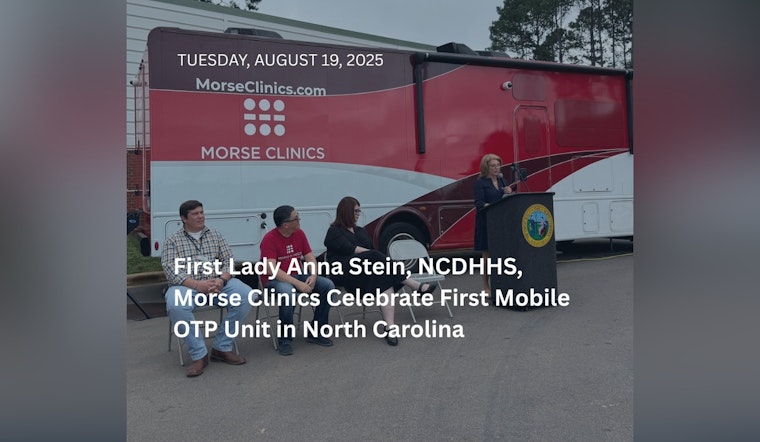
In a move to combat the opioid crisis, North Carolina unveiled its first Mobile Opioid Treatment Program (OTP) earlier this week, with First Lady Anna Stein leading the celebrations. The program comes as a novel approach to make treatment for opioid use disorder more accessible to those in need. According to NCDHHS, this initiative is expected to facilitate the delivery of Medications for Opioid Use Disorder (MOUD), an established standard of care, coupled with counseling, case management, and peer support services.
The ceremony, which took place on Tuesday, included notables such as Kelly Crosbie, who directs the NC Department of Health and Human Services Division of Mental Health, Developmental Disabilities and Substance Use Services, and Dr. Eric Morse, the founder and president of Morse Clinics. "People who struggle with substance use face many barriers on their road to recovery," First Lady Stein told NCDHHS. "Mobile OTPs will make it easier for people to begin the journey in their communities and stay on the path so they can live their best and most impactful lives."
The significance of OTPs has been underscored by recent increases in enrolment, with a 25% rise since 2019, and a record 31,641 individuals served in 2024. The mobile units are in fact extensions of existing brick-and-mortar facilities and are instrumental in reaching out to patients who are unable to access fixed sites due to various barriers such as transportation. The first of such units is being sponsored by Morse Clinics, currently providing services across an extensive range of counties in North Carolina.
Expanding on the importance of the initiative, NC Health and Human Services Secretary Dev Sangvai said, "We are committed to helping people who struggle with substance use obtain the appropriate services and supports they need to live a life in recovery." Additionally, up to six more mobile OTPs may be deployed by the year’s end, thanks to Hurricane Helene relief funds. These units will aim to service various rural communities, improving access to crucial MOUD treatments for those living in these areas. Currently, there are 96 OTPs with physical locations in 55 counties, but patients from all 100 counties need services, a need mobile units are set to address, as per NCDHHS.
With an increased focus on extending care to rural areas, the potential impact of mobile OTPs is significant. Kelly Crosbie emphasized this saying, "Mobile units will expand access to treatment to rural areas where it can be hard for people to find transportation to get life-saving medications." For more information on OTP providers, interested parties can refer to the online map detailing locations and schedules of both stationary and mobile units, according to NCDHHS.





