

























































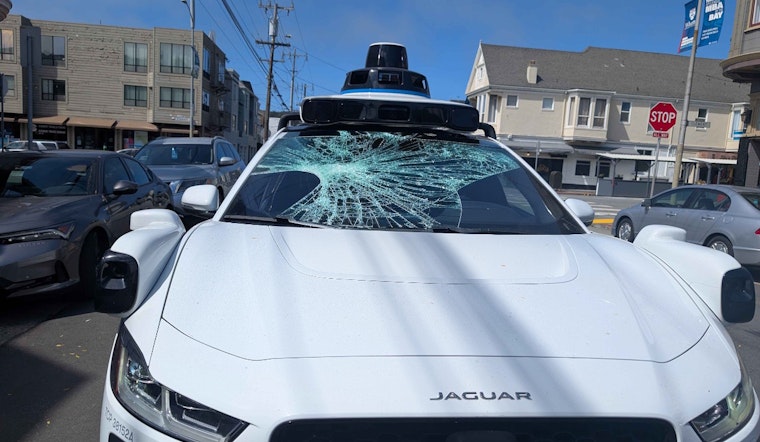
A 45-year-old man with an extensive criminal history has been charged with systematically targeting Waymo autonomous vehicles across San Francisco's South of Market neighborhood in what prosecutors describe as an escalating pattern of destructive behavior that culminated in a dramatic windshield-stomping incident caught on surveillance video.
A Six-Week Spree
Walker Reed Quinn's alleged war against robotaxis began quietly on July 4, when prosecutors say he dove onto the hood of a Waymo vehicle on the 1200 block of Howard Street and strategically placed a traffic cone over the car's LiDAR sensors. But the incidents grew progressively more brazen, reaching a crescendo on August 11 when Quinn allegedly attacked a Waymo carrying a passenger at Fifth and Harrison streets, as per the San Francisco District Attorney's Office.
Surveillance footage from that final incident, which was shared with local television news, shows Quinn climbing onto the vehicle's hood, yelling incoherently, and repeatedly stomping on the windshield with both feet until it caves in. The passenger eventually exited the vehicle and walked away as Quinn continued his destructive tantrum, at one point beating the car with his belt. According to SFist, Quinn appeared to treat the autonomous vehicle as if "it had wronged him."
A Familiar Face to SFPD
Quinn is far from a first-time offender. Arrest records reveal a "ton of previous vandalism arrests" dating back to 2015, including charges for battery, malicious mischief to vehicles, possession of drug paraphernalia, and assault with a deadly weapon. Most recently, he was arrested for vandalism exceeding $5,000 in both February and June 2025, and for assault with a deadly weapon and carrying a concealed dagger in March 2024, as per SFist.
The defendant has become a neighborhood fixture, well-known to San Francisco police and the local social media account @friscolive415, which documents street-level incidents throughout the city. One March incident documented by that account showed Quinn being handcuffed while screaming obscenities at an officer after allegedly throwing chairs at UN Plaza. "Honestly the first thing I thought was 'Is it Walker?'" the account owner said, as cited by SFist. "And, it was."
Part of a Broader Pattern
Quinn's alleged anti-Waymo crusade represents just the latest chapter in San Francisco's complicated relationship with autonomous vehicles. The city has witnessed a string of high-profile incidents targeting the robotic cars, from a Waymo being set on fire in Chinatown during February 2024 Lunar New Year celebrations to three vehicles being vandalized by a gang filming themselves in the Mission District in September 2024, according to The SF Standard.
More recently, at least five Waymo vehicles were spraypainted and set on fire during June immigration raid protests in Los Angeles, while an unknown number were similarly vandalized in San Francisco the same weekend. The incidents forced Waymo to suspend service in parts of both cities temporarily.
Each incident raises questions about public acceptance of autonomous technology and the unique vulnerabilities these expensive vehicles face on city streets. Waymo vehicles, valued between $150,000 and $200,000 each, have become what some see as symbols of tech industry displacement in a city grappling with affordability and inequality, per SFist.
Legal Implications
Quinn faces serious legal consequences under California's vandalism statutes. He's been charged with three counts of felony vandalism exceeding $400 in damages and one count of misdemeanor vandalism under $400 with prior convictions. Critically, prosecutors allege these crimes were committed while Quinn was released on his recognizance or on bail in other pending felony cases, including one that also involved damaging a Waymo vehicle, according to the San Francisco District Attorney's Office.
The enhancement for committing crimes while on bail could significantly increase Quinn's potential sentence. Under California Penal Code 594, felony vandalism can result in up to one year in county jail and fines up to $10,000, while the bail enhancement carries additional penalties designed to deter repeat offenses.
District Attorney Brooke Jenkins' office has moved to have Quinn detained pending trial, citing the public safety risk he poses. This case fits into a broader pattern of San Francisco grappling with repeat offenders who cycle through the criminal justice system. Recent reporting has highlighted the challenges facing the city's "missing middle" of mentally ill, nonviolent offenders who resist treatment programs yet don't meet the threshold for conservatorship, as per The SF Standard.
The Tech Tension
The case also underscores the friction between San Francisco's tech-forward image and street-level realities. While Waymo touts its safety statistics and expansion plans, incidents like Quinn's alleged spree highlight the human element that automation cannot predict or control. The company's vehicles have been cited 589 times by San Francisco in 2024 for various traffic violations, generating $65,065 in penalties, according to Gizmodo.
As autonomous vehicles become more prevalent on city streets, the Quinn case reminds us that technological solutions must navigate complex urban environments where human unpredictability remains a constant challenge. For now, Quinn remains in custody awaiting trial, while Waymo continues operating its fleet throughout the city, their sensors and cameras ever-watchful for the next potential threat.





