

























































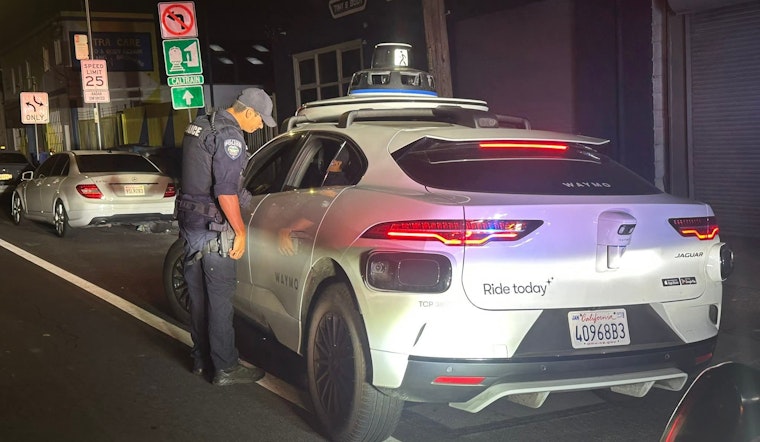
Friday night's DUI enforcement operation in San Bruno took an unexpected turn when officers watched a Waymo autonomous vehicle perform an illegal U-turn right in front of their checkpoint—leaving police scratching their heads and facing an empty driver's seat when they pulled it over.
The incident occurred during a grant-funded DUI operation when the self-driving Jaguar I-Pace made the illegal maneuver at a traffic light, according to KTVU. San Bruno Police Department's social media post about the stop—complete with Rihanna's "Shut Up and Drive" as background audio—captured the surreal moment of an officer peering into an empty vehicle.
"No driver, no hands, no clue," police wrote in their characteristically witty Facebook post. But here's the kicker: they couldn't actually issue a citation because "our citation books don't have a box for 'robot.'"
When Silicon Valley Meets Small-Town Policing
The San Bruno incident highlights California's ongoing legal limbo around autonomous vehicles and traffic enforcement. Current state law requires moving violations to be issued to human drivers, leaving police powerless to cite robotaxis for traffic infractions, as reported by The San Francisco Chronicle. Officers contacted Waymo representatives to report the "glitch," but the vehicle effectively drove away scot-free.
This legal gray area won't last forever. Starting July 1, 2026, Assembly Bill 1777 will allow police to issue "notices of autonomous vehicle noncompliance" to companies when their cars break traffic laws, according to NBC Bay Area. However, critics note the new law stops short of allowing actual citations with fines—creating what the Teamsters union calls "unequal enforcement" compared to human drivers.
Part of a Troubling Pattern
The San Bruno U-turn adds to a growing list of Waymo traffic violations across the Bay Area. In San Francisco alone, the company's fleet accumulated 589 parking tickets in 2024, totaling $65,065 in fines, as documented by Gizmodo. These violations ranged from blocking traffic to parking in prohibited zones while vehicles waited for passengers or between rides.
Meanwhile, federal regulators have launched investigations into reports of Waymo vehicles failing to obey traffic laws. The company's expansion into San Mateo County, including San Bruno, began in May 2024 for employees and opened to the public in August, according to San Mateo Daily Journal.
The Irony of DUI Enforcement
There's a certain dark humor in a robot car potentially avoiding a DUI checkpoint—especially when autonomous vehicles are often marketed as a solution to drunk driving. Waymo's own policies prohibit passengers from drinking alcohol while in their vehicles, though the policy doesn't address already-intoxicated passengers.
The legal questions around autonomous vehicles and alcohol remain complex. While fully autonomous vehicles like Waymo operate without human drivers, passengers could theoretically face DUI charges if deemed "in control" of the vehicle in certain circumstances.
What Happens Next
Waymo issued a standard response to the incident, stating that their autonomous driving system "is designed to respect the rules of the road" and that they're "looking into this situation," as reported by KTVU. The company typically investigates such incidents and issues software updates across their entire fleet when problems are identified.
For San Bruno Police, the incident serves as a preview of law enforcement's future. As the department noted in their social media post, they're committed to keeping streets safe "whether it's drivers, passengers, or even driverless cars." They also reminded residents that legislation is in the works to give police more authority over autonomous vehicles.
Until then, San Bruno officers will continue their DUI enforcement operations with the understanding that some traffic violators might not have pulses—just processors.





