

























































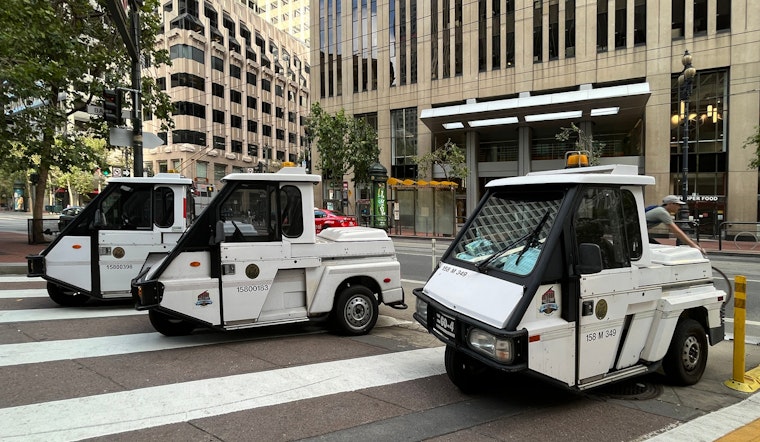
For exactly four hours on Tuesday morning, San Francisco drivers had their very own parking enforcement radar—a sleek website called "Find My Parking Cops" that tracked the city's ticket-writing officers in real time like dots on a map. Then the city pulled the plug.
Riley Walz, the 22-year-old North Beach resident behind the viral creation, watched his brainchild go from zero to over a million views before crashing back to earth faster than a street-cleaning ticket on Tuesday morning. The reason? The SF Standard reports that San Francisco Municipal Transportation Agency changed their data portal within hours, cutting off the public information Walz had been scraping to power his ingenious tracking system.
"In rare lightning speed, the SF government changed their site within hours of this site going live," read the message that replaced Walz's map by Tuesday afternoon. "I can't get data from it anymore."
The Accidental Data Detective
The whole thing started when Walz's roommate got slapped with a parking ticket and left it lying around their apartment. Most people would grumble and pay up, but Walz is the kind of guy who installs mystery phones on Mission District poles to capture the neighborhood's musical vibe through Shazam. So naturally, he got curious about that nine-digit citation number.
What he discovered was beautifully absurd: San Francisco's parking tickets follow a predictable pattern—add 11 to get the next number, except add 4 if the last digit is 6, according to Wired. This meant no ticket could end in 7, 8, or 9, and Walz could essentially predict future ticket numbers and scrape them from the city's payment portal as they were issued.
The result was "Find My Parking Cops," a website that borrowed Apple's "Find My Friends" interface to show where parking officers were prowling the city. Users could watch one officer zip through a street-cleaning zone in Diamond Heights, handing out nine tickets in about 20 minutes, or observe another camped outside the Hyatt Regency on Drumm Street, systematically ticketing cars in the bus zone.
The Leaderboard Nobody Asked For
Perhaps the most entertaining feature was Walz's officer leaderboard, which ranked parking enforcers by the dollar value of tickets they'd issued each week. By Tuesday afternoon, at least three officers had racked up over $15,000 worth of tickets in just over a day, according to Mission Local. Officer 0336 was apparently having quite the productive week before the whole operation went dark.
The app revealed fascinating patterns in San Francisco's parking enforcement machine. Some officers work in pairs tackling street cleaning areas, while others stake out specific locations, as reported by The Chronicle. One particularly dedicated enforcer spent an entire day writing tickets to buses at the same address outside a downtown hotel—a bureaucratic Groundhog Day that Walz found oddly mesmerizing.
Swift City Response
The speed with which SFMTA killed the data feed was almost as impressive as Walz's original hack. "Ahhhhhh … the MTA just changed their site so I am no longer getting data!" Walz texted the SF Standard at 2:34 p.m.—roughly four hours after his morning tweet had gone viral.
SFMTA spokesperson Erica Kato defended the move, stating that "we also want to make sure that our employees are able to do their jobs safely, and without disruption." The concern isn't entirely abstract—parking control officers face daily threats and hostile situations while doing their jobs, according to the SF Standard, with union representatives noting that officers are essentially "armed" only with badges and ticket-writing computers.
Legal and Safety Implications
The incident raises questions about the balance between government transparency and employee safety. While Walz was using publicly available data, the real-time tracking capability could theoretically enable harassment or confrontation with parking officers. Trevor Adams, president of the parking control officers' union, has previously noted that officers "experience it on a daily basis" when it comes to threats and compromising situations.
However, privacy advocates might argue that tracking public employees performing public duties on public streets falls within acceptable bounds of civic oversight—especially when the underlying data is already publicly accessible through official channels.
The Broader Context
Walz launched his parking cop tracker at a particularly sensitive moment for San Francisco's enforcement apparatus. Earlier this year, Mayor London Breed and SFMTA announced increased parking enforcement throughout the city, with citations up 6% from May through July compared to the same period last year, as reported by The Chronicle. The agency has been conducting intensive neighborhood sweeps, rotating through all 11 supervisorial districts every three months.
The crackdown has yielded results: citations for blocking sidewalks increased by 62% during the first three months of intensive enforcement. With over a million parking tickets issued annually and fines that can reach $107 for an expired meter, parking enforcement represents a significant revenue stream for the cash-strapped city.
The Artist Behind the App
For Walz, "Find My Parking Cops" was just the latest in a series of playful data projects that reveal hidden patterns in urban life. His "Bop Spotter" installation uses a solar-powered phone mounted on a Mission District pole to continuously Shazam whatever music drifts by, creating an accidental soundtrack of neighborhood life, as covered by NPR. He's also created projects like IMG_0001, which surfaces old YouTube clips uploaded by everyday people in the platform's early days.
"I'm not 'pro' parking cop. I'm not 'anti' parking cop," Walz told Wired. "It's just data I was able to unearth, and I thought it would be cool to visualize it."
Resurrection and Cat-and-Mouse Game
The story didn't end with SFMTA's data blackout. By 10 p.m. Tuesday night, Walz had found a workaround and restored the site's functionality, prompting him to tweet triumphantly: "CORRECTION: THE SITE'S BACK UP! GUESS WHO'S BACK, BACK AGAIN" according to Dexerto. How long this digital cat-and-mouse game will continue remains anyone's guess.
The episode highlights the ongoing tension between civic transparency and institutional control in the digital age. While Walz's creation may have been short-lived, it offered San Francisco drivers a brief glimpse behind the curtain of one of the city's most ubiquitous—and profitable—public services. In a city where parking fines fund everything from Muni operations to street maintenance, "Find My Parking Cops" revealed just how systematic—and lucrative—the whole enterprise really is.




