

























































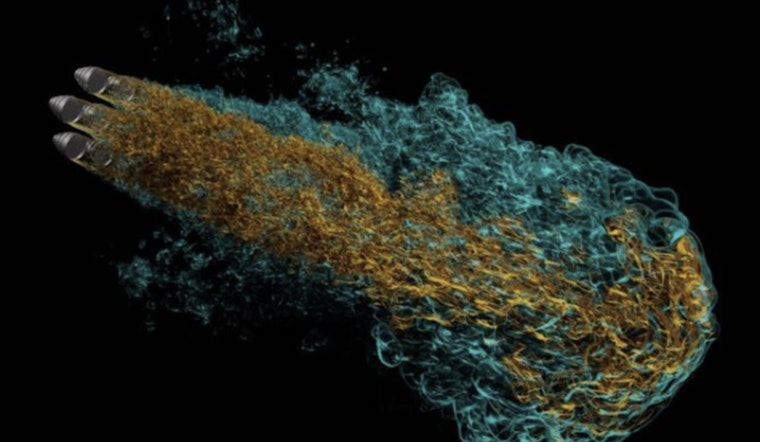
Researchers from Georgia Institute of Technology and New York University's Courant Institute of Mathematical Sciences recently embarked on a groundbreaking journey in the realm of computational fluid dynamics (CFD) using the formidable power of the Frontier supercomputer at the Department of Energy's Oak Ridge National Laboratory. Their work has catapulted the team into the spotlight as finalists for 2025's prestigious Gordon Bell Prize, administered by the Association for Computing Machinery, for outstanding achievements in high-performance computing (HPC). The study’s leaders, Spencer Bryngelson of Georgia Tech and Florian Schäfer of the Courant Institute, leveraged a novel technique known as information geometric regularization (IGR) to push the boundaries of CFD—the first of its kind on such a scale—from prediction models in aircraft designs to detailed simulations of rocket engine clusters.
At the core of their research, the team focused on a 33-engine configuration resembling that used by the SpaceX Starship Super Heavy Booster, revealing that the modern aerospace sector is moving towards multi-engine first stages in their rocket designs. Seeking to prevent potential launch mishaps, the scientists probed the intricate interactions of exhaust plumes using their open-source Multicomponent Flow Code, as per information shared by the Oak Ridge National Laboratory. This code enabled a simulation with more than 200 trillion grid points at velocities 10 times the speed of sound where gases behave in highly unpredictable ways.
Compared to conventional numerical methods, this cutting-edge research, which optimized the use of unified CPU-GPU memory on Frontier, achieved a fourfold faster time to solution and ramped up energy efficiency by 5.7 times. As "exciting" as the scientific challenge was, bringing an "interesting new method" to the table tailored for the latest supercomputers was equally thrilling for Bryngelson, as he told the Oak Ridge National Laboratory. The Georgia Tech professor's remark underscores the project's dual pursuit of advanced computational methods and confronting grand scientific questions.
The heart of the project, IGR, tackles the complex issue of representing shock dynamics, which are common in high-speed fluid flows and manifest as dramatic shifts in fluid properties that can derail simulations. Schäfer and his former student Ruijia Cao originally developed IGR as a blend of optimization and statistics concepts, which found an "unusual application" in fluid dynamics. By redefining the representation of shocks, IGR manages to maintain the crucial post-shock behavior without introducing numerical instabilities. Schäfer's reflection on the method’s implementation at this extraordinary scale offered a sense of gratification, especially given the rarity of mathematical concepts finding use in real-world HPC applications, as he expressed to the Oak Ridge National Laboratory.
As the computing community turns its attention to the International Conference for High Performance Computing, Networking, Storage, and Analysis (SC25) in St. Louis, from Nov. 16 to 21, anticipation builds for the announcement of this year's Gordon Bell Prize winners. Frontier continues to set the bar as the world's most powerful supercomputer for open science, facilitated by the Oak Ridge Leadership Computing Facility and managed by UT-Battelle for the DOE Office of Science. This prestigious recognition of Bryngelson, Schäfer, and their team not only honors their specific achievements in CFD simulation but also underscores the persistent innovation within the domain of high-performance computing.



