

























































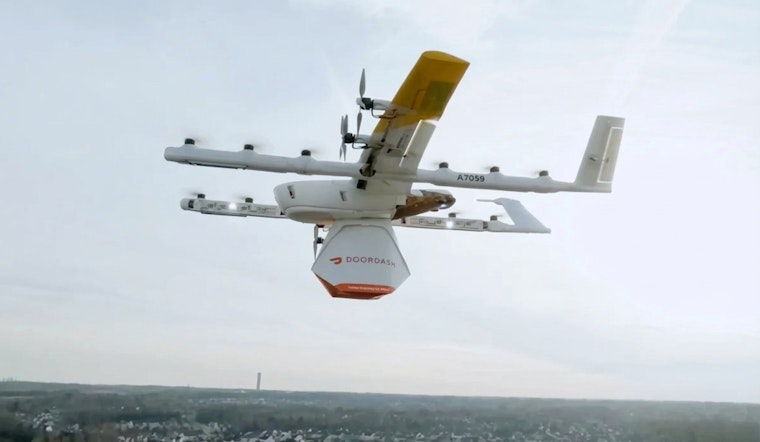
DoorDash cleared a major hurdle Wednesday evening when San Francisco's Board of Appeals upheld a zoning administrator's decision that allows the food delivery giant to test drone delivery systems at its Mission District warehouse—despite fierce opposition from the Teamsters union.
The 34,000-square-foot facility at 1960 Folsom Street, which DoorDash leased in August, can now move forward as a research and development hub for aerial delivery technology. The drones would fly up to 150 feet above ground, with no more than two operating simultaneously for up to 30-minute flights in a gated outdoor parking area.
"The question is, 'Can we do this here?' not, 'Can we have your permission right now to go out and build this lab right now?'" Commissioner Rick Swig said during the hearing, emphasizing the narrow scope of the board's review.
Labor Versus Tech Innovation
Teamsters Local 665, which represents over 70,000 Bay Area workers, had argued that outdoor drone testing doesn't qualify as "laboratory use" under city zoning rules for the site's Production, Distribution and Repair (PDR) district. According to Mission Local, Principal Officer Tony Delorio put it bluntly: "This PDR property is meant for blue-collar jobs, but DoorDash is using it to develop technology designed to destroy jobs."
The union drew parallels to San Francisco's contentious experience with autonomous vehicles, with a Teamsters representative warning: "San Franciscans saw what happened when their streets were turned into a laboratory with autonomous vehicles. Now, apparently as well, our skies will too."
But DoorDash, which employs 1,600 people citywide and anticipates 200 workers at the new site, pushed back against these claims. Jim O'Sullivan, the company's Head of Drone Strategy who joined DoorDash in January after leading regulatory efforts at drone company Matternet, assured the board that any future flights would comply with Federal Aviation Administration and state privacy regulations.
District Supervisor Takes Action
The controversy has already spurred legislative action. District 9 Supervisor Jackie Fielder, who represents the Mission, has introduced legislation alongside District 10 Supervisor Shamann Walton that would require companies to obtain conditional use authorization from the Planning Commission before converting properties to "laboratory use" for 18 months.
According to Mission Local, Fielder said the DoorDash case exemplifies "an increasing number of applications to convert space in the Mission to laboratory use," raising concerns about preserving the district's industrial character and blue-collar employment.
Business Groups Back DoorDash
The project has garnered support from major business organizations, including the Bay Area Council, San Francisco Chamber of Commerce, and Mission Merchant's Association. DoorDash framed the initiative as part of San Francisco's economic recovery, with a spokesperson stating the company is "deeply invested in the city's comeback and eager to continue our testing of autonomous technologies more broadly."
The facility represents a significant expansion of DoorDash's autonomous delivery ambitions. The company has been testing drone delivery in partnership with Wing (Google's parent company Alphabet's drone subsidiary) and Israeli company Flytrex in markets including Dallas-Fort Worth, Charlotte, and Christiansburg, Virginia. According to Fox Business, their Texas operations can deliver up to 6.6 pounds of food at speeds of 32 mph.
Technical Challenges in Urban Environments
Werner von Stein, founder of SF Drone School on Treasure Island, highlighted the unique challenges facing drone delivery in San Francisco. "When you deliver items with a drone, there's weight involved, and then you have wind and other interference in the environment that reduces flight time," he told the San Francisco Chronicle. "In San Francisco, we have larger skyscrapers and buildings, and pretty small areas where you could land drones safely."
Despite these challenges, DoorDash is betting on automation as the future of last-mile delivery. The company recently unveiled "Dot," an autonomous ground-based delivery robot, and launched its Autonomous Delivery Platform, which according to the company, serves as an AI dispatcher matching orders with optimal delivery methods—whether human Dashers, ground robots, or aerial drones.
What Happens Next
While Wednesday's Board of Appeals decision clears a zoning hurdle, DoorDash still faces a complex regulatory landscape. The Federal Aviation Administration's proposed new rules, announced in August, would make it easier for companies to fly drones beyond visual line of sight—a crucial step for scaling commercial drone delivery. However, San Francisco's stringent local drone regulations, including prohibitions on flying in city parks without permits, add layers of complexity.
Community reaction remains mixed. Comments on Mission Local's coverage ranged from residents expressing concern about noise and surveillance ("I don't want to be a guinea pig for unnecessary drones that would be the next front in corporate surveillance alongside Waymos' cameras") to others welcoming the development ("I live a block away and I would MUCH rather have something occupy that space than have it stay forever empty").
The PDR districts where the facility is located were originally designed to preserve manufacturing jobs and housing for low and middle-income residents. According to Mission Local, 23 percent of Mission District employees work in PDR businesses. The tension between preserving these traditional industrial jobs and embracing new technology sectors continues to define San Francisco's economic evolution.
As Zoning Administrator Corey Teague repeatedly emphasized during the hearing, the board's decision only addresses whether drone testing qualifies as laboratory use under current zoning—not whether it's appropriate for the neighborhood. Those broader questions will likely continue as DoorDash moves forward with its testing plans, adding San Francisco to the growing list of cities grappling with the promise and perils of automated delivery.



