

























































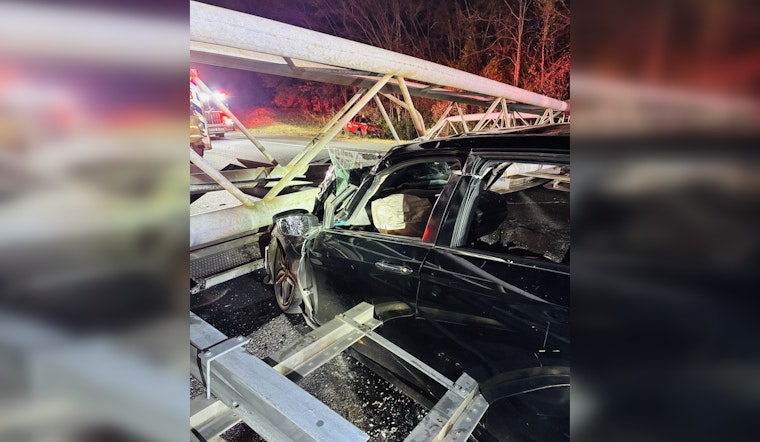
A routine Friday night on Interstate 77 turned into a seven-hour emergency operation when an overhead freeway sign collapsed onto a vehicle, trapping the driver beneath twisted steel and sparking questions about infrastructure safety on one of Charlotte's busiest corridors.
Charlotte Fire crews arrived at the southbound lanes near Exit 5 at Tyvola Road just before 11 p.m. Friday to find a driver pinned inside a crushed vehicle beneath a massive interstate sign structure. Engine 12 reached the scene within minutes, according to Charlotte Fire Department, immediately confirming entrapment and beginning patient care while additional units mobilized.
Late last night Charlotte Fire crews responded to a crash on I77 South where an overhead interstate sign collapsed onto a car, trapping the driver beneath the wreckage.
— Charlotte Fire Dept. (@charlottefire) November 29, 2025
Engine 12 arrived within minutes, confirmed entrapment and began patient care. Ladder 20, which went into… pic.twitter.com/FVAzXvn8SO
Complex Rescue in Cold Conditions
Ladder 20—which only entered service earlier this month as part of the department's expansion to 20 aerial devices—worked alongside Rescue 10 to free the trapped driver. Despite freezing temperatures and the challenging scene, crews completed the complex extrication in under 30 minutes, as reported by WSOC TV.
Two patients were transported to Atrium Health Carolinas Medical Center with serious injuries. The North Carolina Department of Transportation stated that an alleged drunk driver struck the sign structure prior to the collapse, according to QC News. The incident occurred near Arrowood Road, with all southbound lanes closed until approximately 5:45 a.m. Saturday—a seven-hour shutdown that forced thousands of commuters onto alternate routes.
I-77's Troubling Safety Record
The southbound stretch of I-77 between Tyvola Road and Arrowood Road has become a recurring scene of serious crashes. This single corridor has witnessed multiple fatal and serious-injury incidents throughout 2024, WCNC has documented, including a deadly helicopter crash in November 2022 that closed the interstate for nearly 24 hours.
Charlotte reports more than 80 vehicle accidents daily on average, with I-77 consistently appearing in annual accident reports as one of the most dangerous roads in the region, according to statistics compiled by traffic safety researchers. Drunk driving remains a persistent factor: approximately one-third of all traffic fatalities involve impaired drivers, with alcohol-related crashes causing serious injuries on major highways like I-77 every day.
Infrastructure Inspection Questions
NCDOT maintains that overhead sign structures are inspected every other year across the state, similar to bridges and culverts. "Immediate action would be taken if a safety issue were to be discovered during a routine inspection," an NCDOT spokesperson told QC News, adding that there are no ongoing safety issues for the traveling public following removal of the damaged section.
The state follows Federal Highway Administration mandates requiring structures to be inspected once every 24 months, with North Carolina using both state and contract inspectors to complete each cycle. However, Friday's collapse—caused by a vehicle impact rather than structural failure—highlights vulnerabilities even well-maintained infrastructure faces from driver behavior.
The Impaired Driving Crisis
Nationally, drunk driving killed more than 13,000 people for the second consecutive year in 2022, according to Mothers Against Drunk Driving. In North Carolina, impaired driving contributes to roughly 40% of fatal accidents, with Charlotte accounting for over 25,000 traffic crashes annually—more than Raleigh, Durham, and Greensboro combined.
An individual will drive drunk an average of 80 times before their first arrest for driving under the influence, studies show. This incident marks yet another case where suspected impairment not only endangered the impaired driver but created cascading consequences—collapsing infrastructure onto an innocent motorist and shutting down a major interstate artery for hours.
Charlotte Fire's Expanding Capabilities
The successful rescue showcased Charlotte Fire Department's recent fleet expansions. Ladder 20, stationed at Fire Station 20 on Nations Ford Road, represents one of three new ladder trucks placed in service in 2024 alongside Tower 17. The department now operates 20 aerial devices across the city—a milestone that enhances response capabilities for complex emergencies like Friday's entrapment.
Charlotte Fire also deployed its Urban Search and Rescue team and additional companies to support operations and stabilize the scene. "Despite the cold conditions and the challenging scene, Charlotte Fire crews worked with precision and teamwork to manage the incident safely and protect everyone on scene," the department stated in its social media post.
Legal and Safety Implications
When a driver causes an accident due to intoxication, they face both criminal prosecution and civil liability for damages caused. North Carolina's contributory negligence standard means even partial fault can eliminate a victim's ability to seek compensation from other parties—though victims of impaired drivers typically have clear pathways to recovery given the illegal nature of drunk driving.
The State Highway Patrol has not released details about charges or the identity of the suspected impaired driver. Charlotte-Mecklenburg Police and NCDOT's Interstate Maintenance Unit assisted with the investigation and scene clearance, though Charlotte Fire noted they are not the lead agency for that portion of the investigation.
For motorists who regularly travel this stretch of I-77, the incident serves as a stark reminder of the risks present on high-speed corridors—even from sources as unexpected as collapsing infrastructure. NCDOT urges drivers to report any safety concerns immediately, and Charlotte Fire remains committed to serving the community "in the most unpredictable moments."



