

























































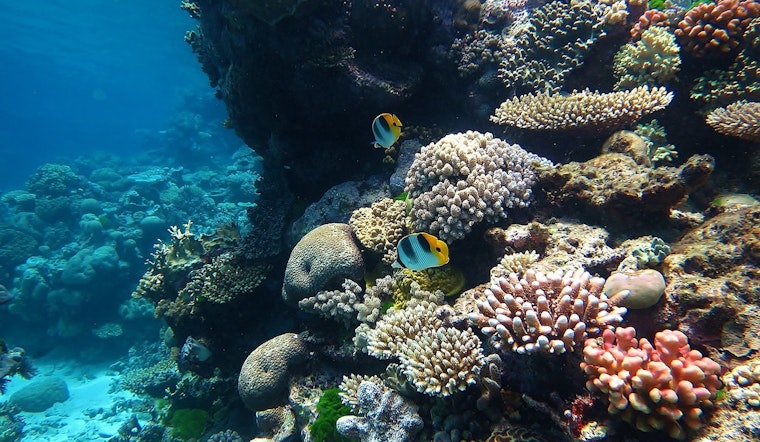
In the waters off Maui this summer, scientists from the Woods Hole Oceanographic Institution have been testing whether "reef music," recordings of healthy reef soundscapes played through underwater speakers, can coax coral larvae back onto dying reefs. Their early in-water trials combine settlement tiles, solar-powered buoys and silent control setups to see whether those underwater playlists nudge baby corals to choose better places to settle.
According to CNN, WHOI scientist Aran Mooney and his Reef Soundscapes team used a Reef Acoustic Playback System, or RAPS, to broadcast recordings of busy, healthy reefs at one site while leaving an identical rig silent at another. Divers then laid out terracotta tiles one meter and 10 meters from each speaker so they could later compare how many larvae settled near the active units versus the silent stand-ins.
That Maui campaign builds on earlier field and lab experiments by WHOI researchers, who found that coral larvae were more likely to settle where recordings of healthy reefs were broadcast, with some trials reporting settlement rates several times higher near playback locations. WHOI describes acoustic enrichment as one potential tool to layer on top of habitat protection and nursery-based restoration work.
How reef music attracts coral larvae
Coral larvae rely on a mix of chemical, visual and acoustic cues when they choose where to settle, and healthy reefs tend to be much louder under water because of snapping shrimp, grazing fish and other constant activity. A peer-reviewed paper in JASA Express Letters found that replayed reef sounds increased settlement in both tanks and field experiments during a brief early window when larvae are particularly selective. JASA Express Letters and coverage in Phys.org report that responses vary by species and that the boost in settlement often fades after about 36 hours.
Maui field test setup
On Maui, the team ran their playback sessions in the late afternoon and overnight, the period when many coral larvae tend to settle, then recovered the tiles to tally settlement after exposure. The fieldwork used a solar-powered buoy to handle the recordings without needing a boat on site, and the crew compared tiles placed one and 10 meters from active speakers with matching tiles near silent controls. CNN documented the operation with interviews and deck footage of the deployments.
Limits and caution
Researchers are clear that drawing larvae to a site is only the first step. Acoustic playback does not guarantee that newly settled corals will survive heat stress, disease or poor water quality, and the early experiments involved relatively small sample sizes. Reports and follow-up analyses note that different coral species respond differently, and that acoustic enrichment has to be combined with strong local protections so the soundscapes do not lure larvae into ecological traps. Phys.org highlights those caveats and the call for careful, site-specific planning.
Funding and next steps
WHOI has received funding to test the method at a larger scale. The institution and its partners secured a $1.5 million grant in 2024 to refine the RAPS units and trial them in several different regions. WHOI says the next phase will involve working with regional managers and NGOs to test acoustic playback alongside coral nurseries and fishery reforms.
Why it matters
The work arrives in the middle of what scientists describe as an unprecedented global bleaching crisis. NOAA’s Coral Reef Watch reports that bleaching-level heat stress has affected roughly 80 to 84 percent of reef area since early 2023 and has been documented across more than 80 countries, which makes tools that might boost coral recruitment feel increasingly urgent. NOAA Coral Reef Watch emphasizes that restoration strategies such as acoustic enrichment must sit alongside emissions cuts and strong local management if corals are going to have a real shot at recovery.
What to watch next
Acoustic enrichment is not a magic fix, but the controlled tests off Maui and the broader lab-to-field experiments in the scientific literature suggest that sound could be a relatively low-cost addition to nurseries and protective measures that improve early recruitment. For the peer-reviewed details, see the JASA Express Letters paper.





