

























































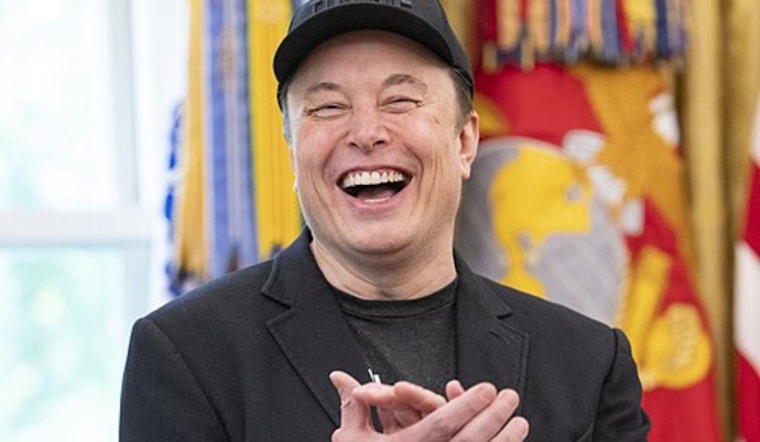
Elon Musk has told staff at xAI's San Francisco headquarters that the next two to three years will decide everything for his AI startup, calling it a stretch where if we survive, we win, according to people in the room. Inside the office, that message is setting the tone for a company-wide sprint to scale compute, lock in massive funding, and ship products fast enough to stay ahead of heavyweight rivals.
According to Business Insider, Musk used an all-hands meeting at xAI's San Francisco office last week to tell employees that simply surviving the next two to three years could be what puts xAI "on top." The outlet reports he walked through a plan that leans heavily on massive compute and a projected funding runway of roughly $20 billion to $30 billion a year, with the company eyeing an early-next-year launch for its Grok 5 model. Staffers described the gathering as "peppy," and leaders demoed updates to Grok Voice and AI agents during the session.
Colossus Buildout And The Compute Race
xAI's strategy hinges on blowing out its Colossus data clusters. The company doubled its GPU count to roughly 200,000 earlier this year and has publicly set a roadmap toward 1 million GPUs, making power and cooling just as critical as the chips themselves. Reporting on the Colossus project notes that the Memphis facility scaled quickly and needed substantial on-site battery and power work to keep racks running, a vivid reminder of how expensive and logistically messy the compute race has become. As reported by Yahoo Tech, those engineering and energy hurdles are central to Musk's argument that raw scale will determine who wins.
Space Data Centers And Optimus
The all-hands did not stick strictly to near-term goals. At points, Musk veered into his more sci-fi flavored ambitions, floating the idea of building data centers in space and suggesting Tesla's Optimus humanoid robots could eventually run off-world facilities linked to SpaceX missions. Business Insider also reports that Musk emphasized tight integration across his companies, such as Grok features already appearing in Tesla vehicles, as part of a broader play to speed up real-world deployment and data collection. Put together, it is a mix of short-term compute targets and a long-range industrial strategy that stretches far beyond a single AI model.
Experts Say AGI Timelines Are Still All Over The Map
Musk's suggestion that xAI could reach AGI within a few years is bold, and experts say the timeline is anything but settled. A synthesis of expert views points to a wide spread of plausible dates, heavily dependent on how AGI is defined and how fast compute and algorithms advance. As outlined by 80,000 Hours, some analysts now see significant odds of transformative AI within the next decade, while others argue that core challenges in reasoning and generalization remain unresolved. That split helps explain why Musk is framing the coming two to three years as existential for AI competitors, not just a period for ambitious but normal growth.
What to watch next: whether xAI can actually finance and feed Colossus at the advertised scale, whether Grok 5 lives up to its performance claims, and how Musk's cross-company strategy translates into paying customers or lasting data advantages. According to reporting by Dagens, xAI's automated response to a request for comment read simply "Legacy Media Lies," a detail that captured the company's combative posture toward outside scrutiny. For San Francisco, the all-hands is a reminder that a very high-stakes technology bet has a physical center in the city, not just in code but in warehouses, power lines, and delivery timelines.
For now, xAI's internal playbook reads as equal parts hardware rollout and product roadmap, and Musk has made it clear he views survival, not incremental gains, as the main metric. The next several months of Colossus buildout and Grok releases will show whether that gamble can actually be paid for in compute, cash, and real-world deployment.




