

























































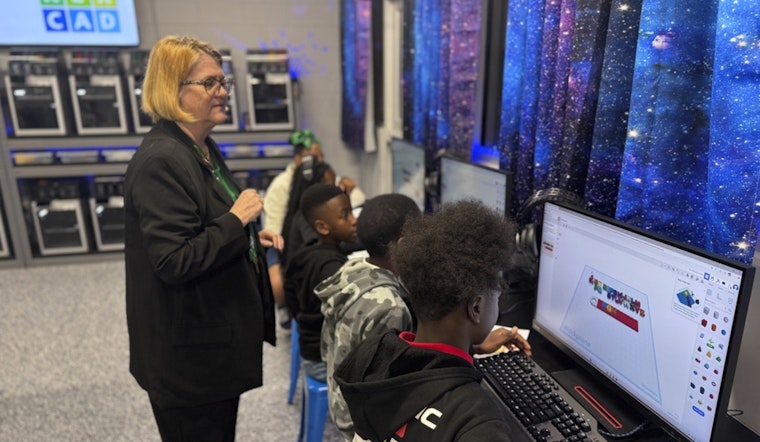
Fort Caroline Elementary School students stepped into a new dimension of learning with the opening of the district's 3D Printing Lab. The "STEM Forge," as it's been named, aims to transform young learners into future innovators by focusing on hands-on experiences with cutting-edge technology. This new educational resource, situated within the DCPS STEM Innovation Center at A. Philip Randolph Career Academies, was funded by both federal and local funds.
"You never know in life where you can find opportunity," Tayshawn Covington, a fifth-grade student, told Duval County Public Schools. Covington, alongside other fourth and fifth graders, had the chance to test the lab's capabilities, which include 16 new 3D printers and 20 computer workstations. The initiative, driven by the boost from federal funding through the Department of Defense Education Activity and contributions from local firms, seeks to kindle a passion for science, technology, engineering, and math (STEM) from an early age.
Dr. Yvonne Day, director of K-12 science, explained the significance of this technological inclusion. “Technology continues to grow and grow,” Dr. Day said in a statement obtained by the Duval County Public Schools. “So if we can help our students go from consumers of technology to innovators and creators by learning about this technology at such a young age, we can really prepare them for the future.” The lab anticipates extending its reach to additional grade levels in the near future, broadening the impact of this state-of-the-art educational tool.
Beyond the core academics of math and science, educators also envision the lab as a breeding ground for critical thinking and collaboration. Dr. Faith Roberts-Graham, principal of Fort Caroline Elementary, saw immediate engagement among students. “They are definitely taking ownership, talking with each other, and collaborating,” Dr. Roberts-Graham said in a statement obtained by the Duval County Public Schools. “It also sparks critical thinking that you sometimes don’t get in a traditional classroom setting.” The intention is to empower students not just with technological prowess, but with the mindset and skills to engineer solutions to real-world problems.
The response from students has been one of excitement and discovery. For example, Dayriel Ortiz, a fifth-grade student, articulated how the lab challenges his understanding of geometry and design. “You get to learn shapes and how they work together,” he explained, as per the Duval County Public Schools. “You have to use the computer to make 3D shapes and models.” This immersive educational experience is designed to leave a lasting impression on students, paving the way for the next generation of creators and solution-finders.




