

























































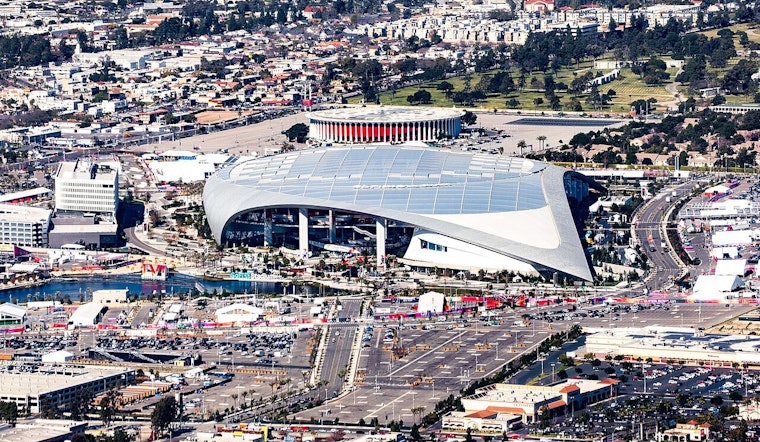
Inglewood is getting serious about moving crowds to SoFi Stadium and the surrounding entertainment district, even if it means forcing a few property sales along the way. The City Council voted this month to start eminent domain proceedings on eight properties tied to a revamped transit plan that leans on new mobility hubs instead of a pricey people mover. The centerpiece is a Market Street mobility hub, a compact transit center with bus bays, electric-vehicle charging, a large parking structure, and a pedestrian overcrossing to the Downtown Inglewood K Line station. City officials expect construction to start in 2026 and are targeting Phase 1 completion before the 2028 Summer Olympics, with a shift in priorities toward bus lanes, pedestrian upgrades, and storefront grants meant to keep Market Street active during construction.
At a recent council meeting, members authorized staff to acquire eight parcels along Florence Avenue and Market Street just south of the K Line's Downtown Inglewood Station. Those properties would be repurposed as a transit hub that bundles bus bays and EV charging with an adjacent parking structure, all linked to the Metro stop by a new pedestrian overcrossing. The vote also opened the procedural door for eminent domain filings if voluntary purchases fall through, according to the council action.
What Phase 1 Will Deliver
Phase 1 of the rephased Inglewood Transit Connector focuses on mobility hubs that group transit, parking, bike amenities, and pedestrian improvements at a handful of key locations, with Market Street identified as one of four hub sites. Planned features include storefront and public-realm upgrades such as new sidewalks, seating, landscapin,g and lighting, along with dedicated bus facilities and EV chargers. City materials say this incremental approach keeps the door open for a future people mover while giving residents and nearby businesses visible improvements sooner, as outlined on the Inglewood Transit Connector project website.
Transit Connections and Bus Lanes
The mobility hubs are designed to plug into two dedicated bus routes that would serve both event-day crowds and everyday riders. One route would connect to the C Line at Hawthorne/Lennox Station and the other to the K Line at Downtown Inglewood Station. Plans also call for dedicated bus lanes along parts of La Brea Avenue, Hawthorne Boulevard and Arbor Vitae Street, while other stretches would operate in mixed traffic to balance neighborhood access with game and concert surges. The combined lane and hub strategy is meant to better handle peak demand while improving downtown walkability, according to those route and lane plans.
Why The Plan Changed Course
The shift to mobility hubs comes after the elevated people-mover concept effectively collapsed in 2024 following a series of funding and political setbacks that made the original, higher-cost plan difficult to advance. That earlier proposal at one point secured roughly $1 billion in federal support but then ran into opposition from regional funders and some local stakeholders, pushing the city toward a lower-impact, lower-cost alternative. The new game plan is to deliver tangible traffic relief and streetscape upgrades before major 2028 events while keeping open the possibility of a higher-capacity system later. Details on the earlier project's funding and opposition were reported by the Los Angeles Times.
Legal Process and Neighborhood Impacts
Starting eminent domain proceedings triggers a formal acquisition process in which the city must follow specific legal steps, make purchase offers, provide relocation options in many cases and be ready for potential challenges from property owners. Project materials highlight a set of community commitments, including grants for facade and tenant improvements intended to help small businesses weather the construction period. Earlier drafts of the people-mover plan had warned that a larger build could have displaced dozens of businesses. City planners say public outreach and mitigation work will continue as design and acquisition efforts move ahead. See the project website and earlier reporting on displacement concerns by L.A. Focus.
Next steps for the program include detailed design and engineering, property negotiations and a series of community meetings scheduled through 2026 as Inglewood moves from planning into construction. City officials say the phased strategy is meant to limit disruption while delivering clearer transit and pedestrian improvements in downtown. How well they juggle construction logistics with the needs of local businesses will be the key test as the Market Street hub shifts from concept to concrete.





.jpg)